
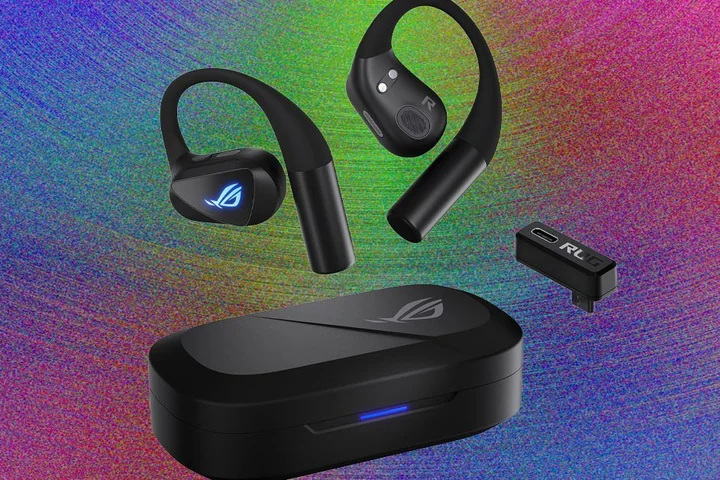
As someone who almost always uses their earbuds in transparency mode, I’ve recently been considering a pair of open wireless earbuds .
This quickly growing product category positions a tiny driver right outside the opening of your ear, letting your brain blend the world around you and your podcast, rather than a tiny chip handling it.
As a result, they’re great for hearing nearby traffic on a run, or catching up with your neighbor while walking the dog, all without stopping the music.
But I’m a gamer, damnit, so of course I need open gaming buds, which these are, as evidenced by the RGB lighting on the side.
They include a USB-C dongle that you can plug into a variety of devices, including PC, PS4 and PS5, Nintendo Switch, as well as iOS and Android phones and tablets, for a lower latency connection that’s particularly good for gaming.
While I like the fit, and they certainly sound great while gaming, I’m not as enthused by how they sound when I’m just playing some Steely Dan.
The same qualities that make these so awesome for gaming also hinder their performance while listening to anything else.
Wearing the Cetra Open Wireless is sort of like walking into a fancy store where there’s music playing: The sound just sort of pours in vaguely from all over, which feels really nice and comfortable, but it also feels a little soulless, without the musicality I’ve come to expect even from other gaming-first earbuds like the SteelSeries Arctis Nova Buds.
Even the Balatro soundtrack, which is objectively a jam, just didn’t feel quite as groovy as it normally does when I’m sneaking in a game on the bus.
Weirdly, I find they work better in noisy environments.
When the world around you is quiet, it becomes more apparent that there are just little speakers pointed at your earholes.
Wear them somewhere with a lot happening, like the grocery store, and it’s easier to ignore that they don’t have the fullest sound.
They didn’t work well on my bike at all, something I’ve heard is the case for most open wireless headphones, as the wind shear above around 10 MPH is much louder than the music.
Speaking of volume, I don’t normally push earbuds past around 40 percent on my Pixel 9 Pro , but I found myself keeping these turned much further down than most pairs.
There also felt like a bigger difference between ticks, so it really only feels like there are a couple of usable volume points between “almost muted” and “way too loud.” The volume that works well for the walk to the barcade down the street is far too loud to hear my favorite machine once I’m inside, and I find myself adjusting more frequently than I’d like for a pair of headphones that’s supposed to be an effortless mix.
At least they’re comfortable, with a soft silicone arm that wraps around the back of your ear and holds them mostly in place.
Because of the rounded arm, you can rotate them a fair bit around your ear, which is great for dialing in a good fit, but I find if I budge them by accident I have to refit them, otherwise they bounce against the outside of my ear.
Even after a few hours I don’t mind the weight, and they work just fine with sunglasses and hats.
They include a reflective neck strap that pops onto the arm end of each bud, but it isn’t particularly comfortable, and it’s stiff enough that those with larger necks will find it restrictive.
Once I have them in the right spot they feel secure, so I don’t feel the need to deploy the strap even when working in the yard.
Battery life hasn’t been an issue at all, with Asus quoting the headset at 16 hours, with 48 additional hours in the charging case, with no mic and all the extra features turned off.
I’m closer to 10 or 12 on a single charge with some calling mixed in, on a blend of USB-C and Bluetooth, and I haven’t felt like I need to do much besides occasionally keep the case topped off.
One nifty feature is that the dongle actually works via pass-through while inside the charging case, so if you only have a single USB-C port available, you can charge and play on the low-latency connection at the same time.
Instead of dedicated software, you control the headset through a web app while connected, which you have to do via USB-C the first time, and includes settings for a manual equalizer or presets, Phantom Bass, which you should always leave on in my opinion, and button functionality.
As I’ve been using these earbuds, I’ve been trying to figure out who exactly they’re for, and why you’d choose them over some of our other favorite open earbuds, especially given their relatively high price.
The real draw, I think, is the low-latency gaming connection, but if you aren’t planning on using that often, these probably aren’t all that appealing.
PC and console owners might turn their nose up at the idea of a “serious” mobile gamer, but between handheld consoles like the Steam Deck and the rise in popularity of more involved mobile games like Destiny: Rising, there’s a growing market of folks catching a ranked round on their bus ride to work.
Related Stories



Source: This article was originally published by Wired
Read Full Original Article →
Comments (0)
No comments yet. Be the first to comment!
Leave a Comment