
Nature volume 651 , pages 321–325 ( 2026 ) Cite this article
Type I superluminous supernovae (SLSNe-I) are at least an order of magnitude brighter than standard SNe, with the power source for their luminosity still unknown 1 , 2 , 3 .
The central engines of SLSNe-I are suggested to be magnetars 4 , 5 but most of the SLSNe-I light curves have several bumps that are unexplained by the standard magnetar model 6 , 7 , 8 .
Existing explanations for the bumps either modulate the engine luminosity or invoke interactions with circumstellar material (CSM).
Surveys of the limited sample of SLSN-I light curves find no compelling evidence favouring either scenario 7 , 9 , leaving both the nature of the light-curve fluctuations and the applicability of the magnetar model unresolved.
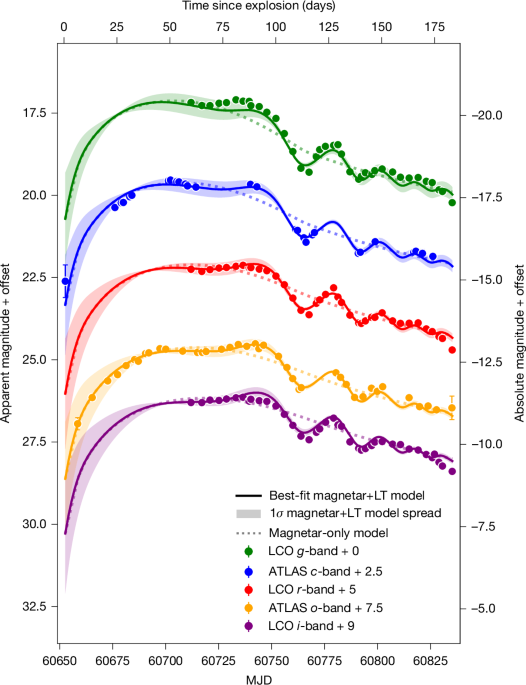
Here we report high-cadence multiband observations of a SLSN-I with clear ‘chirped’ (that is, decreasing period) light-curve bumps that can be directly linked to the properties of the magnetar central engine.
Our observations are consistent with a magnetar centrally located within the expanding supernova ejecta, surrounded by an infalling accretion disk undergoing Lense–Thirring precession.
Our analysis demonstrates that the light curve and bump frequency independently and self-consistently constrain the magnetar spin period to P = 4.2 ± 0.2 ms and the magnetic-field strength to B = (1.6 ± 0.1) × 10 14 G.
These results provide the first observational evidence of the Lense–Thirring effect in the environment of a magnetar and confirm the magnetar spin-down model as an explanation for the extreme luminosity observed in SLSNe-I.
We anticipate that this discovery will create avenues for testing general relativity in a new regime—the violent centres of young SNe.
This is a preview of subscription content, access via your institution
Access Nature and 54 other Nature Portfolio journals
Get Nature+, our best-value online-access subscription
Receive 51 print issues and online access
Prices may be subject to local taxes which are calculated during checkout
Fig.
1: Multiband light curves of SN 2024afav.
Fig.
2: Diagram of disk infall and precession.
Fig.
3: Alternative explanations of modulations.
Fig.
4: Application to legacy SLSNe-I.
Stripped-envelope supernova light curves argue for central engine activity
A superluminous supernova lightened by collisions with pulsational pair-instability shells
Extremely stripped supernova reveals a silicon and sulfur formation site
The photometric and spectroscopic datasets analysed during the present study are available in the WISeREP online database ( https://www.wiserep.org/object/27312 ).
The code used to run parts of this analysis as well as sample walkers from MOSFiT are available on Github ( https://github.com/jrfarah/24afav_analysis ).
Gal-Yam, A.
in Handbook of Supernovae (eds Alsabti, A.
W.
& Murdin, P.) 195–237 (Springer, 2017).
Moriya, T.
J., Sorokina, E.
I.
& Chevalier, R.
A.
Superluminous supernovae.
In Supernovae (eds Bykov, A.
et al.) Vol.
68, 109–145 (Springer, 2019).
Quimby, R.
Superluminous supernovae.
Zenodo https://doi.org/10.5281/zenodo.3478147 (2019).
Kasen, D.
& Bildsten, L.
Supernova light curves powered by young magnetars.
Astrophys.
J.
717 , 245–249 (2010).
Woosley, S.
E.
Bright supernovae from magnetar birth.
Astrophys.
J.
Lett.
719 , L204–L207 (2010).
Lunnan, R.
et al.
Hydrogen-poor superluminous supernovae from the Pan-STARRS1 Medium Deep Survey.
Astrophys.
J.
852 , 81 (2018).
Hosseinzadeh, G.
et al.
Bumpy declining light curves are common in hydrogen-poor superluminous supernovae.
Astrophys.
J.
933 , 14 (2022).
Chen, Z.
H.
et al.
The hydrogen-poor superluminous supernovae from the Zwicky Transient Facility Phase I survey.
II.
Light-curve modeling and characterization of undulations.
Astrophys.
J.
943 , 42 (2023).
Chatzopoulos, E.
& Tuminello, R.
A systematic study of superluminous supernova light-curve models using clustering.
Astrophys.
J.
874 , 68 (2019).
Kumar, A.
et al.
GOTO Transient Discovery Report for 2024-12-27.
Transient Name Server Discovery Report, No.
2024-5091 (2024).
de Wet, S., Wichern, H., Leloudas, G.
& Yaron, O.
ePESSTO+ Transient Classification Report for 2025-01-24.
Transient Name Server Classification Report, No.
2025-337 (2025).
Dong, X.-F., Liu, L.-D., Gao, H.
& Yang, S.
Magnetar flare-driven bumpy declining light curves in hydrogen-poor superluminous supernovae.
Astrophys.
J.
951 , 61 (2023).
Zhang, B., Li, L., Dai, Z.-G.
& Zhong, S.-Q.
Hydrogen-poor superluminous supernovae with bumpy light curves powered by precessing magnetars.
Astrophys.
J.
985 , 172 (2025).
Ogilvie, G.
I.
& Dubus, G.
Precessing warped accretion discs in X-ray binaries.
Mon.
Not.
R.
Astron.
Soc.
320 , 485–503 (2001).
Perna, R., Duffell, P., Cantiello, M.
& MacFadyen, A.
I.
The fate of fallback matter around newly born compact objects.
Astrophys.
J.
781 , 119 (2014).
Lin, W., Wang, X., Wang, L.
& Dai, Z.
Supernova luminosity powered by magnetar–disk system.
Astrophys.
J.
Lett.
914 , L2 (2021).
Chashkina, A., Lipunova, G., Abolmasov, P.
& Poutanen, J.
Super-Eddington accretion discs with advection and outflows around magnetized neutron stars.
Astron.
Astrophys.
626 , A18 (2019).
Tamilan, M., Hayasaki, K.
& Suzuki, T.
K.
Steady-state solutions for a geometrically thin accretion disk with magnetically driven winds.
Prog.
Theor.
Exp.
Phys.
2025 , 023E02 (2025).
Mashhoon, B., Hehl, F.
W.
& Theiss, D.
S.
On the gravitational effects of rotating masses: the Thirring-Lense papers.
Gen.
Relativ.
Gravit.
16 , 711–750 (1984).
Article ADS MathSciNet Google Scholar
Iorio, L.
General Post-Newtonian Orbital Effects: From Earth’s Satellites to the Galactic Centre (Cambridge Univ.
Press, 2024).
Iorio, L.
Lense-Thirring effect at work in M87*.
Phys.
Rev.
D 111 , 044035 (2025).
Article ADS MathSciNet CAS Google Scholar
Iorio, L., Lichtenegger, H.
I.
M., Ruggiero, M.
L.
& Corda, C.
Phenomenology of the Lense-Thirring effect in the solar system.
Astrophys.
Space Sci.
331 , 351–395 (2011).
Renzetti, G.
History of the attempts to measure orbital frame-dragging with artificial satellites.
Cent.
Eur.
J.
Phys.
11 , 531–544 (2013).
Jurua, E., Charles, P.
A., Still, M.
& Meintjes, P.
J.
The optical and X-ray light curves of Hercules X-1.
Mon.
Not.
R.
Astron.
Soc.
418 , 437–443 (2011).
Romanova, M.
M.
et al.
MHD Simulations of Magnetospheric Accretion, Ejection and Plasma-field Interaction.
In Proc.
European Physical Journal Web of Conferences , Vol.
64, 05001 (EDP Sciences, 2014).
Soker, N.
Jets launched at magnetar birth cannot be ignored.
New Astron.
47 , 88–90 (2016).
Bucciantini, N., Quataert, E., Arons, J., Metzger, B.
D.
& Thompson, T.
A.
Relativistic jets and long-duration gamma-ray bursts from the birth of magnetars.
Mon.
Not.
R.
Astron.
Soc.
383 , L25–L29 (2008).
Liska, M.
et al.
Formation of precessing jets by tilted black hole discs in 3D general relativistic MHD simulations.
Mon.
Not.
R.
Astron.
Soc.
474 , L81–L85 (2018).
Dexter, J.
& Kasen, D.
Supernova light curves powered by fallback accretion.
Astrophys.
J.
772 , 30 (2013).
Nixon, C., King, A., Price, D.
& Frank, J.
Tearing up the disk: how black holes accrete.
Astrophys.
J.
Lett.
757 , L24 (2012).
Rybicki, G.
B.
& Lightman, A.
P.
Radiative Processes in Astrophysics (Wiley, 1986).
Sonneborn, G.
et al.
X-ray Heating Of The Ejecta Of Supernova 1987A.
In Proc.
219th American Astronomical Society Meeting Abstracts , 242.25 (American Astronomical Society, 2012).
Menou, K., Perna, R.
& Hernquist, L.
Stability and evolution of supernova fallback disks.
Astrophys.
J.
559 , 1032–1046 (2001).
Arnett, W.
D.
Type I supernovae.
I - Analytic solutions for the early part of the light curve.
Astrophys.
J.
253 , 785–797 (1982).
Armitage, P.
J.
Eccentricity of masing disks in Active Galactic Nuclei.
Preprint at https://arxiv.org/abs/0802.1524 (2008).
Lai, D.
Magnetically driven warping, precession, and resonances in accretion disks.
Astrophys.
J.
524 , 1030–1047 (1999).
Morsink, S.
M.
& Stella, L.
Relativistic precession around rotating neutron stars: effects due to frame dragging and stellar oblateness.
Astrophys.
J.
513 , 827–844 (1999).
Colaiuda, A., Ferrari, V., Gualtieri, L.
& Pons, J.
A.
Relativistic models of magnetars: structure and deformations.
Mon.
Not.
R.
Astron.
Soc.
385 , 2080–2096 (2008).
Tremaine, S.
& Davis, S.
W.
Dynamics of warped accretion discs.
Mon.
Not.
R.
Astron.
Soc.
441 , 1408–1434 (2014).
Liu, L.-D., Wang, L.-J., Wang, S.-Q.
& Dai, Z.-G.
A multiple ejecta-circumstellar medium interaction model and its implications for superluminous supernovae iPTF15esb and iPTF13dcc.
Astrophys.
J.
856 , 59 (2018).
Lin, W.
et al.
A superluminous supernova lightened by collisions with pulsational pair-instability shells.
Nat.
Astron.
7 , 779–789 (2023).
Kumar, H.
et al.
SN 2024afav: A superluminous supernova with multiple light-curve bumps and spectroscopic signatures of circumstellar interaction.
Astrophys.
J.
Lett.
998 , L3 (2026).
West, S.
L.
et al.
SN 2020qlb: a hydrogen-poor superluminous supernova with well-characterized light curve undulations.
Astron.
Astrophys.
670 , A7 (2023).
Ivezić, Ž et al.
LSST: from science drivers to reference design and anticipated data products.
Astrophys.
J.
873 , 111 (2019).
Tyson, J.
A.
Large Synoptic Survey Telescope: Overview.
In Survey and Other Telescope Technologies and Discoveries , Vol.
4836, 10–20 (SPIE, 2002).
Villar, V.
A., Nicholl, M.
& Berger, E.
Superluminous supernovae in LSST: rates, detection metrics, and light-curve modeling.
Astrophys.
J.
869 , 166 (2018).
Hogg, D.
W., Baldry, I.
K., Blanton, M.
R.
& Eisenstein, D.
J.
The K correction.
Preprint at https://arxiv.org/abs/astro-ph/0210394 (2002).
Poznanski, D., Prochaska, J.
X.
& Bloom, J.
S.
An empirical relation between sodium absorption and dust extinction.
Mon.
Not.
R.
Astron.
Soc.
426 , 1465–1474 (2012).
Schlafly, E.
F.
& Finkbeiner, D.
P.
Measuring reddening with Sloan Digital Sky Survey stellar spectra and recalibrating SFD.
Astrophys.
J.
737 , 103 (2011).
Guillochon, J.
et al.
MOSFiT: Modular Open Source Fitter for Transients.
Astrophys.
J.
Suppl.
Ser.
236 , 6 (2018).
Nicholl, M., Guillochon, J.
& Berger, E.
The magnetar model for type I superluminous supernovae.
I.
Bayesian analysis of the full multicolor light-curve sample with MOSFiT.
Astrophys.
J.
850 , 55 (2017).
Gomez, S.
The Type I superluminous supernova catalogue I: light-curve properties, models, and catalogue description.
Mon.
Not.
R.
Astron.
Soc.
535 , 471–515 (2024).
Farah, J.
R.
et al.
Shock-cooling constraints via early-time observations of the Type IIb SN 2022hnt.
Astrophys.
J.
984 , 60 (2025).
Virtanen, P.
et al.
SciPy 1.0: fundamental algorithms for scientific computing in Python.
Nat.
Methods 17 , 261–272 (2020).
Article CAS PubMed PubMed Central Google Scholar
Lomb, N.
R.
Least-squares frequency analysis of unequally spaced data.
Astrophys.
Space Sci.
39 , 447–462 (1976).
Frank, J., King, A.
& Raine, D.
J.
Accretion Power in Astrophysics 3rd edn (Cambridge Univ.
Press, 2002).
Stone, N.
& Loeb, A.
Observing Lense-Thirring precession in tidal disruption flares.
Phys.
Rev.
Lett.
108 , 061302 (2012).
Article ADS PubMed Google Scholar
Fragile, P.
C.
& Liska, M.
in New Frontiers in GRMHD Simulations (eds Bambi, C., Mizuno, Y., Shashank, S.
& Yuan, F.) 361–387 (Springer, 2025).
Brandt, N.
& Podsiadlowski, P.
The effects of high-velocity supernova kicks on the orbital properties and sky distributions of neutron-star binaries.
Mon.
Not.
R.
Astron.
Soc.
274 , 461–484 (1995).
Barnes, J.
et al.
A GRB and broad-lined Type Ic supernova from a single central engine.
Astrophys.
J.
860 , 38 (2018).
Li, Y.-F.
et al.
The effect of anisotropic energy injection on the ejecta emission.
Astrophys.
J.
976 , 113 (2024).
Raj, A., Nixon, C.
J.
& Doğan, S.
Disk tearing: numerical investigation of warped disk instability.
Astrophys.
J.
909 , 81 (2021).
Liska, M., Musoke, G., West, A., Krawczynski, H.
& Tchekhovskoy, A.
GRMHD simulations of misaligned and truncated accretion disks.
Bull.
Am.
Astron.
Soc.
https://baas.aas.org/pub/2022n3i110p91/release/1 (2022).
Musoke, G., Liska, M., Porth, O., van der Klis, M.
& Ingram, A.
Disc tearing leads to low and high frequency quasi-periodic oscillations in a GRMHD simulation of a thin accretion disc.
Mon.
Not.
R.
Astron.
Soc.
518 , 1656–1671 (2023).
Tong, H., Wang, W., Liu, X.
W.
& Xu, R.
X.
Rotational evolution of magnetars in the presence of a fallback disk.
Astrophys.
J.
833 , 265 (2016).
Fragner, M.
M.
& Nelson, R.
P.
Evolution of warped and twisted accretion discs in close binary systems.
Astron.
Astrophys.
511 , A77 (2010).
Shakura, N.
I.
& Sunyaev, R.
A.
Black holes in binary systems.
Observational appearance.
Astron.
Astrophys.
24 , 337–355 (1973).
Kendall, M.
& Stuart, A.
The Advanced Theory of Statistics.
Vol.
2: Inference and Relationship (Hodder Arnold, 1979).
We thank L.
Bildsten, O.
Blaes, S.
Wong, J.
Delgado, C.
Fragile and D.
Kasen for helpful discussions.
J.R.F.
is supported by the U.S.
National Science Foundation (NSF) Graduate Research Fellowship Program under grant 2139319.
This work makes use of data from the Las Cumbres Observatory (LCO) global telescope network.
The LCO group is supported by NSF grants AST-1911225 and AST-1911151.
We respectfully acknowledge the profound cultural significance and enduring reverence of the summit of Haleakalā to the indigenous Hawaiian community and we are grateful for the opportunity to study the heavens from this mountain.
This research was supported in part by grant NSF PHY-2309135 to the Kavli Institute for Theoretical Physics (KITP).
L.J.P.
is supported by a grant from the NASA Astrophysics Theory Program (ATP-80NSSC22K0725).
The Flatiron Institute is supported by the Simons Foundation.
A.V.F.
acknowledges financial support from the Christopher R.
Redlich Fund and many other donors.
This work is supported by the U.S.
NSF under Cooperative Agreement PHY-2019786 (the NSF AI Institute for Artificial Intelligence and Fundamental Interactions, http://iaifi.org/ .) This work has made use of data from the Asteroid Terrestrial-impact Last Alert System (ATLAS) project.
The ATLAS project is primarily financed to search for near-Earth asteroids through NASA grants NN12AR55G, 80NSSC18K0284 and 80NSSC18K1575; by-products of the near-Earth object search include images and catalogues from the survey area.
This work was partially financed by Kepler/K2 grant J1944/80NSSC19K0112 and HST GO-15889 and STFC grants ST/T000198/1 and ST/S006109/1.
The ATLAS science products have been made possible through the contributions of the University of Hawaii Institute for Astronomy, the Queen’s University Belfast, the Space Telescope Science Institute, the South African Astronomical Observatory and the Millennium Institute of Astrophysics (MAS), Chile.
These authors contributed equally: Logan J.
Prust, D.
Andrew Howell, Yuan Qi Ni
Las Cumbres Observatory, Goleta, CA, USA
Joseph R.
Farah, D.
Andrew Howell, Yuan Qi Ni, Curtis McCully, Moira Andrews & Kathryn Wynn
Department of Physics, University of California, Santa Barbara, Santa Barbara, CA, USA
Joseph R.
Farah, D.
Andrew Howell, Moira Andrews & Kathryn Wynn
Kavli Institute for Theoretical Physics, Santa Barbara, CA, USA
Center for Computational Astrophysics, Flatiron Institute, New York, NY, USA
Center for Astrophysics | Harvard & Smithsonian, Cambridge, MA, USA
Harsh Kumar, Daichi Hiramatsu, Sebastian Gomez, Edo Berger & Peter Blanchard
The NSF AI Institute for Artificial Intelligence and Fundamental Interactions (IAIFI), Cambridge, MA, USA
Harsh Kumar, Daichi Hiramatsu, Edo Berger & Peter Blanchard
Department of Astronomy, University of Florida, Gainesville, FL, USA
Department of Astronomy, The University of Texas at Austin, Austin, TX, USA
Department of Astronomy, University of California, Berkeley, Berkeley, CA, USA
Steward Observatory, University of Arizona, Tucson, AZ, USA
Search author on: PubMed Google Scholar
J.R.F.
initiated the study and conceived the mechanism, helped organize follow-up observations of the object with the LCO, processed LCO photometry and spectra, performed the analysis and led the writing of the manuscript.
L.J.P.
assisted with the theoretical development of the mechanism and alternatives and contributed text to the manuscript.
L.J.P., Y.Q.N.
and D.A.H.
contributed equally to development of the mechanism and application to observables.
C.M., M.A., H.K., D.H., S.G., K.W., A.V.F., E.B.
and P.B.
provided data, assisted with interpretations and gave feedback on the manuscript.
K.A.B.
developed the lcogtsnpipe software that was used for reductions of LCO photometry.
Correspondence to Joseph R.
Farah .
The authors declare no competing interests.
Nature thanks Adam Ingram and the other, anonymous, reviewer(s) for their contribution to the peer review of this work.
Peer reviewer reports are available.
Publisher’s note Springer Nature remains neutral with regard to jurisdictional claims in published maps and institutional affiliations.
Extended data figures and tables
Extended Data Fig.
1 Comparison of SLSN spectra.
Comparison of the spectra of SN 2024afav (black) with the spectra of SN 2017egm (blue 41 ), another well-known SLSN.
Lines are shown at a velocity of about 8,000 km s −1 .
The spectra of the two objects are similar, supporting the classification as a SLSN, to which the magnetar model of ref.
4 may be applicable.
We note minor deviations from the spectra of SN 2017egm, such as variations in the strength of iron lines in the Fe II + Fe III complex around 5,000 Å.
The spectral evolution of SN 2024afav is investigated in more detail in ref.
42 .
Extended Data Fig.
2 Fit to the magnetar-only model.
Corner plot and posterior samples (inset) for the magnetar-only model fit to the light curve of SN 2024afav.
The σ parameter (units of mag) is an extra systematic uncertainty that the model is allowed to vary to bring the fit reduced χ 2 to 1.
The posterior exploration achieved satisfactory convergence with minimal correlations between parameters and symmetric, unimodal uncertainties.
The model explains the rise and overall trend of the light curve well; however, the model fails to explain the post-peak chirped modulations that appear in all bands.
1 σ and 2 σ regions of the joint posterior distributions are shown as contours.
Extended Data Fig.
3 Magnetar-model residuals.
Residuals between the magnetar and model data across all bands phenomenologically investigated.
The aggregated residuals from each band (grey points) are binned in time (blue points).
Error bars represent the standard deviation of the photometry binned daily in all filters.
We identify at least five clear bumps in the residual (grey dashed lines).
To characterize the behaviour, we fit a combined quadratic polynomial envelope and a cubic polynomial phase function, for a total of seven free parameters (dark-blue line).
The result of this fit indicates a hybrid growing/decaying envelope peaking around 120 days from the explosion epoch estimated by MOSFiT and a chirped signal with periodicity declining from P ≈ 50 days to P ≈ 20 days over the course of about 80 days.
The fit underestimates the first peak but produces peaks consistent with the remaining modulations.
Extended Data Fig.
4 Regime of validity of the LT model.
Visualization of the regime of validity of the magnetar+LT model.
Error bars represent the standard deviation of the photometry binned daily in all filters.
The magnetar+LT model fundamentally assumes that the luminosity of the SN is driven by the emission interacting with the ejecta.
At early times, when the diffusion timescale t d > t , modulations are not visible and thus our model is not valid.
At late times, when the ejecta are optically thin (nebular phase, indicated by the spectral evolution) and no longer illuminated by the magnetar wind, our model is similarly invalid.
Between these two regimes, our model may be applied, as the ejecta are sufficiently optically thick to allow high-energy photons from the magnetar to be reprocessed but sufficiently optically thin to allow the reprocessed photons to escape.
Extended Data Fig.
5 Landscape of inferred magnetar properties in SLSNe-I.
Comparison of P spin and B field between objects modelled with the magnetar+LT mechanism (SN 2024afav, SN 2021mkr, SN 2018kyt and SN 2019unb) and the sample of SLSNe-I provided in ref.
52 .
Error bars represent 1 σ uncertainties on parameter estimates from the fits.
The parameters inferred by our model are consistent with the overall distribution of SLSNe-I.
Extended Data Fig.
6 Characteristic parameter estimation.
We pedagogically demonstrate the procedure for estimating characteristic parameters \({\dot{P}}_{{\rm{c}}}\) and P c , as described in Methods section ‘Residual analysis’.
The left panel ( a ) shows the periods estimated from SN 2024afav, corrected for the diffusion timescale, with 1 σ uncertainties propagated from quadratic fits to the modulations used to determine extrema positions.
We fit a line to the periods and use a posterior sampling of the parameters to estimate the slope \({\dot{P}}_{{\rm{c}}}=0.44\pm 0.05\) (right panel, b ; blue distribution).
Next we compute the median of the period measurements to get a characteristic period P c = 23 ± 1.6 days (uncertainty is estimated from the spread in the medians of the linear fits; right panel, b ; orange distribution).
For our models, which generate effectively continuous time series periods, we sample them on the same days as the period midpoints shown above and compute their characteristic quantities using that sampling.
This serves as a pedagogical tool to help understand the ability of the models to describe the data.
Extended Data Fig.
7 Power spectral density of chirp.
Power density spectrum of the SN 2024afav residual from t = 30 to t = 180 days in comparison with a simulated static period and a simulated chirp.
The presence of the chirp ‘smears’ the peak frequency in a characteristic way, visible in both the simulated chirp and the SN 2024afav data.
By contrast, a stable periodicity produces a narrow peak, which is clearly inconsistent with the SN 2024afav data.
Extended Data Fig.
8 LT model fit to residuals.
Same as Extended Data Fig.
3 but instead investigated using the LT model.
We characterize the residual behaviour using an amplitude envelope modulated by spin-down power and photon diffusion through the ejecta, combined with a precession governed by the Lense–Thirring effect.
Unlike the seven-parameter phenomenological fit shown in Extended Data Fig.
3 , this model only requires three parameters (overall scale, accretion rate and initial precession angle of the disk) yet explains the data to a similar degree of success.
We show the decomposition of the model into the envelope and precession, which makes the shrinking period easily visible and demonstrates the consistency between the location of the four unambiguous bumps and the prediction from the Lense–Thirring effect.
Extended Data Table 1 Modulation location and confidence Full size table
Supplementary Information (download PDF )
Supplementary Information sections 1–4
Peer Review file (download PDF )
Springer Nature or its licensor (e.g.
a society or other partner) holds exclusive rights to this article under a publishing agreement with the author(s) or other rightsholder(s); author self-archiving of the accepted manuscript version of this article is solely governed by the terms of such publishing agreement and applicable law.
Version of record : 11 March 2026
DOI : https://doi.org/10.1038/s41586-026-10151-0
Related Stories



Source: This article was originally published by Nature News
Read Full Original Article →
Comments (0)
No comments yet. Be the first to comment!
Leave a Comment