
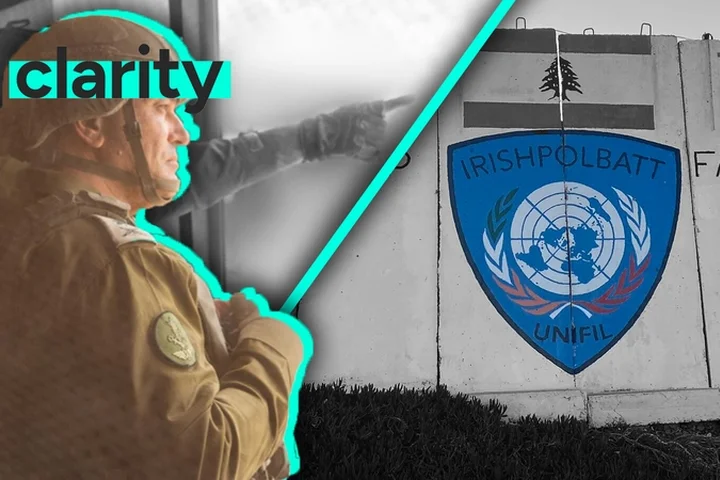
The Israel Defense Forces (IDF) has said the primary focus of its ground war in Lebanon targeting Hezbollah is now centred on the town of Bint Jbeil, a key location within the Irish UN peacekeepers' area of operations.
Bint Jbeil is the largest urban centre in the Irish UNIFIL zone in southern Lebanon, located just a few kilometres from the Israeli border.
The town has long been considered a Hezbollah power centre.
"The primary arena of our fighting is here in Lebanon," Israel's Chief of Staff, Eyal Zamir, said on Thursday during a visit to locations in Lebanon described by the IDF as "on the outskirts of Bint Jbeil."
"We continue to deepen the ground operations and continue to strike Hezbollah," he added.
"This is a very powerful operation; our troops are operating along the front lines and at depth."
The area around the town has seen increased military activity between the IDF and Hezbollah in recent days and weeks, including ground operations, artillery fire, and airstrikes.
Hezbollah is a Shia Muslim paramilitary and political organisation backed by Iran which has operated in Lebanon for decades.
The IDF says that Hezbollah had launched more than 2,000 missiles and drones across the border into northern Israel since 2 March.
Most of the projectiles have been intercepted or fallen in open areas, it said.
Since the IDF renewed its ground campaign to southern Lebanon around that time, at least 12 Israeli soldiers have been killed and more than 400 others have been wounded.
More than 300 Irish peacekeepers operate out of a base known as Camp Shamrock which about 2.5km from Bint Jbeil, on a hilltop near where clashes and exchanges of fire have been ongoing particularly in the last week.
We need your consent to load this flourish content We use flourish to manage extra content that can set cookies on your device and collect data about your activity.
Please review their details and accept them to load the content.
Manage Preferences
The Israeli ground operation has seen troops move up to 8km into southern Lebanon, behind a wave of drone and jet strikes, as well as artillery bombardment.
The latest IDF updates also showed drone strike footage against what they described as Hezbollah operatives launching rockets from Tir Zibneh, a village a few kilometres north of Camp Shamrock.
Irish troops located close to clashes
The comments from the IDF place Irish peacekeepers directly within the zone of intensifying combat activity.
Recent reports from local media indicates heavy fighting across the villages of of Ainata, Kounine, and At-Tiri toward the Saf-al-Hawa area overlooking the town, all within four kilometres of Camp Shamrock.
The Irish Defence Forces said all personnel are "well and accounted for" and that "all necessary force protection measures continue to be observed" amid the escalation.
Local reports on Friday said Israeli strikes were hitting multiple areas across the Bint Jbeil district.
Footage circulating online appears to show sites in and around Bint Jbeil and smoke rising, amid reports of heavy fighting in the outskirts of the town.
Hezbollah says its fighters are engaged in "direct clashes" with Israeli forces inside Bint Jbeil.
In a statement, the group said Israeli forces were attempting to advance towards the town centre, while its fighters push back with rocket and artillery fire targeting Israeli movements.
Pincer movement around Bint Jbeil
Military analyst Declan Power, a former Irish soldier, told Prime Time on Tuesday that Bint Jbeil has long been a focal point of conflict and is considered a Hezbollah stronghold.
Mr Power said Israeli forces are advancing in a "pincer movement" aimed at surrounding the area and taking control of key terrain.
"They fought there before in 2006 and got a very bloody nose from Hezbollah," he said.
"The Israelis are moving to circle the area and dominate the high ground."
UNIFIL has warned that the proximity of fighting to its positions is placing peacekeepers at increasing risk.
"UNIFIL has continually expressed concern about Hezbollah fighters and Israeli soldiers firing projectiles and bullets at or near our positions," spokesperson Kandice Ardiel said.
"Actions which have already tragically caused death and injury among our peacekeepers."
The mission said the presence of combatants near UN bases increases the likelihood of further incidents.
"These activities put peacekeepers in danger," it said.
Watch: Declan Power speaking to Prime Time on Tuesday about the situation in south Lebanon
Bint Jbeil was a major battleground during the 2006 Lebanon War, when Israeli forces failed to take control of it despite intense fighting.
A 34-day conflict, initiated after Hezbollah captured two Israeli soldiers, resulted in significant casualties with roughly 1,200 Lebanese and 160 Israelis killed along with extensive damage to infrastructure.
The conflict ended under UN Resolution 1701, which called for the disarmament of southern Lebanon and the strengthening of UNIFIL to stabilise the region.
The recent escalation in fighting has resulted in a number of incidents involving UN peacekeepers operating in the area.
This week, a UN peacekeeper was briefly detained by Israeli forces, in what the United Nations has described as a "violation of international law."
The peacekeeper was held after a logistics convoy was blocked by Israeli forces on Monday.
UNIFIL said the individual was released less than an hour later following what it described as direct and immediate contact by senior officials.
"Any detention of a United Nations peacekeeper is a blatant violation of international law," the mission said, adding that any interference with the movement of peacekeepers also breaches UN Security Council Resolution 1701.
It followed the killing of Indonesian personnel in recent weeks during two separate incidents, explosions at UNIFIL headquarters in Naqoura, around 20km from the main Irish base at Camp Shamrock, amid nearby clashes, and an incident where artillery fire struck an Ghanaian UN base.
Wider escalation across Lebanon
The intensification of fighting in the south comes alongside a broader escalation across Lebanon, including in the capital, Beirut.
Across the wider country, more than 250 people were reported killed on Wednesday, in what was described as the single day of "heaviest bombardment" since the conflict reignited.
This involved strikes which hit several dense commercial and residential areas in Lebanon's capital, Beirut, without warning, killing hundreds and wounding more than one thousand according to the Lebanese Civil Defence.
The strikes were carried out hours after a ceasefire was announced by the US and Iran, amid apparent disagreement between Iran and Israel about the inclusion of Lebanon.
At least 254 people were killed and 1,165 others wounded in the attacks, a statement from the Lebanese Civil Defence said.
On Wednesday, local reports said that dozens of people were still unaccounted for under the rubble as rescue teams attempted to find survivors.
Many of those displaced have fled areas near the Israeli border, including towns within the UNIFIL area of operations, and moved north towards Beirut and other parts of the country.
Aid agencies have also warned that the scale of displacement is placing severe strain on infrastructure, with families sheltering in schools, unfinished buildings and overcrowded accommodation.
Related Stories
Source: This article was originally published by RTÉ News
Read Full Original Article →
Comments (0)
No comments yet. Be the first to comment!
Leave a Comment