
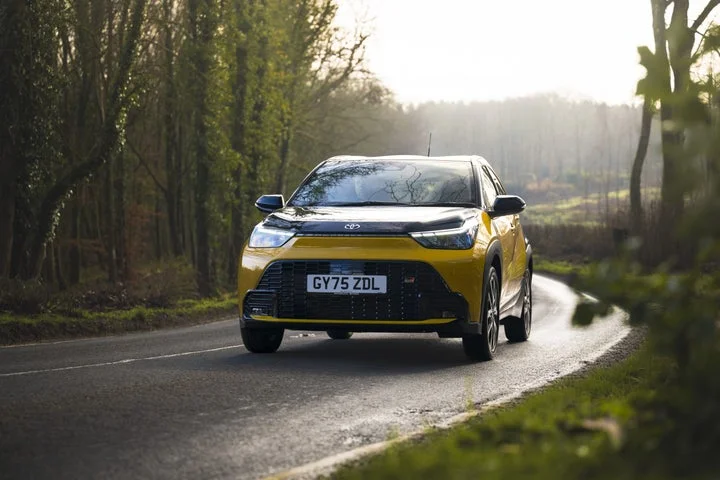
H ow do you make the Toyota Aygo X (pronounced “cross”, btw) one of the nicest little cars on sale, even better to own and drive?
Well, if you’re Toyota, the natural inclination is to turn it into a hybrid, and so here we are: the Toyota Aygo X Hybrid, which means that all Aygo models sold in the UK now have this pseudo-SUV chunky styling plus “self-charging” full hybrid technology as standard, like a Prius (but no heavier plug-in hybrid options for the Aygo).
The result?
More power, superior performance and updated, sharper looks than the outgoing model.
Better still, if that were possible, this smallest car in the Toyota range has been given a mild sporty makeover in the GR Sport variant, in which I had the pleasure of scooting around for a few days.
It was a lot of fun and, thanks to the significant power upgrades, much better at tackling a long motorway run than its immediate predecessor.
It’s undoubtedly still primarily urban transport and, frankly, unsuitable for any family unit exceeding two adults and two small children, but it is capable of ranging far and wide without wearying its occupants.
Like the best of small cars that have big car pretensions, such as the old and much-missed Smart ForTwo, the VW Up/Seat Mii/Skoda Citigo trio, or indeed Toyota’s own quirky iQ, the Aygo has a bit more of a quality, grown-up feel about it.
A bit.
Compared to the pre-hybridised Aygo X it supersedes, the new versions have bigger engines (1.5l v 1.0l), more power and extra torque from the electric motor (114 v 71 hp), lower CO2 emissions (well below 100g/km) and fuel economy – now in the low 70s miles per gallon, which Toyota claims is best in class.
They are well built and have decent quality materials inside, and the touchscreen and manual controls are finely weighted.
Plus, given that badge, it won’t break down.
Price : £26,945 (as tested; range from £21,495)
Engine capacity : 1.5l petrol, 3-cyl, CVT auto
CO2 emissions (WLTP, g/km) : 87
Do I sound like a Toyota salesman?
Well, let me make amends by telling you what the man or woman in the showroom might not.
The sting, you see, and it’s a painful one, is a big hike in price – up by about £4,000 more, about a quarter, in the starting price for the base “Icon” version.
It’s more car for more money, if you will, but we’d prefer more motor for less dosh.
If you’re not going to be doing many miles in your Aygo, I’d suggest looking at a lightly used example of the old model, which is still a hoot to chuck about and, I’d hope, possibly even more reliable (less complicated drivetrain).
Of course, such official figures don’t always translate into real-world experience, but even with a heavy right foot, I found the figures just about plausible – and the baby all-electric alternatives such as the Hyundai Inster are even cleaner and cheaper to run, and are also excellent value.
If you can stretch to the Aygo X GR Sport version, it will reward you with even sharper handling, thanks to tweaked steering and suspension, plus – get this – a black bonnet, larger, 18-inch alloy wheels and it looks especially good in contrasting mustard yellow.
It’s an extremely attractive package and is fully equipped – but it all pushes the list price even higher.
The Aygo X has always enjoyed strong reviews and, money apart, the new hybrid is an improvement on a well-sorted design in every way.
The naturally aspirated (non-turbo) three-cylinder petrol unit is still entertainingly thrummy rather than unrefined, and is well suited to the automatic gearbox.
It’s just a car that feels good to drive and does everything competently or better, and the only feature I missed on it was a heads-up display, something that would just add that little bit of extra sophistication to the offering.
With the new generation of city EVs, the small car still has a future in a world where cars are suffering so much from weight and size inflation.
It’s just a pity that the manual gearbox option has quietly disappeared, and you can no longer buy a new small Toyota for less than £20,000, like the original non-hybrid, non-SUV model, a proper little city hatch.
Maybe, given the cost of living crisis, which seems never-ending, Toyota, which has been building exemplary cars for the masses for decades (a noble calling), may bring just such a basic but efficient and dependable machine back one day.
A £10k Toyota.
Think of that.
It’d be good to have the choice.
Join thought-provoking conversations, follow other Independent readers and see their replies
Related Stories


Source: This article was originally published by The Independent
Read Full Original Article →
Comments (0)
No comments yet. Be the first to comment!
Leave a Comment