
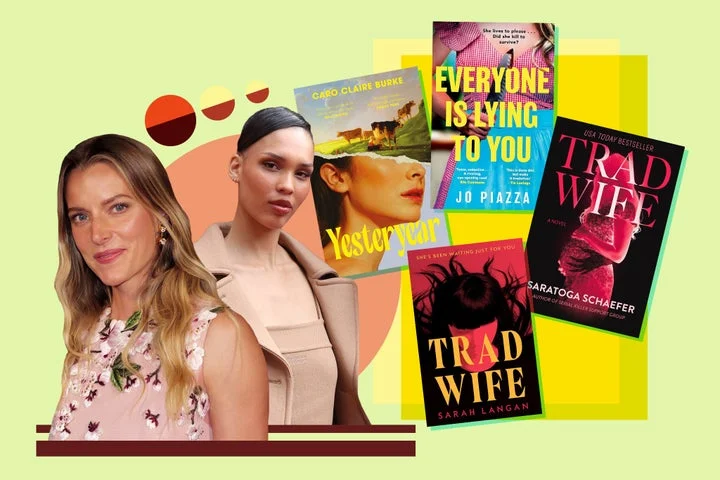
Tradwife influencers are lightning rods for debates about gender roles and conservative ideology.
Now they are literary protagonists too.
Katie Rosseinsky explores the rise of this new genre and its most talked-about entry yet, ‘Yesteryear’ by Caro Claire Burke
Natalie is, as she so humbly puts it, “perfect at being alive”.
But soon, the veneer will crack.
She will wake up to find herself in an early-19th-century version of her farmhouse, with all the mod cons not just cleverly kept out of shot but totally non-existent.
No heating.
No fridge.
No wifi.
She is flanked by kids she doesn’t recognise, and a husband who resembles her partner, but has attitudes about marital duties that are, well, very pre-civil war.
And while this new, old Yesteryear is an iPhone-free zone, Natalie still feels as though she is being watched.
Is this an elaborate prank?
Did she inadvertently sign up to some sort of ethically dubious reality show?
Will the antiquated beliefs she so strongly holds in a hypothetical sense hold up under the harsh glare of reality?
In the months leading up to the book’s release, Yesteryear has received the sort of buzz a debut novelist dreams of – and it’s true that Burke, a journalist and the co-host of the culture and politics podcast Diabolical Lies , could hardly have come up with a more zeitgeisty premise.
Over the past few years, the tradwife – a portmanteau for “traditional wife” that has come to stand for a woman who adopts rigid gender norms and dedicates her life to housekeeping, child-rearing and other wifely tasks – has become one of our most talked-about, extensively dissected pop-cultural phenomenons.
These women have become lightning rods for debates about gender roles.
Are they romanticising regressive ideas with their softly lit portrayal of old-fashioned “feminity”?
Is tradwife ideology a photogenic gateway to right-wing politics?
Are they girlbosses in artisan aprons, shilling an old-fashioned lifestyle through affiliate links and brand partnerships?
And can it be coincidence that these women have come to prominence at a time when reproductive rights are being rolled back across the United States?
This discussion has spilled over from thinkpieces and TikTok videos into fiction, a form that gives all these questions space to, well, bubble up like one of Natalie’s prized sourdough starters.
Yesteryear has rightly generated plenty of hype already, thanks in no small part to an 11-way auction for the publication rights, with Amazon optioning a film adaptation soon after; Anne Hathaway is set to produce and star.
But it is not the only novel in the rapidly expanding genre we might call “tradwife lit”, which is part domestic noir and part fictionalised influencer confessional, with a sprinkling of topicality.
Last year, Jo Piazza’s thriller Everyone Is Lying to You was an American bestseller; it told the story of a struggling journalist who lands a potential scoop when her old friend, now a tradwife influencer, offers her an exclusive interview – only to disappear, leaving a trail of violence in her wake.
This year also marks the arrival of not one but two novels with the simple title: Trad Wife .
One of them, by Saratoga Schaefer, is a body horror probing the protagonist’s desire to procreate at any cost.
The other, by Sarah Langan, is another tale of a journalist given the chance to profile a tradwife influencer – you can only assume that The Times ’s much-analysed 2024 interview with Hannah Neeleman was an inspiration.
Both books explore the strange gap between appearance and reality inherent in any influencer’s self-fashioning, making it somehow sinister.
Burke is especially astute when it comes to the contradictions of Natalie’s world, its old-fashioned cosplay designed to be consumed on a very modern social media platform.
“I wanted all the aesthetics of the olden times and all the amenities of modernity,” she writes of Natalie’s renovation of Yesteryear .
Her character preaches the benefits of an organic-only diet, then tells the farm workers to spray their crops with pesticides (these undocumented labourers are unseen on her Instagram account; the smallholding, like so much of her empire, is contingent upon the hidden work of others).
The merchandise designed to recreate the family’s all-American lifestyle?
It’s made in China.
That Natalie is not unaware of these dichotomies only makes her a more fascinating character.
It is never entirely clear just how much of her own philosophy she truly believes in, but the mask of the tradwife is certainly an expedient and profitable one to wear.
If the prairie dress fits, and all that.
Despite the traditional gender roles that her content seemingly celebrates, it is she who is the machine of the operation; there is yet more irony in earning money by suggesting that women should pack in their own careers.
Burke makes it clear that Natalie’s dream life is riddled with paradoxes; forcing her back into the past only makes those more glaring.
Natalie is a woman who could only have been forged in the 21st century – and the tradwife feels like a fitting literary protagonist for a strange and difficult-to-navigate cultural era, where nostalgia for a past that never really existed is a highly marketable commodity.
‘Yesteryear’ by Caro Claire Burke is published on 9 April by 4th Estate
Join thought-provoking conversations, follow other Independent readers and see their replies
Related Stories


Source: This article was originally published by The Independent
Read Full Original Article →
Comments (0)
No comments yet. Be the first to comment!
Leave a Comment