
As President Donald Trump backs efforts to advance psychedelic drugs, doctors are speaking out about how the move could impact mental health treatments.
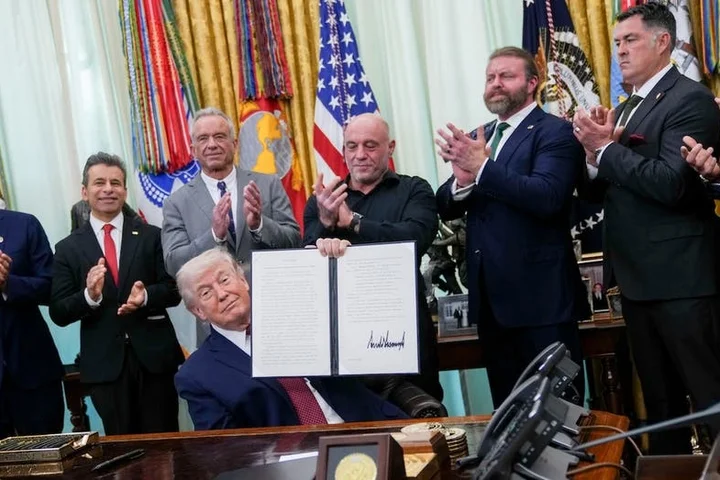
On Friday, Trump signed an executive order to fast-track the research, funding and potential FDA approval of psychedelics like ibogaine, psilocybin, LCD and MDMA, primarily to treat PTSD, depression and addiction.
Psychedelics, psychoactive compounds that act largely through serotonin pathways, are being studied in controlled clinical settings for mental health treatment, experts say.
SINGLE DOSE OF POWERFUL PSYCHEDELIC CUTS DEPRESSION SYMPTOMS IN CLINICAL STUDY
Trump’s move is drawing mixed reactions, with supporters praising its potential to transform mental health treatment, particularly for veterans, while critics warn about limited evidence on safety and effectiveness.
"The president’s action today opens a pathway to research that will further open doors to expedited approval of this life-saving medicine as a treatment for our veterans — and society — who have suffered for decades from treatment-resistant PTSD, TBI (traumatic brain injury) and depression," Jay Kopelman, former Marine Corps lieutenant colonel and CEO of Mission to Live Foundation in San Diego, told Fox News Digital.
"This act will require the VA Health System to begin psychedelics research and clinical trials, making psychedelics available to veterans for whom the traditional modalities of care (SSRIs and talk therapy) haven’t worked."
Dr.
Marc Siegel, Fox News senior medical analyst, agreed that psychedelics hold "big potential" for severe depression and PTSD, and said he supports Trump’s commitment to funding more research.
"It changes brain chemistry in a way that can provide more modulation of dopamine, serotonin and other neurochemicals, making a patient less fearful," he told Fox News Digital.
"At the same time, the psychiatric impact of psychedelics can be useful to change perception in a positive way."
Siegel emphasized, however, that these therapies need to be further researched, and that doses and exact indications must be carefully determined.
Juliana Mercer, a 16-year Marine Corps veteran and the executive director of Healing Breakthrough, a San Diego-based nonprofit dedicated to advancing MDMA-assisted therapy for veterans with PTSD, applauded the president’s move as a "meaningful step."
"The people who need this most are those who have already tried everything and found no real relief," she told Fox News Digital.
Kevin A.
Sabet, Ph.D., president and CEO of the Foundation for Drug Policy Solutions in Washington, D.C., expressed concerns about the executive order.
FOX NATION: WATCH ‘IBOGAINE: THE FIGHT OF A LIFETIME’
"Ibogaine remains a Schedule I substance with serious safety concerns, including documented cardiotoxicity and deaths.
[The government] should not normalize unproven and risky drugs under the guise of helping those who have served our country."
Siegel also cautioned about the risk of improper prescribing of psychedelics by unqualified practitioners.
"Unfettered recreational use and microdosing can increase the risk of psychosis and other anxiety disorders," he added.
Kopelman noted that the primary risk of ibogaine is its "cardiotoxicity properties."
"It can prolong the QT interval in the heartbeat, which can lead to arrhythmia or even heart attack," he told Fox News Digital, noting that this risk is mitigated by "rigorous medical examinations" and monitoring during treatment.
Mercer agreed that these treatments aren’t appropriate for everyone.
"They can have significant psychological effects and, in some cases, physiological risks, which is why they should only be administered in controlled clinical settings by trained providers," she told Fox News Digital.
CLICK HERE FOR MORE HEALTH STORIES
"Continued research is essential to better understand who these therapies are right for, and who they’re not, before broader implementation."
While Trump’s order is a step toward FDA approval for psychedelics, the substances still need to go through clinical trials and the standard regulatory pathway, including rescheduling, Mercer noted.
"Veterans and others will still be waiting unless we also build the systems to provide this safely at scale, trained providers, reimbursement pathways and clinical care models," she said.
"This is the gap we’ve been highlighting for years, and it still needs to be closed."
Kopelman agreed that while the legislation paves a path for expedited study of these medications, it’s important to "do it the right way," warning that "one misstep could overturn and sink this entire effort."
TEST YOURSELF WITH OUR LATEST LIFESTYLE QUIZ
CLICK HERE TO SIGN UP FOR OUR HEALTH NEWSLETTER
"Psychedelics are not a panacea," Kopelman added.
"They are a gateway to healing — but the real work begins after treatment."
Related Stories


Source: This article was originally published by Fox News
Read Full Original Article →
Comments (0)
No comments yet. Be the first to comment!
Leave a Comment