
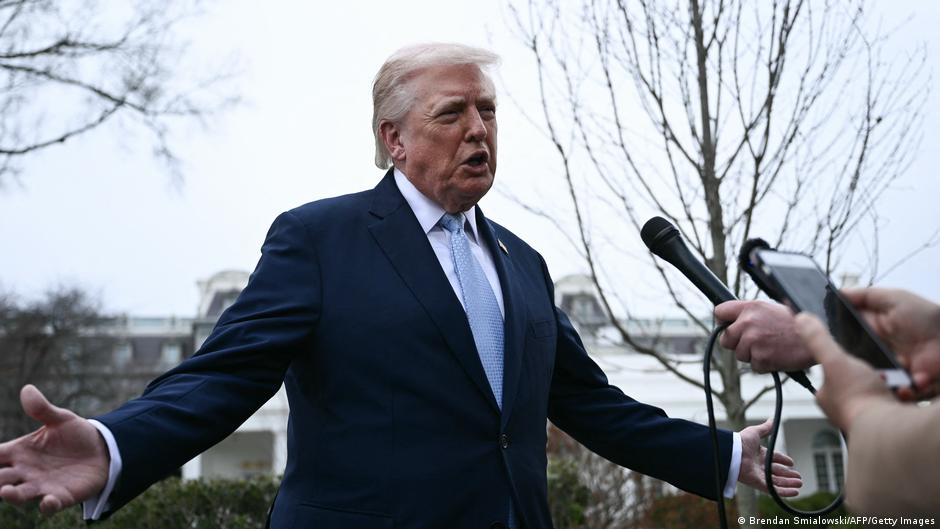
US President Donald Trump announced a five-day postponement of military strikes on Iran's energy infrastructure on Monday after previously threatening to "obliterate" it if the Hormuz Strait remained closed.
DW has more.
Here is a roundup of the war in the Middle East on Monday, March 23, 2026.
You can catch up on Sunday's developments here .
Trump: US holds 'strong talks' with Iran, deal could be near
US President Donald Trump said the US has held talks with Iran, claiming the two sides have "major points of agreement" and suggesting a potential deal could be imminent.
"We have had very, very strong talks," Trump said.
"We'll see where they lead."
Trump told reporters that his special envoy for the Middle East, Steve Witkoff, and his son-in-law, Jared Kushner, had held discussions with Iran's "respected leaders," but said that the talks did not involve Iran's new supreme leader Mojtaba Khamenei.
He added that a deal could be reached soon if negotiations remain productive, but warned that if they fail, "we'll keep bombing our little hearts out," he told reporters.
Iran has so far denied that such negotiations are taking place.
Markets have responded to Trump's recent comments on Iran, with oil prices falling and stocks rising.
Nigeria steps up gasoline exports across Africa amid Iran war
Nigeria has accelerated gasoline exports across Africa, amid the ongoing energy disruptions triggered by the Iran war.
Data from tanker-tracking firm Kpler showed on Monday that Nigeria's exports of clean petroleum products have more than doubled daily in March.
Clean petroleum products include gasoline, diesel, kerosene and jet fuel.
Dangote Refinery, which is owned by Africa's richest man Aliko Dangote, announced late on Sunday that it sold 12 cargoes totalling 456,000 tons of fuel.
Shipments to other African countries have also more than doubled.
They now stand at around 90 thousand barrels per day.
"By supplying neighboring and other economies, the Dangote Refinery is expected to contribute to enhance energy security in west, east and central Africa," the company said.
It added that the recipients included Cote d'Ivoire, Cameroon, Tanzania, Ghana and Togo.
"We have demands even out of Africa, especially for jet fuel," a company spokesperson told the French AFP news agency.
The Middle East conflict has disrupted traditional fuel transfer routes from Europe and the Gulf.
This has created opportunities for suppliers with shorter supply chains.
Nigeria is Africa's largest oil producer.
Iran denies Trump negotiation claim, says 'There are no talks'
After US President Donald Trump publicly stated that "very good and productive" talks with Iran had led to the postponement of threatened US military strikes, Tehran flatly rejected the assertion.
Iran's Mehr news agency quoted the country's Foreign Ministry, which dismissed Trump's statement as an attempt "to reduce energy prices," saying, "There are no talks between Tehran and Washington."
Though Trump is leaning into the idea of negotiations, it remains unclear whether any progress has been made toward reopening the Strait of Hormuz.
Merz 'grateful' as Trump postpones Iran attacks
German Chancellor Friedrich Merz welcomed US President Donald Trump 's decision to delay previously threatened strikes on Iranian power plants.
"I am grateful that he said he is postponing them for another five days," Merz said at a press conference in Berlin.
He said he had called Trump on Sunday to express his concerns about the planned attacks.
At the press conference, Merz also appreciated Trump for "opening the possibility for immediate and direct contact with the Iranian leadership."
Trump pauses ultimatum, citing 'very good' Iran talks
US President Donald Trump took to Truth Social Monday morning to announce that he would back off his 48-hour ultimatum — due to expire late Monday — for Iran to open the Strait of Hormuz or face massive attacks on its energy infrastructure.
In an all-caps statement, Trump cited "very good and productive conversations" with Iran as the reason for the pause.
The US leader said he had instructed the military "to postpone any and all military strikes against Iranian power plants and energy infrastructure for a five-day period."
Trump added the caveat that the pause remained contingent upon the success of talks that will be ongoing this week.
Trump offered no information about the talks that he was referring to, nor has Iran acknowledged that any have taken place.
Global economy 'taken hostage' by Iran war — Singapore top diplomat
Singapore 's Foreign Minister Vivian Balakrishnan said the US-Israeli war on Iran , now in its fourth week, risks plunging Asian economies into turmoil.
"Right now the closure of the Strait of Hormuz is, in a sense, an Asian crisis," he told Reuters in an hour-long interview.
He said the conflict has "taken the entire global economy hostage" and could spark a financial crisis.
"I didn't think (the war) was necessary," he said.
"Even now, there are even doubts expressed about the legality of the situation."
He also expressed disappointment at the breakdown of talks between the US and Iran and said he was "surprised by the onset of hostilities."
READ: Markets in Asia and Europe nosedive with no end to conflict in sight
Traders returned from their weekend off in a dour mood amid the reciprocal threats from the US and Iran and with no real sign of deescalation in the region.
Most of the major Asian markets shed more than 3% in a single day's trading and Europe has not started the day in a much more optimistic mood either.
In Germany, the DAX had shed more than 2% of its value by lunchtime.
Traditional safe havens gold and silver were also in freefall again , after their peaks and troughs of recent months and years.
For a more detailed look at the situation on the markets on Monday, you can read our full story here .
Israeli civlian killed by friendly fire
The Israeli military accidentally killed its own resident — an Israeli farmer in a northern kibbutz, a communal farm settlement.
Israel's Northern Command chief, Major General Rafi Milo, said the farmer "was killed by our own forces" during an operation “whose entire purpose was to protect" citizens.
He described the incident as "very severe," acknowledging "several severe issues and operational errors" in the mission.
The civilian was initially believed to have been killed by missiles fired by Lebanon's Iran-backed Hezbollah, but preliminary findings indicate he was struck by Israeli artillery supporting troops in southern Lebanon, he said.
A full inquiry has been launched.
Kremlin calls for 'political and diplomatic' end to Iran war
Kremlin spokesman Dmitry Peskov on Monday said that Russia is calling for a "political and diplomatic" end to hostilities in the Middle East.
The statement came after US President Donald Trump threatened to "obliterate" Iran's energy infrastructure if it did not reopen the Strait of Hormuz by late Monday.
"We believe that the situation should have transitioned to a political and diplomatic settlement," Peskov told journalists.
"This is the only thing that can effectively contribute to defusing the catastrophically tense situation that has now developed in the region," Peskov added.
Iran has held the strait closed since the US and Israel launched their war on the Islamic Republic on February 28.
Iran is deploying swarms of drones in its war with the US and Israel.
It also uses them to attack neighboring Gulf states in the Middle East.
How do these weapons systems work and why are they difficult to combat?
To view this video please enable JavaScript, and consider upgrading to a web browser that supports HTML5 video
Iran will mine 'entire Persian Gulf' if coast and islands attacked
Iran's Defense Council on Monday warned that it would take drastic measures if the US and Israel launch attacks against its southern coast or attempt to occupy Iran's strategically important Kharg Island.
"Any attempt to attack Iran's coasts or islands will cause all access routes in the Gulf to be mined with various types of sea mines, including floating mines that can be released from the coast," read a council statement.
"In this case," the statement continued, "the entire Gulf will in effect be in a situation similar to the Strait of Hormuz."
The statement said this would be the case "for a long time" if Tehran is forced to take action and referenced the difficulty had by "100 minesweepers attempting to open the strait [during the Iran-Iraq War] in the 1980s."
According to US news outlet Axios, Trump is considering occupying or blockading Kharg Island, Iran's main oil export hub, to pressure Tehran to reopen the strait.
In its Monday statement, the Defense Council reiterated that vessels from non-belligerent nations were free to pass but must first coordinate with Iranian authorities.
Iran's oil hub on Khargh island hit by US overnight strikes
Trump talks with Starmer, reposts mocking skit
UK Prime Minister Keir Starmer and US President Donald Trump spoke late Sunday to discuss tensions in the Middle East, including threats to global shipping through the Strait of Hormuz, according to a British government press release.
Both leaders agreed that reopening the vital waterway was essential to global markets, but details on how they would proceed have not been made public.
They are expected to speak again soon, the statement said.
The call came just hours after Mr.
Trump amplified a comedic jab at Mr.
Starmer over the weekend, reposting a television skit portraying the British prime minister as anxious about taking Trump's calls.
The clip, from the UK debut of Saturday Night Live , shows a fictionalized Mr.
Starmer panicking at Downing Street before abruptly hanging up once Mr.
Trump answers.
Trump added no comment to the video.
China warns of 'uncontrollable situation' in Middle East
Speaking of US President Donald Trump's threat to "obliterate" Iranian power plants if Tehran does not open the Strat of Hormuz and Tehran's reciprocal threat of massive energy infrastructure attacks if Trump moves ahead, China has warned the situation in the Middle East risks spinning out of control.
"If the war expands further and the situation deteriorates again, the entire region could be plunged into an uncontrollable situation," Chinese Foreign Ministry spokesman Lin Jian told reporters in Beijing on Monday.
"The use of force will only lead to a vicious cycle," he added when asked about the deadline to Trump's looming threat.
Beijing is reliant upon Iranian oil and is a partner to Tehran, nevertheless, Beijing has made clear that it "does not go along" with the Iranian regime's strategy of attacking neighboring Gulf countries in response to US and Israeli aggression.
Earlier this month, Foreign Minister Wang Yi said the war "should never have happened" and called for an end to hostilities.
Beijing has repeated calls for a ceasefire throughout, as the war cuts off global oil supplies, including to China.
Trump has also called on nations such as China to send military to the region in order to force the opening of the Strait of Hormuz.
The US president had previously said he would visit Beijing in April but has postponed the trip to deal with his war in Iran.
Beijing has given no sign that it will answer Trump's call — nor have any of the other countries that he demanded join the fight — instead dispatching special envoy Zhai Jun to the region to work at finding a path to de-escalation.
Why China's support for Iran has clear limits
Iran campaign 'ahead or on plan': US Central Command head
The US campaign against Iran is "largely ahead or on plan," said the top commander of the US military's Central Command, in an interview to the Farsi-language network Iran International.
US Navy Admiral Brad Cooper's interview was aired on Monday morning, just as Israel began what it called a "wide-scale wave of strikes targeting Iranian terror regime infrastructure."
In the same interview, he claimed that Iran was launching missiles and drones from populated areas, suggesting that those areas would be targeted.
"You need to stay inside for now," Cooper told Iranian civilians.
"There will be a clear signal at some point, as the president has indicated, for you to be able to come out," he said.
When asked about his assessment of Iran's operations, he said: "They're operating in a sign of desperation."
He claimed that the Islamic Regime had move from deploying a large number of drones and missiles at the same time to "one or two at a time," and swapped military targets for civilian ones.
Iranian overnight strikes hit Israeli towns
Iran threatens Middle East's power plants to counter Trump's deadline
Tehran warned that it would strike electrical plants across Israel and the Gulf nations if US President Donald Trump follows through on his threat to bomb Iran's power stations.
On Sunday morning, Trump had given Iran 48 hours to open the Strait of Hormuz, failing which it would target Iranian power plants.
This US-imposed deadline will expire just before midnight on Tuesday.
Iran's reciprocal threat was also presented as a justification for its continued attacks on its neighbors.
"Do not doubt that we will do this," the statement said.
Iran's threat not only puts the region's energy supply at risk but also its drinking water supply.
That's because the desert nations have an integrated electrical and water system where waste heat from power plants is used to run desalination plants and provide drinkable water.
Related Stories



Source: This article was originally published by Deutsche Welle (DW)
Read Full Original Article →
Comments (0)
No comments yet. Be the first to comment!
Leave a Comment