
US President Donald Trump both threatened to bomb Iran "to Hell" and claimed there was a chance of reaching a ceasefire deal soon.
The statements came after a second US airman was rescued.
DW has the latest.
Here are the main developments in the US-Israel war with Iran on Sunday, April 5:
OPEC+ to increase output, says repairing energy facilities 'takes a long time'
The OPEC+ oil cartel has said that repairing energy facilities damaged by the ongoing conflict in the Middle East “is both costly and takes a long time.”
The statement, released after key members of the alliance met on Sunday, is likely to intensify global concerns over energy security.
The monthlong US-Israeli war against Iran has severely disrupted flows of oil and gas from the Persian Gulf region.
Iran has choked off traffic through the Strait of Hormuz, a key waterway for energy shipments, raising the specter of energy shortfalls in a number of fuel-importing countries worldwide.
Against this backdrop, the OPEC+ statement also stressed "the critical importance of safeguarding international maritime routes to ensure the uninterrupted flow of energy."
The cartel members also agreed to raise oil production quotas for May by 206,000 barrels per day.
But whether they can truly ramp up production remains to be seen, as the Iran war and Russia’s invasion of Ukraine have severely strained the alliance’s production capacity.
Shipping in limbo as Strait of Hormuz crisis deepens
To view this video please enable JavaScript, and consider upgrading to a web browser that supports HTML5 video
'Good chance' of deal with Iran, Trump claims after expletive-laden threat
US President Donald Trump said he believes there is a "good chance" of making a deal with Iran on Monday, ahead of his deadline for Tehran to reopen the Strait of Hormuz or face heavy bombing.
"I think there is a good chance tomorrow, they are negotiating now," the president told Fox News.
"If they don't make a deal and fast, I'm considering blowing everything up and taking over the oil," he added.
The president had earlier posted an expletive-laden warning on his Truth Social platform, threatening to strike power plants and bridges in Iran (also see entry below).
He vowed the "crazy bastards" would be "living in Hell" if the strait, a crucial waterway for global trade, isn’t opened by Tuesday.
Trump ended his post with "Praise be to Allah."
"We are in a position that’s very strong, and that country will take 20 years to rebuild, if they’re lucky, if they have a country," Trump said in an interview with the Wall Street Journal on Sunday.
"And if they don't do something by Tuesday evening, they won't have any power plants and they won't have any bridges standing."
Trump has issued such deadlines before but extended them when mediators have claimed progress toward ending the war.
Iran, however, has so far remained defiant, showing no sign of backing down.
It has also continued to fire missiles and drones targeting US interests and key energy infrastructure across the Gulf region.
Trump vows to hit more Iranian infrastructure
Iran internet blackout is longest nationwide shutdown on record: NetBlocks
Iran's internet blackout has become the world's longest nation-scale internet shutdown on record, according to internet monitoring group Netblocks.
The monitor said Sunday that the internet blackout has lasted for 37 consecutive days.
"Iran's internet blackout is now the longest nation-scale internet shutdown on record in any country, exceeding all other comparable incidents in severity," NetBlocks said.
It noted that some countries had experienced intermittent or regional-level shutdowns over longer periods, and pointed out that North Korea had never been connected to the global internet.
Iranian authorities cut off the internet at the start of the war with the US and Israel on February 28.
Since then, only a few authorized people in Iran have had access to the worldwide internet.
Some have tried to circumvent the blackout by connecting via a VPN or Starlink , although doing so is punishable with jail time.
Iran also saw widescale internet blackouts before the war during anti-government protests that were violently put down by the regime.
Trump repeats threats to Iranian infrastructure if Hormuz stays shut
US President Donald Trump has again threatened to bomb Iran's power plants and bridges if Tehran doesn't reopen the Strait of Hormuz .
In an expletive-laden post on his Truth Social platform, Trump said the "crazy bastards" would be "living in Hell" if the crucial waterway remained closed to ship traffic beyond his Monday deadline.
"Tuesday will be Power Plant Day, and Bridge Day, all wrapped up in one, in Iran," he wrote.
Trump issued a similar ultimatum two weeks ago, but extended the deadline twice after claiming there had been progress in negotiations with Iran.
Tehran, meanwhile, has shown no sign of backing down.
Around a fifth of the world's oil and gas passed through the strait before the US-Israel war with Iran broke out at the end of February.
Iran has largely halted those energy shipments, with far-reaching consequences for the global economy and energy supplies.
Israel's defense minister vows to kill Iran's leaders
Israeli Defense Minister Israel Katz has threatened to go after Iran's leaders and target the country's strategic assets if missile attacks on Israel continue.
"As long as missile fire continues to target Israeli civilians, Iran will pay a heavy price that will degrade and ultimately cripple its national infrastructure and the operational capacity of the regime," Katz said in a video statement.
"At the same time, we will continue to pursue and neutralize the leadership of terror, and strike security targets and strategic assets throughout Iran," he added.
The statement came after Iran said it would step up its attacks on oil and other civilian infrastructure sites if the US and Israel continued to strike Iranian civilian facilities.
Iran's central military command was cited by state media as saying it had attacked a number of energy facilities in Israel and Gulf states after an Israeli airstrike struck Iran's largest petrochemical complex on Saturday.
OPEC+ to mull increasing oil production
Key members of the OPEC+ oil cartel are meeting on Sunday to discuss lifting May production quotas as the US-Israeli war with Iran continues to disrupt oil markets .
Sources cited by the Reuters news agency ahead of the planned video conference said the alliance had already agreed in principle to raise the quotas by 206,000 barrels per day.
The increase would be largely theoretical, however, given that OPEC's key members are unable to significantly ramp up production due to the war.
Since the conflict began on February 28, shipments of oil through the Strait of Hormuz have effectively been halted.
Around a fifth of the world's oil and much of its gas supply passed through the waterway before the crisis.
Now, top producers such as Saudi Arabia, the UAE, Iraq and Kuwait have been forced to curtail supplies.
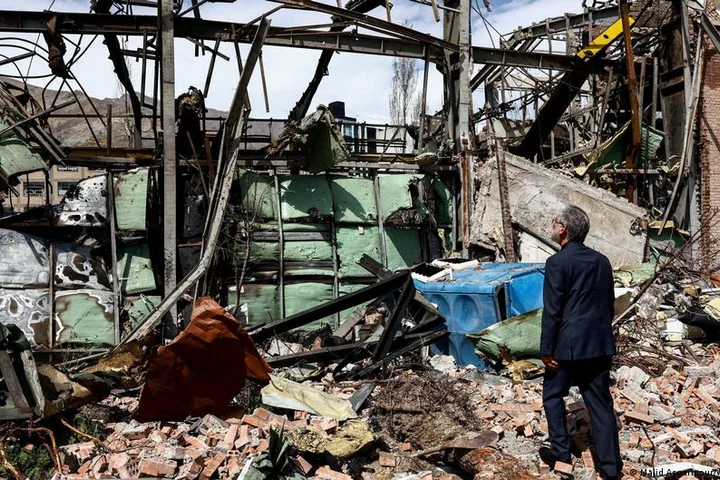
Several Gulf countries have also seen their oil infrastructure damaged by missile and drone strikes.
Other countries, such as Russia, are not able to increase production due to Western sanctions and damage caused by the war with Ukraine.
The Iran war sent oil prices climbing to almost $120 a barrel last month.
If the Strait of Hormuz remains blocked until mid-May, prices could climb to a record high of over $150, according to JPMorgan.
Oman, Iran hold talks on Strait of Hormuz
Officials from Iran and Oman have held a meeting to discuss options for ensuring safe passage of ships through the Strait of Hormuz , Oman's Foreign Ministry said Sunday.
Tehran has closed the key oil and gas chokepoint to most vessels in response to the US-Israeli bombing campaign , sending energy prices soaring.
The ministry statement said deputy foreign ministers and experts from the two countries had met to look at "a number of visions and proposals" to ensure "smooth transit" through the waterway.
The talks come ahead of a Monday deadline imposed by US President Donald Trump for Iran to reopen the strait or face "devastating consequences."
Oman has previously served as a mediator between the US and Iran .
Kuwait: 'Severe' damage as Iranian drones hit energy facilities, finance ministry
Iranian drones struck government and energy facilities in Kuwait , local authorities said Sunday.
"Kuwaiti Air Defenses are currently responding to hostile missile and drone threats," the country's military posted on X, noting that any explosions heard were the result of air defence interceptions.
A drone hit an oil facility operated by Kuwait Petroleum Corporation with no injuries reported, according to local media.
But the drone attacks did result in "severe" damage to a number of oil and petrochemical facilities, which had been "subjected to a heinous Iranian attack and targeting involving the use of drones," the state-owned Kuwait Petroleum Corporation said.
It added that the attacks caused fires at several of those facilities.
Another Iranian drone caused "significant" damage to a building belonging to the Finance Ministry, the state news agency KUNA reported.
There were also no reports of injuries.
In response to US-Israeli strikes, Iran has targeted Kuwait and other Gulf countries hosting US military forces .
What else do we know about the US operation to rescue the missing airman?
More details are starting to emerge about the complex search and rescue mission to extract the US airman stranded in Iran after his jet was shot down.
Here's what else we've learned:
Israeli strike kills family of 6 in southern Lebanon: reports
Six people from one family have been killed in an Israeli attack in the southern Lebanese town of Kfar Hatta, Lebanon 's state-run National News Agency (NNA) and AFP reported Sunday.
The Israeli military had earlier ordered the evacuation of the town.
A source from the Lebanese civil defense cited by AFP said the family had already been displaced and was waiting for a relative to pick them up so they could leave.
At least three other people were killed in another airstrike elsewhere in southern Lebanon on Sunday, NNA reported.
The information could not be independently verified.
Meanwhile, the Israeli military said it had carried out strikes on Hezbollah targets in the Lebanese capital, Beirut .
The Iran-backed militia lobbed rockets at northern Israel on Sunday and also said it had fired a cruise missile at an Israeli warship off the Lebanese coast.
In a statement, Hezbollah claimed the warship was "preparing to launch attacks on Lebanese territory."
There was no confirmation from Israel.
Lebanon was dragged into the war in the Middle East in early March when Hezbollah launched rockets at Israel following the killing of Iranian Supreme Leader Ayatollah Ali Khamenei in a US-Israeli attack.
Israel responded with airstrikes across Lebanon and a ground operation.
Lebanese President Joseph Aoun on Sunday reiterated a call for negotiations with Israel to avoid the same level of destruction in his country's south as seen in Gaza.
Egypt holds talks with US and regional counterparts
Egypt's foreign minister has held separate phone calls with US envoy Steve Witkoff and Iranian Foreign Minister Abbas Aragchi to discuss proposals for deescalating the US-Israel war with Iran .
In a statement Sunday, the Egyptian Foreign Ministry said top diplomat Badr Abdelatty also spoke with his Turkish and Pakistani counterparts, who are helping to mediate between the US and Iran.
The ministry said he discussed "ideas and proposals to achieve the required calm" and warned of an "unprecedented explosion" in the Middle East.
The phone calls come as US President Donald Trump 's Monday deadline for Tehran to reopen the Strait of Hormuz approaches.
Trump has threatened that "hell will reign down" on Iran if the crucial waterway remains closed.
Debris sparks fires at UAE petrochemicals plant
Operations have been suspended at the Borouge petrochemical plant in the United Arab Emirates after multiple fires broke out following attacks on Sunday, authorities said.
According to the Gulf emirate's media office, the blazes were caused by "falling debris following successful interceptions by air defense systems."
It said no injuries had been reported and that production would be halted while damage at the facility was assessed.
The plant, located near the UAE's western border with Saudi Arabia, is a joint venture of the Abu Dhabi National Oil Co.
and Borealis of Australia.
Earlier Sunday, the UAE's Defense Ministry said it was responding to missile and drone attacks from Iran.
Tehran has repeatedly targeted the UAE , a close US ally, with retaliatory attacks since the US and Israel began striking Iran in late February.
Iran claims it brought down 'enemy aircraft' during US rescue mission
Iran 's Revolutionary Guards have said US and Israeli aircraft were destroyed during a search and rescue mission to find a missing American airman on Iranian territory, the official Tasnim news agency reported.
"During a joint operation (Aerospace, Ground Force, Popular Units, Basij and Police command), enemy aircraft were destroyed," the group said, according to Tasnim.
Earlier, Iran's police command announced an American C-130 aircraft had been downed in the south of Isfahan province.
The spokesperson of Khatam al-Anbiya Central Headquarters, Iran’s central military command, said the downed aircraft also included two Black Hawk helicopters, Tasnim reported.
Iran's army also claimed it had shot down an Israeli drone in the same province.
US President Donald Trump announced the rescue of the stranded airman on Sunday morning, saying he was injured but "will be just fine." He was the second crew member of an F-15 jet that was downed in Iran on Friday.
Search for the missing US airman shot down in Iran — a timeline
The United States says a crew member whose F-15E fighter jet was shot down by Iran has been rescued.
Here is a recap of how the search and rescue operation unfolded:
WATCH: What's the common thread in Israel's wars in Iran and Lebanon?
Israel has been carrying out strikes across Lebanon since the start of its joint operation with the US against Iran.
Israel says it is targeting the Iran-backed Hezbollah militant group, which has a stronghold in Beirut's southern suburbs, where the Israeli military struck Hezbollah infrasture on Saturday.
Lebanon was pulled into the conflict in the Middle East on March 2 when Hezbollah — which functions as a proxy of Tehran, its largest benefactor — launched attacks on Israel in response to the US-Israel strikes on Iran.
Related Stories



Source: This article was originally published by Deutsche Welle (DW)
Read Full Original Article →
Comments (0)
No comments yet. Be the first to comment!
Leave a Comment