
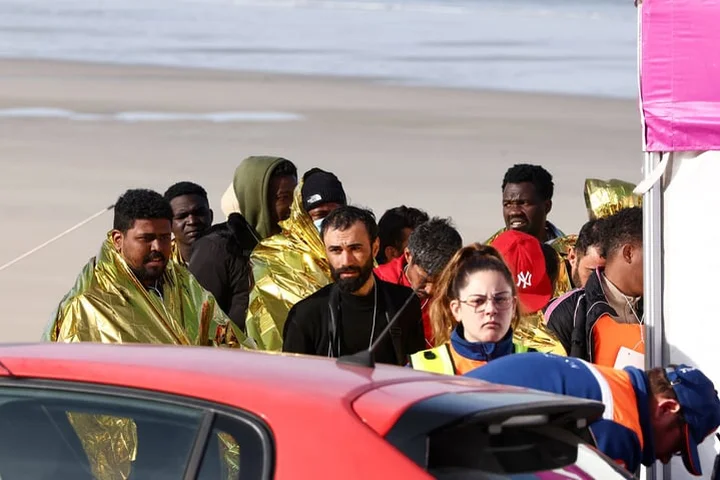
Two women and two men have died after a small boat sank in the English Channel on Thursday, French authorities have confirmed.
The victims were swept away by strong currents having tried to board a dinghy, a French government official said.
At least 42 others were rescued in the incident off the coast of Boulogne,
Search and rescue operations were taking place after the vessel capsized off a French beach.
Emergency vehicles rushed to Equihen beach in the Pas de Calais at about 7.30am on Thursday.
Bodies were recovered from the sea near Ecault beach.
Francois-Xavier Lauch, prefect of Pas-de-Calais, said: "We sadly have to report four deaths this morning.
"The people who died were attempting to board a taxi-boat.
"I have to commend the actions of our officers and firefighters who, as you know, are deployed every day to stop these crossings."
Mr Lauch said emergency services rescued at least 42 people during the course of the incident.
Speaking of the four people who died, he said: "They were already quite far into the sea.
"The currents, which can be dangerous here, swept them away.
"This provisional toll, and I insist that it is provisional, states four deceased: two men, two women."
One person also suffered hypothermia, and another 37 other people are currently being treated by emergency services.
A number of other small boats were at sea and being monitored by French authorities, including a military helicopter, Mr Lauch added.
"The responsibility lies with the smugglers," he stressed.
The French authorities, though, have been accused of failing to do enough to stop the crossings.
Around thirty migrants were being cared for by emergency services in mobile intensive care units set up on Equihen beach, according to the Voix du Nord.
The local mayor Christian Fourcroy was at the scene of the tragedy which happened at around 7am off the Saint-Etienne-au-Mont beach.
“There was a failed departure (by a small boat),” he said.
The body of a teenager, believed to have fallen from a “small boat” seeking to cross the Channel, was discovered on the beach last September, highlighting the dangers migrants face when they are forced into overcrowded, unseaworthy vessels as they seek to reach Britain.
Two people died on April 1 in another “small boat” tragedy off the beach near Gravelines, near Calais, the first fatalities of the year in the Channel crossings.
Four people die attempting to cross English Channel in small boat
Celine Dion announces six extra dates for Paris comeback concerts
Kanye West antisemitism storm: Wireless Festival axed as US rapper denied entry to UK
Rediscover your adventurous side on an exotic getaway
Six other migrants were rescued, with one of them rushed to hospital for further care.
More than 100 migrants are believed to have crossed the Channel on Wednesday, with numbers expected to rise as the weather calms in months ahead.
In London, a Government spokesman said: “We are deeply saddened to hear about the deaths in French waters today.
“Every death in the Channel is a tragedy and a stark reminder of the dangers posed by criminal gangs exploiting vulnerable people for profit.
“We will continue working relentlessly with the French and our partners overseas to prevent these perilous journeys.”
He added: “The French authorities are leading the response to this incident and we are supporting their investigation."
In the past year, traffickers have taken to motoring dinghies along stretches of the northern French and Belgian coasts picking migrants up along the shore.
Authorities refer to them as 'taxi-boats'.
About 41,500 people crossed the Channel last year.
Last month, UK and French authorities failed to agree a new beach patrol deal aimed at reducing the number of departures.
Foreign Secretary Yvette Cooper, on the media round for the Government, was asked about the French government refusing to allow British Border Force vessels to be deployed to stop “small boat” crossings.
“The co-operation that we have in place so far has prevented tens of thousands of people making these illegal crossings but we also have negotiations underway at the moment in order to strengthen that.
“We’ve just had come into force the new counter terrorism powers to use against people smugglers and against these criminal gangs that are organizing these boat crossings in the first place.”
Related Stories


Source: This article was originally published by Evening Standard
Read Full Original Article →
Comments (0)
No comments yet. Be the first to comment!
Leave a Comment