
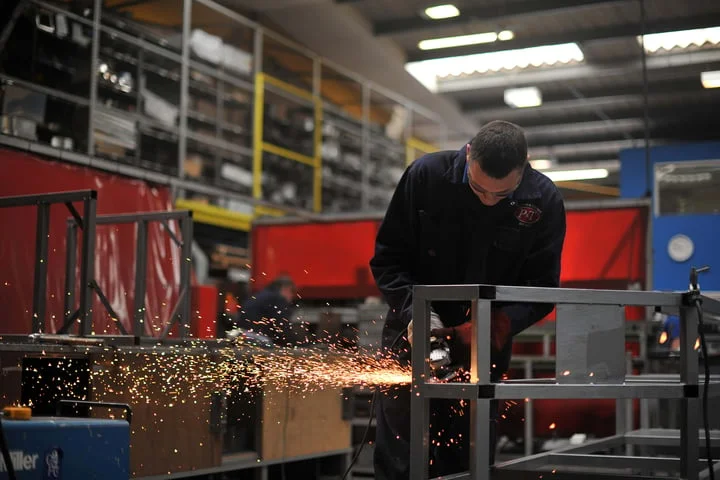
The UK economy grew by a “bumper” 0.5% in February, official figures reveal.
The latest GDP figure from the Office for National Statistics showed an unexpected boost to growth before Donald Trump launched his Iran war.
The City had expected a far more modest 0.1% increase in GDP.
Amid the economic turmoil from the Iran war, the Bank of England was "not going to rush to judgements" on interest rate rises, Governor Andrew Bailey told BBC News.
Mr Bailey, in Washington for the International Monetary Fund's spring meetings, said higher oil and gas prices would certainly feed through to prices, but that other factors made a decision on rates "very, very difficult".
He added: "There's really difficult judgements to be made.
"We're not going to rush to judgements on those things, because there are a lot of uncertainties around this, not just how it's going to play out, but also how it's going to pass through into the UK economy."
On the latest growth figures, Ruth Gregory, Deputy Chief UK Economist at Capital Economics, said: “GDP rose by a bumper 0.5% in February but March’s activity PMIs suggest the war in Iran has already all-but extinguished growth.
“And in our baseline scenario we think GDP growth will slow from 1.4% in 2025, perhaps to just 0.7% this year.”
She added: “The 0.5% rise in real GDP was far stronger than both the consensus forecast of a 0.1% rise and our forecast of a 0.2% gain.”
She stressed there was “strength across the board,” in economic growth, including in the giant services sector, construction and industrial production.
Responding to the upbeat news, Chief Secretary to the Treasury James Murray said: “Growth only happens when the economy is on solid ground.
“That's why in a changing world our plan to restore stability, boost investment and deliver reform is the right one to build a more stronger more resilient Britain.”
He added: “At the IMF meetings in Washington the Chancellor has set out how we will go further and faster to boost Britain’s competitiveness and build a stronger, more resilient economy, keeping costs down for families and businesses and taking back control of our energy costs as today we cut bills by up to 25% for 10,000 British businesses.”
Tesco says Iran conflict increasing uncertainty over profit outlook
France prepares for terror attack hitting London amid Trump Iran war tensions
Protesters confront riot police following suspected gang rape in Epsom
Choose the right education path for your child
However, the Government is braced for the economy to be hit by Donald Trump ’s Iran war which Chancellor Rachel Reeves has branded a “folly”.
She has accused the US president of launching the conflict with no exit plan and with no clear war aims.
Millions of people in the UK are now facing higher energy bills, mortgage rates have risen, and petrol and diesel prices are up.
Just days ago, the International Monetary Fund warned that the UK would be the most impacted by the war among G7 nations, which are the US, Britain, Germany, France, Italy, Japan and Canada.
The IMF predicted miserly growth in the UK of just 0.8% this year, down sharply from the 1.3% predicted in January.
In Washington, Ms Reeves has expanded plans to cut electricity bills for thousands of UK manufacturing firms as she continues talks in focused on the economic fallout from the Iran conflict.
The Chancellor, who is in Washington for the International Monetary Fund (IMF) spring meetings, said the plan will help UK businesses compete and create jobs despite the uncertain economic backdrop.
Ministers have been planning for the conflict to threaten to lead to shortages in the food industry in the UK, due to a possible lack of CO2 which is crucial to preserve products.
“At this moment, this is not a concern for our economy,” Business Secretary Peter Kyle told Sky News, stressing that the contingency planning had been under way for weeks.
“I can tell you, because I’m in these meetings, the Prime Minister has been there since the very start, and he is going through personally and driving deep dives into lots of areas of resilience throughout our economy,” he added.
Mr Kyle pointed to his own decision near the start of the conflict to reverse the mothballing of the Ensus bio-ethanol plant in Teesside to secure supplies of carbon dioxide.
He added: “People should be reassured that we are doing this kind of action behind the scenes to keep resilience in our economy, so that when the full extent of what may or may not emerge, because this situation is still unfolding in the Middle East, you have a Government that is acting with creativity and boldness.”
Related Stories



Source: This article was originally published by Evening Standard
Read Full Original Article →
Comments (0)
No comments yet. Be the first to comment!
Leave a Comment