
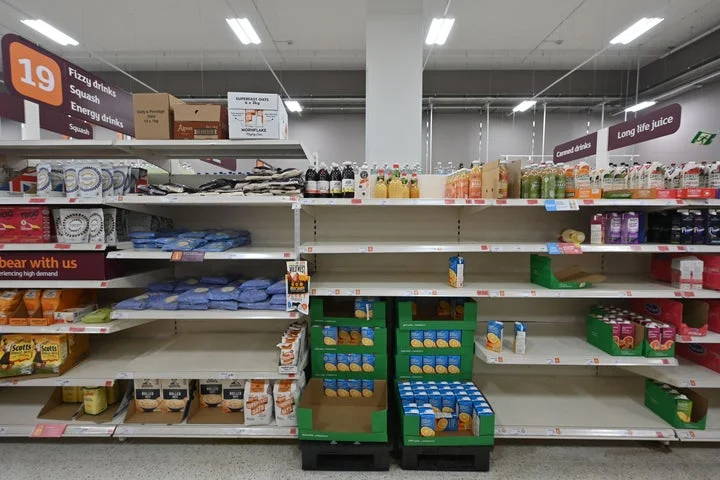
The business secretary said the public should be ‘reassured’ that ministers are making contingency plans for the impact of the Iran war
The UK could see shortages of key supermarket goods this summer if the Iran war continues, a leaked government document has revealed.
Officials have put together contingency plans for a “reasonable worst-case scenario”, highlighting that the closure of the crucial Strait of Hormuz shipping route could lead to carbon dioxide shortages.
The secret analysis – first reported by The Times – was codenamed “Exercise Turnstone” and was run by the government’s emergency committee, Cobra.
It showed that No 10, the Treasury, and the Ministry of Defence were all involved in rehearsing scenarios looking at the impact of the Iran war on British industry.
The “reasonable worst-case scenario” was based on the assumption that the Strait of Hormuz had not been reopened and no peace deal had been reached .
It warned supplies of CO2 could fall to just 18 per cent of current levels – a warning that was based on a key UK plant suffering a mechanical error, and high gas costs leading to a fall in production across Europe of ammonia and fertiliser, which make CO2 as a by-product.
It is thought that farming and hospitality would be the two worst-hit industries, because CO2 is used to prolong the shelf life of foods, including salad, packaged meats, and baked goods.
CO2 is also used in the process of slaughtering pigs and chickens, a sector that is not thought to have much in the way of stockpiled supplies.
Breweries could also be hit by shortages because of CO2’s use in making drinks fizzy, sparking concerns that shortages could disrupt the Fifa World Cup, which starts in June.
But a government spokesperson said that reasonable worst-case scenarios are “a planning tool used by experts and are not a prediction of future events”.
Asked about the leak, the business secretary said the public should be “reassured” that ministers are making contingency plans for the impact of the Iran war.
“It is difficult for me, because, of course, these leaks are very unhelpful,” Peter Kyle said.
“But when people do read it, they need to be reassured that we are doing this kind of planning, and we are doing this kind of scenario planning.
“Bear in mind that back in Covid, Boris Johnson missed five Cobra meetings in the lead-up to it.
“I can tell you, because I’m in these meetings, the prime minister has been there since the very start, and he is going through personally and driving deep dives into lots of areas of resilience throughout our economy.”
Mr Kyle pointed to his own decision near the start of the conflict to reverse the mothballing of the Ensus bioethanol plant in Teesside to secure supplies of carbon dioxide.
He added: “People should be reassured that we are doing this kind of action behind the scenes to keep resilience in our economy, so that when the full extent of what may or may not emerge, because this situation is still unfolding in the Middle East, you have a government that is acting with creativity and boldness.”
Mr Kyle also insisted that supplies of carbon dioxide are “not a concern” for the UK.
Asked about the availability of CO2 in the country, he told Sky News: “If any of these things change, I will be up front with the public about it in advance so that we can prepare.
But right now, people should go on as they are, enjoying beer, enjoying their meats, enjoying all the salads.
“But also, there are critical uses for CO2: MRI scanning, for example, water purification; it’s involved in our nuclear industry, our civil nuclear power industry, some defensive uses for it as well.
“There’s lots of needs for CO2, so these are the reasons why I took it so seriously way back to six months ago, not just in the last few weeks.”
To prevent the “reasonable worst-case scenario” from unfolding, The Times reported, ministers have drawn up plans to ask factories to increase CO2 production to 100 per cent by ceasing other manufacturing.
They have also discussed emergency legislation to compel the factories to cooperate, which could be passed in just a few days of parliamentary time, as well as relaxing competition law to allow the prioritisation of more limited CO2 supplies to key areas, including healthcare.
A government spokesperson said: “We took decisive action last month to shore up the UK’s critical supplies of CO2 by temporarily restarting the Ensus bioethanol plant in Teesside and are continuing to work closely with business groups to tackle the impacts of events in the Middle East.
“Reasonable worst-case scenarios are a planning tool used by experts and are not a prediction of future events.”
Join thought-provoking conversations, follow other Independent readers and see their replies
Related Stories


Source: This article was originally published by The Independent
Read Full Original Article →
Comments (0)
No comments yet. Be the first to comment!
Leave a Comment