
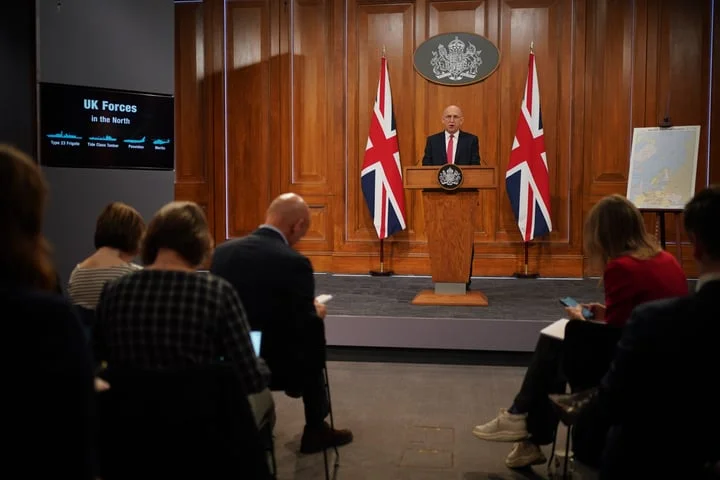
The UK and allies tracked a Russian attack submarine and two spy submarines loitering over undersea cables in the North Atlantic for a month before they retreated, John Healey has revealed.
Addressing Russian President Vladimir Putin , the Defence Secretary said: “We see your activity over our cables and our pipelines, and you should know that any attempt to damage them will not be tolerated and will have serious consequences.”
Mr Healey told a press conference in Downing Street on Thursday that in the past few weeks – while many eyes were trained on the Middle East crisis – the UK, in partnership with Norway and other allies, responded to “increased Russian activity” in the Atlantic north of the UK.
This involved a Russian Akula-class nuclear-powered attack submarine and two specialist submarines from Russia’s ministry of defence deep sea research programme known as Gugi (Main Directorate of Deep-Sea Research), he said.
Mr Healey said: “In response to the Russian submarines, I can confirm that I deployed our armed forces to track and to deter any malign activity by these vessels.
“A Royal Navy warship and Royal Air Force P8 aircraft alongside allies ensured that the Russian submarines were monitored 24/7.
“Our armed forces left them in no doubt that they were being monitored, that their movements were not covert, as President Putin planned, and that their attempted secret operation had been exposed.
“Those Gugi submarines have now left UK waters and headed back north.”
He said the month-long operation had now concluded.
The senior minister said the attack submarine acted as “a likely decoy to distract us from the Gugi submarines as they “spent time over critical infrastructure relevant to us and our allies in the North Atlantic”.
He continued: “Because we were watching them, we wanted to ensure that we could warn them that their covert operation had been exposed and reduce the risk that they may attempt any action that could damage our pipelines or our cables.
“And I’m confident, we have no evidence that there has been any damage, but with allies, were sure that this is now verifiable.”
Related Stories


Source: This article was originally published by Evening Standard
Read Full Original Article →
Comments (0)
No comments yet. Be the first to comment!
Leave a Comment