
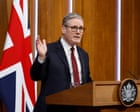
Keir Starmeris speaking at his press conference.
The war is entering its third week, he says.
He says he has been clear in his objectives.
double quotation markFirst, we will protect our people in the region.
Second, while taking the necessary action to defend ourselves and our allies, we will not be drawn into the wider war.
And third, we will keep working towards a swift resolution that brings security and stability back to the region and stops the Iranian threat to its neighbours.
Robert Booth is the Guardian’s UK technology editor.
Reform UK will turn Britain’s coastline into one of the most surveilled in the world using AI and satellite technology in a bid to halt illegal migration, the party’s home affairs spokesman,Zia Yusuf, has said.
Nigel Farage’s party has been briefed on a range of technologies to surveil maritime borders and has been examining the examples of Kuwait and Australia, Yusuf told the Guardian at a tech policy event in London.
Kuwait this year began usingdriverless boatscalled the Needlefish which reach speeds of 40mph and can stream surveillance information from cameras and radar back to shore.
Australia is also using unmanned vessels for coastal surveillance.
The Home Office previously contracted with the US AI weapons company Anduril to provide a handful of several AI-enabled maritime sentry towers in the south-east of England that algorithmically identify and track individuals or vessels of interest.
Anduril supplies similar towers to the US border with Mexico.
Yusuf said it was it was “beyond insane” that small boat crossings were not all detected.
He said:
double quotation markIf Reform wins the next general election and Nigel Farage is prime minister, Britain’s maritime borders will be among the most surveilled borders in the world …
It will be a focus for us to ensure that you should not be able to land on our shores on a boat and ...
evade any form of detection.
He said a Reform government could bolt AI tools onto radar systems to help coastguards and immigration officials detect suspicious activity.
double quotation markThere’s some novel technologies around using satellites that are very useful.
If you are using things like radar, [the AI is] trying to work out what is a dinghy with 90 people on it.
That technology does exist.
It’s not being deployed in any meaningful way at the moment.
Yusuf said Reform would make a more detailed announcement in the coming weeks.
The surveillance plans come amid the rising use of AI powered facial recognition technology by police forces and private retailers to prevent shoplifting.
Peter Walker is the Guardian’s senior political correspondent.
All Britons should do their best to pay the minimum tax they possibly can,Richard Tice, Reform UK’s deputy leader has argued, as he dismissed a newspaper investigation over his own tax affairs as a “smear”.
Tice, who was presenting a press conference todaytabout Reform’s claims to have saved large amounts of money in the English councils it runs, faced questions abouta Sunday Times storywhich detailed of a tax scheme the paper said had helped him avoid nearly £600,000 in corporation tax.
According to the paper, Tice’s property company used a rare legal status known as a real estate investment trust, or Reit, to mean it paid no corporation tax between 2018 and 2021.Labourhas urged HMRC to investigate the arrangements.
Asked whether he was right to minimise his tax payments in such a way, Tice told reporters that he rejected the idea people should “pay the absolute maximum tax possible”.
Asked if he would thus encourage everyone in the UK to pay as little tax as possible, if it was within legal limits, Tice replied: “Yes, of course, that’s what you should do.”
Tice also used a tweet by the Sunday Times journalist, Gabriel Pogrund, about the story, which confirmed that Tice had paid the necessary tax under the terms of the scheme, to claim the story about him had been misleading.
“Given that was his conclusion by the end of the afternoon, maybe he was just trying to smear me,” Tice said.
In fact,Pogrund’s tweethad re-stated what the story set out: that while Tice did not appear to have broken any laws or criminally underpaid tax, his use of a Reit scheme for his property company was a complex and unusual way to minimise tax.
Tice sought to characterise the story as an attempt by the media to argue that everyone had to pay the maximum tax possible.
He said:
double quotation markWe have entered a new a new world where there is a moral imperative now in the United Kingdom that you shouldn’t just pay tax as required …
You must pay the maximum personal income tax rate on everything – that is a mad situation to be in.
We have to call it out.
How many friends and family do you have who voluntarily choose to pay more tax than they are legally obliged to do, or who voluntarily decide, actually I’m going to pay the absolute maximum I can?
Tice argued that this “new moral code” would lead to people leaving the UK in large numbers.
Torsten Bell, a Treasury minister, has criticised Tice for “aggressive tax avoidance”.
In posts on social media yesterday, prompted by the Tory peerDaniel Hannanclaiming that what Tice did wasequivalent to putting money in an ISA,Bellsaid:
double quotation markIdea that what Tice was doing was remotely like opening an ISA is mad.
His was VERY unusual behaviour associated with aggressive tax planning :
- UK resident using an offshore trust
- he claimed REIT status for a firm that never met the tests (because he owned it personally)
double quotation markThe contrast is clear:
- Parliament legislated specifically FOR people to be able to open ISAs.
- Parliament has legislated specifically AGAINST people engaging in aggressive tax avoidance like this (ie the General Anti-Abuse Rule)
double quotation markIt’s for Richard Tice & HMRC to conclude on the specific legal position here.
But it’s already clear this was someone doing absolutely everything to avoid paying the tax that ordinary people contribute week in week out.
Oh, and he was meant to be a public servant at the time.
Kemi Badenochhas accusedKeir Starmerof not being fully involved in the US plan to reopen the strait of Hormuz.
She told the Press Association this morning:
double quotation markWe have believed in freedom of navigation as a country for centuries, even this government has had targeted strikes at the Houthis in the Strait of Hormuz.
But what is the plan?
We need to see the plan.
It is not clear the prime minister has been involved in the planning process.
All of our allies seem to be worried about how slow he is.
I’m worried that he’s not deep enough in conversations with the US.
But before we start sending ships out, we need to know what the plan is.
This comment implies that the US actually has a plan that Starmer should be more fully engaged with to get oil flowing past the strait of Hormuz.
In fact, the evidence implies no such plan exists.
In the US it has been reported that Trump and his teamdid not fully appreciate the risk of the strait being closed.
As well as the money (see12.27pm), the government is also announcing plans to toughen regulation in the heating oil market to help consumers.
This is how theTreasuryexplains it inits news release.
double quotation markHeating oil is different from other sectors in the energy market as it does not have the same consumer protections and is not regulated by Ofgem.
The government intends to introduce new consumer protections for heating oil customers and is rapidly exploring new ways to step in and ensure households are better protected.
-An agreement secured with industry on a strengthened code of practice to rapidly provide enhanced protections to customers, including greater flexibility on delivery volumes and improving price transparency and formalising a priority customers register – meaning all customers who are vulnerable are eligible for prioritised support in times of disruption.
-Introducing stronger consumer protections in the heating oil market, which could cover dispute resolution, a greater variety of repayment options for those facing hardship, greater price transparency and enhanced protections for vulnerable groups such as the elderly.
-Supporting the Competition and Markets Authority’s plans to carry out a more comprehensive examination of the UK’s heating oil industry.
-Exploring the creation of a new ombudsman or appointment of a regulator, such as Ofgem, to champion consumers, and taking powers to do so through the energy independence bill.
-Working with the Northern Ireland executive to ensure that protections are fit for purpose for Northern Irish households, who are particularly reliant on heating oil.
In addition, the chancellor earlier this week wrote to the Competition and Markets Authority (CMA) to ask that it remains vigilant across heating oil prices and supports CMA action to tackle unjustified price increases.
This fleshes out what Keir Starmer was saying at his press conference.
See10.49am.
Here is theTreasury news releasewith details of the £53m heating oil support package (see10.49am) announced by Keir Starmer this morning.
This is what it says about how the £53m will be distributed.
double quotation markThe chancellor is announcing over £50m of targeted financial support, helping low-income households in rural communities who have no choice but to top up their tanks at a time when prices have risen so significantly.
In England, funding will be distributed by local authorities via the Crisis and Resilience Fund (CRF), which comes into effect from 1 April, targeted areas with higher rates of oil heating.
This is a particular issue in Northern Ireland, where a greater proportion of homes rely on heating oil, and we have allocated £17m to support them.
England will receive £27m, Scotland £4.6m and Wales £3.8m.
This funding has been allocated based on census data, reflecting where the greatest need is, and it will be allocated directly to the devolved governments, with the expectation that it will be used to support vulnerable households.
Q: [From George Parker from the FT] When you spoke about not allowing firms to profit from high oil prices, were you implying that you might consider another, or a higher, windfall tax?
Starmersaid there was already a windfall tax in place on energy companies.
He did not comment on what might happen in the future.
Q: [From Millie Cook from the Independent] How concerned are you about Donald Trump’s comments about Nato.
Do you agree with Pat McFadden that this was just rhetoric?
[See8.57am.]
Starmersaid the proposal being discussed to reopen the strait of Hormuz would not be aNatomission.
It would be “an alliance of partner”, he said.
He repeated the point about how this would be “not straightforward”.
He did not comment explicitly on Trump threatening Nato.
But he did repeat his claim that he and Trump had a good conversation yesterday.
Q: [From Jason Groves from the Daily Mail] The Treasury gets a VAT windfall when petrol prices go up.
For every 5p it goes up, they get another 1p.
Shouldn’t they give that back?
And are you planning for petrol rationing?
Starmerignored the point about VAT on fuel, but said that fuel duty was frozen until September.
And he did not address the point about rationing either, beyond saying the government wanted to increase the UK’s energy independence.
Q: [From Mat Gay, who runs thequidsquid account on TikTok] What are you doing to help people with the cost of living?
Starmerrepeated many of the points he made in his opening comment.
But he also claimed that wages are going up more than they were in the first 10 years of the last government.
Q: [From Christopher Hope from GB News] On a scale of 1 to 10, how do you rank your relationship withDonald Trump?
Starmersaid it was “a good relationship”.
He had a “good discussion” with Trump yesterday, he claimed.
(See9.56am.) He went on:
double quotation markWe’re strong allies, have been for decades, but it is for me to act in what I consider to be the best interests of Britain.
And I have to keep that uppermost in my mind
And it is interesting, for want of a better word, that those that two weeks ago were urging us to go headlong into the full-blown war are beginning to have second thoughts about that, and there’s a reason for that.
Starmer said it was also important for GB News viewers to realise that, in the short term, their energy bills will go down, not up, because of the energy price cap.
Q: [From Andy Bell from 5 News] Are you worried that your relationship with President Trump is getting frayed, given you keep turning down his requests for help?
Starmerrepeated his point about how he wanted “as many partners as possible” involved in a plan to keep the strait of Hormuz open.
He said:
double quotation markI discussed it with President Trump yesterday, in the way that you would expect between two allies.
But no decisions have been taken yet, he said.
Q: [Rigby’s second question] Last week we learned that Jonathan Powell, your national security adviser, thought the Mandelson appointment was rushed.
But you told MPs due process was followed.
Did you mislead parliament?
Starmerreplied: “No.” He said Sir Laurie Magnus, his ethics adviser, looked at this question last week (in response to a complaint from the Tories) andconcluded that the proper process was followed.
Starmer repeated his earlier point about the process being flawed.
(See11.08am.)
Related Stories



Source: This article was originally published by The Guardian
Read Full Original Article →
Comments (0)
No comments yet. Be the first to comment!
Leave a Comment