
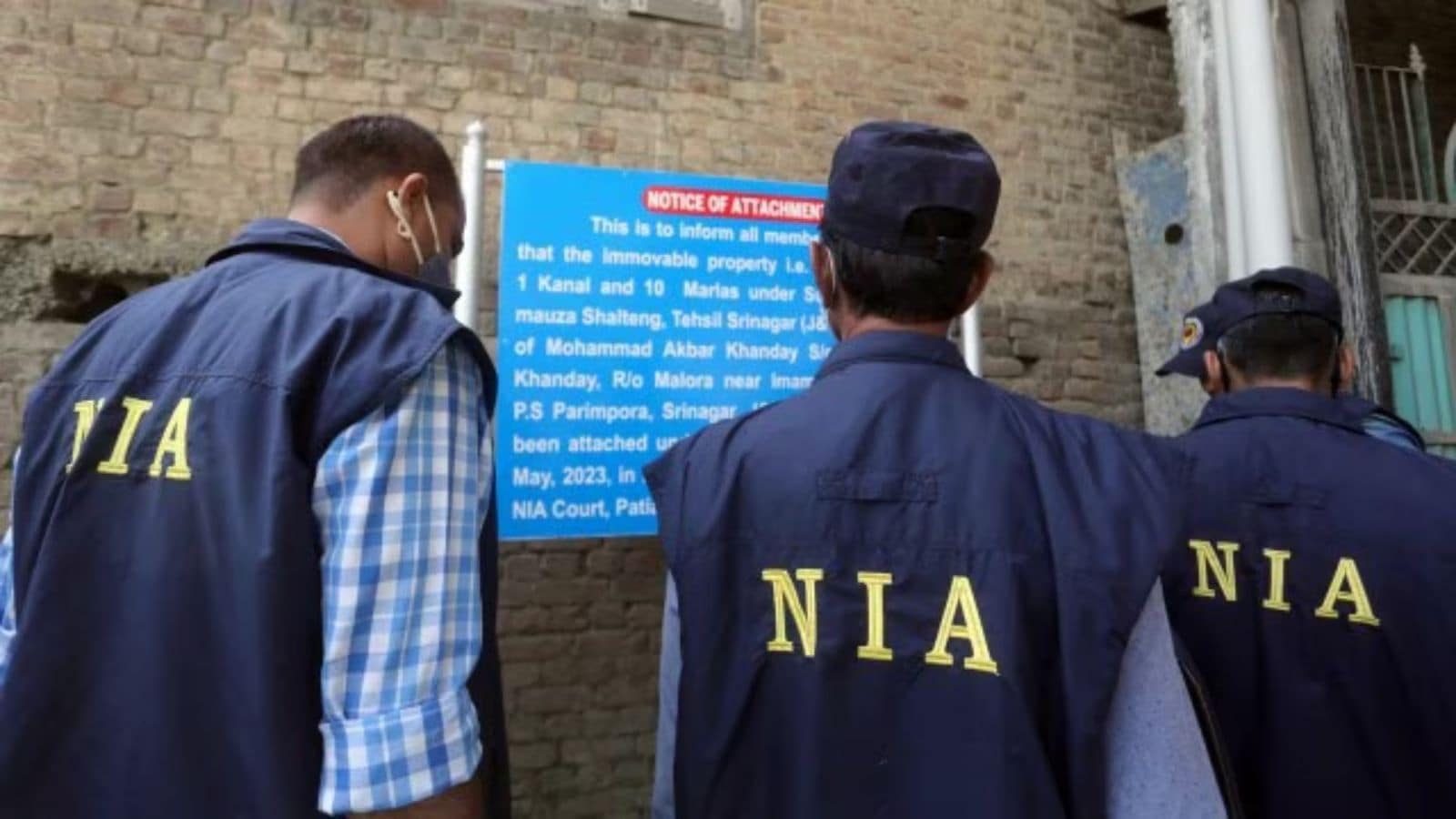
Six Ukrainians and an American have been remanded in NIA custody until March 27 to unearth the alleged conspiracy.
Why did the men travel to Assam, Mizoram, and Myanmar?
Where did the alleged drones come from, and for whom were they meant?
In an extraordinary operation on Friday (March 13), law enforcement agencies arrested seven foreign nationals — six Ukrainian nationals and one from the United States — at three airports in the country on charges of conspiring to carry out terrorist activities against India.
A United States national was detained by the Bureau of Immigration at Kolkata airport, and three Ukrainians each were detained at airports in Lucknow and Delhi .
The National Investigation Agency (NIA), the country’s top anti-terrorism agency, registered an FIR that same day.
An extended remand until March 27 was granted on Monday by a Patiala House court in Delhi, and the seven arrested persons are currently in the NIA’s custody.
This is what is known about the arrests so far.
Who are these seven individuals?
According to documents submitted by the NIA in court, the US national has been identified as Matthew Aaron Van Dyke.
The six Ukrainians have been identified as Hurba Petro, Slyviak Taras, Ivan Sukmanovskyi, Stefankiv Marian, Honcharuk Maksim, and Kaminskyi Viktor.
According to the FIR registered by the NIA on March 13, 14 Ukrainians had entered India on tourist visas on separate dates, and had flown to Guwahati .
The six Ukrainians who have been arrested appear to be part of this group of 14.
It is not immediately clear where the American who has been arrested fits into the Ukrainian group.
From Guwahati, the Ukrainians had allegedly travelled to Mizoram without the requisite document, that is the Restricted Area Permit (RAP), also known as Protected Area Permit (PAP).
They had then allegedly crossed the border illegally into Myanmar with the intention of carrying out a “pre-scheduled training for Myanmar-based Ethnic Armed Groups (EAGs)”, the NIA has said in its FIR.
These EAGs, according to the NIA, are known to support insurgent organisations operating in India in the domain of “drone warfare, drone operations, assembly and jamming technology etc., targeting the Myanmar Junta”.
The seven men were arrested in a coordinated operation by multiple NIA teams.
They have been accused under Section 18 (punishment for being part of a terrorist conspiracy) of the Unlawful Activities (Prevention) Act (UAPA), along with sections.
All the suspects were produced before the Duty Magistrate on Saturday, and were remanded in three days’ custody of the NIA.
In these three days, the accused persons were questioned thoroughly, The Indian Express has learnt.
The accused were produced again in court for extension of the NIA’s custody.
What has the investigation found so far?
According to sources, the NIA’s investigation has found evidence that suggest that multiple consignments of drones from Europe were delivered by the accused persons to individuals and groups in Mizoram.
The NIA submitted before the court that the accused persons have disclosed during interrogation that they were in “direct touch and abetted in their terrorist illegal activities by unknown terrorists carrying AK47 Rifles”.
The NIA has also claimed that the questioning of the accused persons has confirmed that they had travelled to Mizoram without requisite documents and entered Myanmar illegally.
They had “conducted training for EAGs on more than one, in addition to illegally importing huge consignments of drones from Europe to Myanmar via India for the use of EAGs”, the NIA said.
These groups were known to be supporting some proscribed Indian Insurgent Groups “by way of supplying weapons and other terrorist hardware and training them”, the NIA claimed.
What does the NIA expect to achieve through further custody of the accused persons?
The NIA has told the court in its remand papers that it needs the custody of the accused persons “to collect more evidence to unearth the overall conspiracy of the present case hatched by the accused persons and their accomplices”.
It has said that it wants to “unearth the route opted” by the accused persons to illegally enter into Myanmar, and to “apprehend the close unknown associates still at large who are likely to surface after technical analysis of the data/social media accounts being extracted and examined”.
The NIA has also submitted that the seized mobile phones of the accused persons were being sent to CERT-IN for data extraction and analysis.
This, it said, was needed to “find out the true facts” of the conspiracy and to “unearth the mastermind” along with the source of funding.
Several important disclosures were made about how the conspiracy was executed during the NIA’s remand, The Indian Express has learnt.
The NIA was represented before Additional Sessions Judge Prashant Sharma of Patiala House Court, where the case is being argued by Special Public Prosecutor Rahul Tyagi, Public Prosecutor Anil Dabas, and advocates Jatin and Amit Rohilla.
Nirbhay Thakur is a Senior Correspondent with The Indian Express who primarily covers district courts in Delhi and has reported on the trials of many high-profile cases since 2023.
Professional Background
Education: Nirbhay is an economics graduate from Delhi University.
Beats: His reporting spans the trial courts, and he occasionally interviews ambassadors and has a keen interest in doing data stories.
Specializations: He has a specific interest in data stories related to courts.
Core Strength: Nirbhay is known for tracking long-running legal sagas and providing meticulous updates on high-profile criminal trials.
Recent notable articles
In 2025, he has written long form articles and two investigations.
Along with breaking many court stories, he has also done various exclusive stories.
1) A long form on Surender Koli, accused in the Nithari serial killings of 2006.
He was acquitted after spending 2 decades in jail.
was a branded man.
Deemed the “cannibal" who allegedly lured children to his employer’s house in Noida, murdered them, and “ate their flesh” – his actions cited were cited as evidence of human depravity at its worst.
However, the SC acquitted him finding various lapses in the investigation.
The Indian Express spoke to his lawyers and traced the 2 decades journey.
2) For decades, the Jawaharlal Nehru University (JNU) has been at the forefront of the Government’s national rankings, placed at No.
2 over the past two years alone.
It has also been the crucible of campus activism, its protests often spilling into national debates, its student leaders going on to become the faces and voices of political parties of all hues and thoughts.
The Indian Express looked at all court cases spanning over two decades and did an investigation.
3) Investigation on the 700 Delhi riots cases.
The Indian Express found that in 17 of 93 acquittals (which amounted to 85% of the decided cases) in Delhi riots cases, courts red-flag ‘fabricated’ evidence and pulled up the police.
Signature Style
Nirbhay’s writing is characterized by its procedural depth.
He excels at summarizing 400-page chargesheets and complex court orders into digestible news for the general public.
X (Twitter): @Nirbhaya99 ...
Read More
Stay updated with the latest - Click here to follow us on Instagram
Related Stories
Source: This article was originally published by The Indian Express
Read Full Original Article →
Comments (0)
No comments yet. Be the first to comment!
Leave a Comment