
Linda Nordling is a freelance journalist in Cape Town, South Africa.
Search author on: PubMed Google Scholar
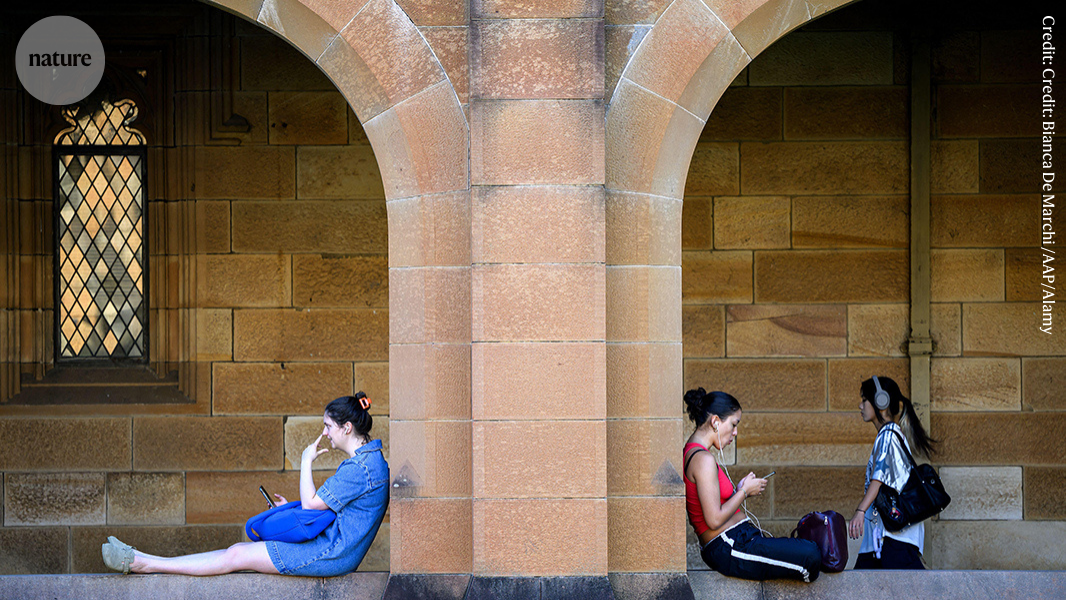
An increase in the price of an Australian visa might make it more difficult for graduates to stay in the nation after they complete their degree.
Credit: Bianca De Marchi /AAP/Alamy University and postgraduate groups in Australia are urging their government to exempt PhD graduates from the surprise doubling of a key visa fee, warning that the price increase will drive international research talent away.
The visa allows international students who have graduated from Australian universities less than six months previously to remain in the nation for a few years (usually two or three depending on the type of qualification they receive) after completing their degrees.
It lets graduates either continue their studies or find work and can serve as a bridge for those transitioning from PhD programmes to postdoctoral positions or into other research careers.
Australia must boost R&D investment to reclaim global research standing
In 2023, international candidates made up 40% of all PhD enrolments in Australia, compared with an average of 25% in 2022 across Organisation for Economic Co-operation and Development (OECD) nations.
The visa fee hike could add to other pressures that universities face when recruiting research talent, such as a lack of funding available for PhD stipends — which often sit close to the poverty line — and a cap on university spending that limits the proportion of doctoral funding that can be offered to international students to 10%.
One international PhD student at an Australian university, who asked not to be identified owing to concerns about future visa applications, told Nature that the increased fees might affect the pipeline of postdocs into Australian research.
“Universities will potentially lose some often-exceptional candidates that can’t afford to put that much money upfront, way before they start getting paid,” he said.
The visa fee increase is the latest in a series of tightened immigration measures flowing from a migration strategy launched by the Australian government in December 2023.
The strategy aimed to fix what it described as a “broken” migration system, tackling serial ‘visa hopping’, a tactic that enabled visitors to stay in the nation for a long time by moving between visa types.
The measures also seek to protect Australia’s higher-education system from “unscrupulous” actors, including “ghost schools” that allow students to enroll without attending real classes as a route to live and work in the nation.
Since then, changes to migration policies have come in quick succession.
In 2024, the maximum eligible age for the 485 visa was reduced from 50 to 35, although postgraduates with research-based degrees were exempt from the change.
From January this year, further restrictions on visa hopping will prevent holders of 485 and visitor visas from applying for student visas while in Australia.
Enjoying our latest content?
Log in or create an account to continue
doi: https://doi.org/10.1038/d41586-026-00822-3
Boost visas for foreign entrepreneurs
Australia dials back effort to control ‘dual use’ research
Trump to suspend new visas for foreign scholars
‘You’re just not welcome’: researchers grapple with US plan to revoke Chinese student visas
The mid-career reset: how to be strategic about your research direction
How I turned online misogyny about my PhD into momentum for my career
China could be the world’s biggest public funder of science within two years
Marine conservation cities: a model for ocean governance
NIH pivots away from agency-directed science
‘Black rain’ in Tehran: what are the health effects?
Join HZAU's global faculty team to advance research with competitive benefits.
Huazhong Agricultural University (HZAU)
The Stomatology Hospital, School of Stomatology, Zhejiang University School of Medicine(ZJUSS)
IRB Barcelona invites applications for Group Leader positions in Chemical Biology (one) and Structural Biology (one).
Barcelona (Provincia), Cataluña (ES)
Fundació Institut de Recerca Biomèdica (IRB Barcelona)
The Paris Brain Institute invites expressions of interest from internationally recognized senior and mid-career researchers.
Full Professorship (W3) for ‚Clinical Epidemiology of Early Cancer Detection’ (f/m/d) We are looking for a highly distinguished physician scientist...
Heidelberg, Baden-Württemberg (DE)
Medizinische Fakultät Mannheim der Universität Heidelberg
Related Stories



Source: This article was originally published by Nature News
Read Full Original Article →
Comments (0)
No comments yet. Be the first to comment!
Leave a Comment