
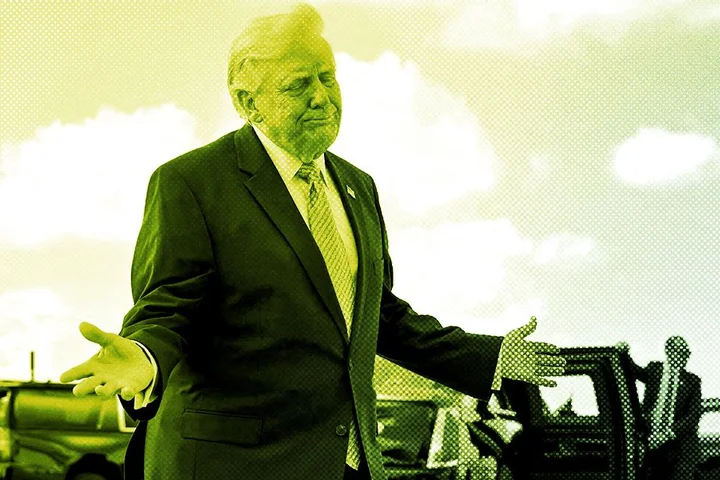
The team is back this week to discuss how top US tech companies are increasingly finding themselves as targets in the ongoing war with Iran.
They also give an inside view into how Polymarket’s pop-up bar in DC went sideways.
Plus, our hosts go through the steps that the Trump administration is taking to control the upcoming midterm elections.
Articles mentioned in this episode:
You can follow Brian Barrett on Bluesky at @brbarrett , Zoë Schiffer on Bluesky at @zoeschiffer , and Leah Feiger on Bluesky at @leahfeiger .
Write to us at [email protected] .
If you're on an iPhone or iPad, open the app called Podcasts, or just tap this link .
You can also download an app like Overcast or Pocket Casts and search for “uncanny valley.” We’re on Spotify too.
Note: This is an automated transcript, which may contain errors.
Brian Barrett: Hey, it's Brian.
Zoë, Leah, and I have really enjoyed being your new hosts these past few weeks, and we want to hear from you.
If you like the show and have a minute, please leave us a review in the podcast or app of your choice.
It really helps us reach more people, and for any questions and comments, you can always reach us at [email protected] .
Thank you for listening.
On to the show.
Zoë Schiffer: Leah, did you make it to Chicago?
Leah Feiger: Honestly, barely.
I have spent more time in airports in the last three days than I care to admit.
Brian Barrett: You told me yesterday that you were excited to be flying out of Newark instead of the other—which is the first time I've heard that.
Leah Feiger: I was young when I said that.
Zoë Schiffer: Welcome to WIRED's Uncanny Valley .
I'm Zoë Schiffer, director of business and industry.
Brian Barrett: I'm Brian Barrett, executive editor.
Leah Feiger: And I'm Leah Feiger, senior politics editor.
Zoë Schiffer: This week on the show, we have a pretty well-rounded episode for you all.
A little bit of international politics as Iran threatens to target US tech firms .
There's also election news as we're tracking Trump's attempts to control the midterms , and a scene report from our DC colleague who had the great assignment of hitting up the Polymarket pop-up bar , which was a bit of a Fyre Fest situation .
Brian Barrett: To let people in behind the scenes of the magic of the Uncanny Valley podcast, we're recording this on a Wednesday.
It's going to come out on Thursday.
That's the magic.
So, things could happen between then, but on this Wednesday, yesterday, Tuesday, Iran's Islamic Revolutionary Guard Corps warned that it planned to begin attacking more than a dozen American companies across the Middle East.
If more of Iran's leaders are killed during the ongoing war, they'd made this threat before, but what was different is that they set a deadline to it.
They said on April 1st, we are going to start targeting companies in these regions.
There are 18 total companies on that.
They actually gave a list.
On that list include Apple, Microsoft, Google, Meta, IBM, Tesla, Palantir, a bunch more.
As of now, that hasn't happened other than an attack that we can talk about later that sort of affects Amazon Web Services.
But it does seem to be another one of these escalations.
And I'm really curious what is going on with these companies, what obligations they have to their employees to protect them, what it means for all kinds of investment in that region, which has been increasingly important.
It feels like it opens up a lot of serious questions.
Regardless of whether these attacks go through—hopefully they don't—but it's really an escalatory time.
Leah Feiger: I was pretty struck by parts of this where, you know, calling on employees of these tech firms in the region to distance themselves from workplaces, for residents living near offices of these companies to move away to a safe place, this is a very serious warning.
And so much to me reminds us that what's happening here, this war that is very much becoming a war with a capital W is not Trump's childhood wars.
We are in a globalized world where he is not going to be able to remove himself from the blowback if American companies are indeed attacked.
This is very different than military.
This is an impact that I think would be very hard to escape from beyond the fact that it's horrible, it's sad.
These are people's lives.
Zoë Schiffer: Yeah.
I mean, we reached out to every company on the list.
It turns out that they don't largely want to comment on their feelings about this or what they're doing.
I actually was kind of surprised.
I was like, I don't know, you're on a target list and you don't want to say anything?
Brian Barrett: And the US did say after this latest thing, there was a comment that someone gave that was basically like, "Well, we'll respond if they do something here," which is a little bit like, "We will definitely put up a stop sign after someone gets run over." I alluded to this before.
Iran is willing to do this.
They've already had two strikes on Amazon Web Services data centers last month and damaged another one.
It is sort of the first publicly confirmed attack on American owned hyperscale cloud infrastructure.
And I guess my question is, how much do we think the targets are sort of the symbolic headquarters, even if they're empty versus actual critical infrastructure or actual infrastructure, powering the cloud, manufacturing facilities, whatever is there, curiously what shaped those targets.
Take again, hopefully it's all bluster and this will move on.
Brian Barrett: I'm a little surprised by that because a knock-on effect of all of this is a stock market that is way down, including tech companies have been really, really hit down 20 percent in some cases.
Nvidia is really pretty far down, Meta—so, I'm a little surprised in that I feel like the IPO climate is going to be less hospitable to a lot of these companies who are looking for that for their exit.
And a lot of people who have or invested in their companies have options at these companies, they're seeing their value dwindled by the day.
So, it's a shame that it takes hitting their wallet to get people to pay attention, but presumably at some point.
Zoë Schiffer: And I think if the effect on their wallets continues, we will see these people really, really care.
I'm sure we will see chatter in Slack about this, but I think they're pretty used to the ups and downs.
And so, while this is a pretty dramatic drop for some of the public companies, especially because when we're talking about say OpenAI, the thought was that they were eyeing an IPO near the end of the year.
So, I think at least from the people I've talked to, which of course is a handful of the overall employee base, it's kind of like, well, a lot could change.
Leah Feiger: This week is going to be a real bellwether as well.
Trump delivers an address Wednesday night about Iran, but regardless in some ways of what Trump says, Iran has indicated that it feels the exact opposite.
Trump says the war is over in two weeks.
Iran says that the war is over when they say it's over, when they have won.
So, we have backed them against the wall in a very serious way, and it doesn't really appear that there's an end in sight, especially if these are the kinds of companies on a target list, which are so near and dear to the Trump administration's heart.
Brian Barrett: I'll say just one more thing on this off of what you just said, Leah, is that there were an amazing trifecta of quotes over the last couple of days where Trump said something like, "Negotiations are going great.
We're making a lot of progress." Iran said, "We haven't even started negotiations, it’s not going to happen." And then Pete Hegseth jumped in and said—
Pete Hegseth, archival audio: We see ourselves as part of this negotiation as well.
We negotiate with bombs.
Brian Barrett: We'll negotiate with bombs.
And that really kind of sums up where we're at.
Brian Barrett: I'm familiar-ish in that it seems bad.
Leah Feiger: This was a strong take.
This is why people come to Uncanny Valley .
It's for these kinds of takes.
Brian Barrett: OK, how about these?
It seems really bad.
Brian Barrett: And has benefited from mail-in voting, I'd say.
Brian Barrett: I feel like it is weird to me that Trump seems to think that mail-in voting is only a Democratic thing.
A lot of Republican voters use mail-in voting.
Leah Feiger: Yes.
And if anything, all of the pushing against mail-in voting has frankly hurt their bottom line a little bit because all these Republicans are like, "Oh God, screw mail-in voting." And then they're not mail-in voting.
It's very messy, and that one is a very strange one, but they've continued to work on that.
Election deniers are across government right now, recruited because they were boosting election conspiracy theories back when Trump was out of office.
They have not stopped doing so since being appointed.
They're all over the government in a variety of agencies.
And even right down to possible concerns day of, the administration has suggested the possibility of sending ICE agents to election sites.
So, there's a lot here.
And I was really taken, I think, with some of the comments on wired.com or online just about how people were like, "Oh yes, this is horrible." I knew that the Trump administration was doing all these things.
I think people were a little bit shocked by how many hands were in so many different pockets This is a very comprehensive approach.
How do you change an entire vision of elections?
This is it.
It's an unbelievable roadmap.
I've got to hand it to them.
Leah Feiger: That's a really good question.
And it's a little bit hard to say right now while we're in this primary period, which is why this approach, which is just throw a ton of spaghetti at the wall and see what sticks has worked for them very well in the past.
So, they're making a lot of really educated guesses on what that would mean for them and what that would mean on the very specific voting breakdowns.
When you say, for example, registering 60 days beforehand to vote, the election is in early November, that brings us to early September.
That cuts out college students that are registering to vote on their college campuses.
That's who we're looking.
So, it's a very specific targeted approach.
Also, I guess to be clear, there's a very decent chance that the Republicans do very, very badly come November.
Things are not looking good for them polling-wise.
And so, to amp up your populace into being like, "If we lose, it's because of cheating." And they're like, "They're not going to do great." If the war in Iran continues, if we all continue to not be able to travel, or some of us spent eight hours straight in the New York airport—
Brian Barrett: Leah is a single issue voter now.
Leah Feiger: I'm a single issue voter, and it's about funding TSA and making weather better.
It's all to say that we're hitting an era where they're hedging their bets and going like, "If we lose, we need to figure out who to blame it on." And it's certainly not going to be Republican voters or Republican strategists.
Brian Barrett: Coming up after the break, we're going to take you inside Polymarket's pop-up bar in DC.
Stay with us.
So, a few weeks ago, Polymarket , which is the online prediction market where people bet on the outcomes of real world events, it's insanely popular—you might have an account—ecided to create an in real life experience in the form of a pop-up bar, which they called the situation room, not to be confused with Wolf Blitzer's Situation Room, no betting there.
The space was outfitted with tons of bright TV screens, showing everything from the news to stock quotes, even a Bloomberg terminal.
So, you got to monitor global events while you bet and drink.
What could go wrong?
Makena Kelly, archival audio: So, I just got in.
We're waiting outside for an hour and a half almost.
Brian Barrett: It was a one weekend only type of thing.
So, we sent our DC-based reporter Makena Kelly to check it out.
Makena Kelly, archival audio: Nothing is working.
There's a couple of tablets set up.
I'm seeing some people playing what looks like a video game of—
Brian Barrett: It seems to have been a messy experiment, to say the least.
Hey, Makena.
Kate Knibbs: Hi, thanks for having me.
And I'm truly sad that I missed going there in real life.
Kate Knibbs: Yes, but it's only because I hate myself.
Brian Barrett: OK.
So, take us there.
When you went, you visited the pop-up, what were you expecting and what did you actually see?
I feel like there's a gap there.
Makena Kelly: Yeah.
So, from the promotional materials that Polymarket put on X and blasted in the press release, my expectations were really high.
They had this orb in the promotional images.
There's all these Bloomberg terminals.
People were supposed to be downing drinks and placing bets and wandering around in this kind of highly fluorescent room where there was just endless screens, endless content to be monitoring whatever situation you wanted to monitor, whether that was who the next Republican presidential nominee was going to be or the war in Iran or things like that.
And so, when I got there, it was supposed to open at 5:0 PM.
It was pouring rain and we all waited outside for about an hour and a half, getting soaked, getting drinks handed to us outside by a very apologetic Polymarket.
And when doors opened, about an hour and a half after they originally scheduled to, nothing worked.
Absolutely nothing worked.
And really the only promise that they kept was a free night of drinks for anyone who showed up.
Zoë Schiffer: What was the ratio of reporters to—
Makena Kelly: Yeah.
So, the ratio to reporters and everyone else, there was a lot of people who were leaving the line because it was starting to feel like this place was never going to open.
And so, anyone who was a casual, "I'm going to show up here for a drink and gawk at the spectacle," for the most part left and all the reporters who were assigned to this, all for the most part stuck around.
And later in the night after things had opened up, more people continued to come in.
Some of the DOGE guys were there—
Makena Kelly: —that we saw mixing around because they were part of the same kind of social circle—
Makena Kelly: —as these folks.
I saw some guys wearing Palantir hoodies and a shirt that said—this didn't make into the story because I had completely forgotten—but he was wearing this shirt that said, "Surveillance is the new sovereignty Palantir something, something."
Brian Barrett: Before we get too deep in the night, I do want to say not to make you relive this, but we do have tape of Josh Tucker, chief marketing officer of Polymarket.
At the moment he let everyone know how badly things were going.
Can we play that real quick?
Josh Tucker, archival audio: As a result of an electrical issue earlier tonight, we had to reset all of the TVs.
With that being said, we want you all to have a great evening tonight.
There are drinks, food, past, apps.
We are here to answer any questions.
Overnight, we will remedy it so that the situation can be properly monitored tomorrow.
Appreciate you all coming out.
We're so excited to meet you.
Thank you all.
And let's go back to you.
Makena Kelly, archival audio: Yes.
Could I get a glass of white, please?
Unidentified speaker, archival audio: Yeah.
Did you want a red or a white?
Makena Kelly, archival audio: A white please.
Unidentified speaker, archival audio: Yeah.
Do you like a sauvignon blanc?
Makena Kelly, archival audio: Sauvignon blanc's great.
Thanks so much.
Brian Barrett: I love that we also got your drink order in there.
Leah Feiger: Was it good?
Was the alcohol at least top shelf?
That's the part to me that I'm like, this company makes so much money and they couldn't even put their screens together.
I don't know.
This is so messy.
Makena Kelly: So, yes, I had a glass of white wine.
It was totally fine, but the apps that were passed around, I was a little bit disappointed because the things that I saw were some pretzel bites and then these little skewers of pineapple strawberry pineapple, and that was about it for the most part.
On the second night, they brought in pizza from somewhere else and put it in these boxes that said Pentagon Pizza on them.
So, there was more food the second night.
But yeah, I got to say I was a little disappointed—
Kate Knibbs: So, you went twice?
Makena Kelly: Yes, Kate.
I went twice.
Zoë Schiffer: Wait, is the Pentagon Pizza thing a joke about the pizza predicting the war?
Makena Kelly: Because they had these Pentagon pizza trackers up.
When I returned the second night, yes, I came back the second night.
Everything was working for the most part.
There were still some screens that were turned off, but I never saw any actual Bloomberg terminals.
There were some monitory Bloomberg type terminal things that it looked like Polymarket had developed themselves, but the real $50,000 Bloomberg terminal was nowhere to be found.
And yeah, the second night, again, it was mostly people looking to gawk at the event, except I did find a couple of people who placed some bets on platforms like Polymarket and Kalshi .
One was named William, and he said he was a member of the military, wouldn't give me his full name.
And he last year got involved in this for the first time by putting in, I think, all of his tax return into Oklahoma City sports betting.
Makena Kelly, archival audio: So, you used Kalshi?
Makena Kelly, archival audio: When did you first start using the service?
William, archival audio: Probably when I got my tax return back.
Makena Kelly, archival audio: OK .
William, archival audio: So, I filed my taxes pretty early and I was like, "Oh, sweet.
I got my tax return.
What am I going to do with it?" So, I was like, "I'm going to just put it on Kalshi."
Makena Kelly: He said that he goes up and down 100 dollars, but he hasn't made any major winnings.
Some of the stuff that we've heard.
Some people making crazy insider bets making millions and millions of dollars.
This is just a guy who was interested in this and just plays it for fun, it sounds like.
Brian Barrett: Kate, what do you see when you see a pop-up like this and Polymarket trying to—is it an attempt to legitimize itself to just a marketing stunt?
And how does it tie into what you're seeing with these companies anyway, that there's the explosive growth that they've got trying to reach out to so many people and getting so many people hooked on what they're offering?
Kate Knibbs: I mean, this particular event definitely seems like a very bald effort to woo DC-based journalists, if nothing else.
One thing that Makena said sort of encapsulates what's going on right now, the thing about the guys in the Palantir hoodies.
So, I think it was the same week that this bar opened.
Polymarket announced a partnership with Palantir and Palantir is helping them protect the integrity of their sports market.
So, Palantir is going to be basically attempting to help Polymarket catch insider traders and market manipulators in all the sports games, which is kind of wild.
I actually asked Polymarket last week whether they had any other deals with Palantir when I was trying to get them to say anything about whether they were investigating the Iran bets that have been raising a lot of eyebrows.
And they said that Palantir was only helping them with sports, which I thought was freaking weird.
And it speaks to how they're rapidly expanding, but doing so in this really messy ad hoc way that doesn't really make a lot of sense.
Because I was like, "If you're going to get Palantir involved, why wouldn't you have them do this geopolitical stuff instead of March Madness?" Yeah, wild, wild times.
Leah Feiger: It does all feel like quite piecemeal, but sort of together as a big step back, what does all of this say to you guys?
Makena, you have now spent two, read two nights with all of these people.
Kate, this is your beach.
Brian Barrett: That we know of.
Makena Kelly: Just two guys, just two.
Leah Feiger: That we know of.
Maybe, yeah.
Makena Kelly: And I went back for brunch on Sunday morning.
Leah Feiger: What does this say about this increasing popularity, the power of prediction markets, and how this is becoming really a cultural phenomenon.
The fact that they were able to get folks to come out for this, to get excited about this, even as it all vaguely blew up in their faces, their name is out there.
The power, the cultural capital here that didn't exist a year ago is very much present.
What does this say to you?
Makena Kelly: Yeah.
I think my main takeaway from the event and the thing that stood out to me the most and that I put in the piece is that the guy who was running it, Josh Tucker, who made that announcement that we played the tape of earlier, his last job was at Mr.
Beast doing viral marketing.
And I think we talk about where Polymarket is right now very much, even with people who are familiar with the name and all that, it's very much a spectacle.
This is very much playing on that and trying to grow its kind of name.
And then when I was at the bar too, it was only a block away from the CFTC.
On K Street, which colloquially in DC is known as lobbyist central and then a block away from the one regulator who regulates it trying to make this big party saying that this is our coming out party and we're here to have this conversation.
And they're there for the spectacle about blowing up all this stuff.
But when it comes to actually following through with the party and the planning or having this kind of productive discussion, that really was nowhere to be seen.
The promotional material on X promoting this event by Polymarket made this out to be a very highly produced event that was going to be kind of otherworldly and highly technical.
But after spending several hours here, the whole thing is kind of janky.
Kate Knibbs: It's super bonkers to me too, because Polymarket had that whole party in DC.
And as of now, most of Polymarket, you're still not legally allowed to bet on from the US.
So, they're really focusing on getting their name out there over people actually using the product.
Brian Barrett: Just to recap, we had Palantir, DOGE, Donald Trump Jr., Mr.
Beast, and an absent Bloomberg terminal.
I feel like we're checking a lot of boxes with this one event.
Leah Feiger: This is WIRED Mad Libs in every way, shape, or form.
Yeah.
Zoë Schiffer: That's our show for today.
We'll link to all the stories we spoke about in the show notes.
Uncanny Valley is produced by Kaleidoscope Content.
Adriana Tapia produced this episode.
It was mixed by Amar Lal at Macro Sound.
Pran Bandi is our New York studio engineer.
Mark Leyda is our San Francisco studio engineer.
Kimberly Chua is our digital production senior manager.
Kate Osborn is our executive producer, and Katie Drummond is WIRED's global editorial director.
Related Stories
Source: This article was originally published by Wired
Read Full Original Article →
Comments (0)
No comments yet. Be the first to comment!
Leave a Comment