
Turkey, Pakistan and Egypt are emerging as potential regional mediators.
Follow DW for more.
Here is a roundup of our coverage of the US-Israeli war with Iran and its wider impact in the Middle East on Tuesday, March 24, 2026:
Strikes continue despite reported ceasefire talks
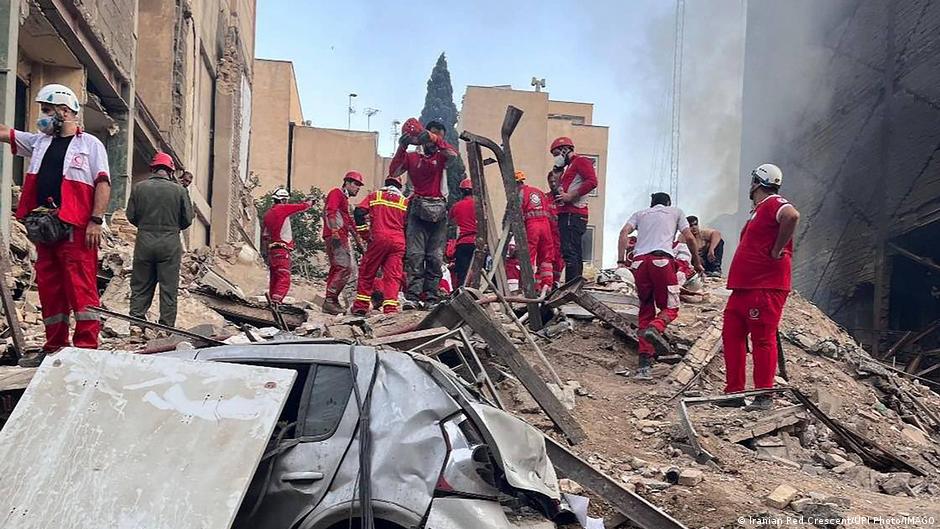
Both sides in the conflict traded strikes on Tuesday, although President Trump had said he held productive talks with Iranian officials.
Smoke was seen rising on the outskirts of Tel Aviv in Israel, and at least 6 Kurdish Peshmerga troops — who have often allied with the US — died in an attack in northern Iraq.
In Iraq's western Anbar provice, the Popular Mobilization Forces (PMF) militia said that 15 of its fighters, including a commander, had been killed in a US strike.
The PMF is a Shiite group that is sympathetic to Iran.
US officials also clarified early on Tuesday that a promised pause to strikes only applied to energy infrastructure.
Japan releasing oil reserves as crisis continues
Japanese Prime Minister Sanae Takaichi has announced that her government began releasing privately held oil reserves on March 16 and "will begin releasing national reserves from the 26th."
"Furthermore, releases from jointly held stockpiles with oil-producing countries are also scheduled to begin later in March."
Global oil prices have reached their highest point since 2022 as Iran continues to block the key Strait of Hormuz waterway, crippling the movement of fuel worldwide.
Industry Minister Ryosei Akazawa said that vessels carrying jointly-held oil are heading towards Japan from Saudi Arabia, which will be bypassing the blocked strait.
Iranian officials had said last week that they would allow Japanese-flagged ships to pass, but that has not happened so far.
South Korea calls for curbs on cars amid fuel crisis
South Korea 's Energy Minister Kim Sung-whan said public institutions would cut back on their use of passenger cars.
The government would ask the top 50 oil-consuming businesses to cut use and encourage staggered commuting hours, Kiim said.
Curbs on the use of private vehicles are voluntary for now, he said, but could be reviewed if the energy alert level increased.
South Korea is also to restart five nuclear reactors by May, ease restrictions on coal plants and expand renewable energy to reduce longer-term dependence on Liquefied Natural Gas, the energy minister told a cabinet meeting.
South Korea normally imports around 70% of its crude oil through the Strait of Hormuz .
But Iran has virtually closed traffic through the strait, triggering a global oil and gas crisis.
Unclear who is leading mediation efforts for Middle East peace
Egypt , Turkey and Pakistan have all held talks with the warring parties in recent days.
An Egyptian source said the United States and Iran even exchanged messages through Egypt, Turkey and Pakistan over the weekend, AP news agency said.
On Sunday, Turkey's Foreign Minister Hakan Fidan talked on the phone with Iranian Foreign Minister Abbas Araghchi, a conversation which was confirmed by Iran.
Fidan also talked to US officials and held a series of talks with his Egyptian and European counterparts, media reported.
Citing a Turkish source, Middle East Eye , a UK-based news site, said that Turkey "is attempting to build a unified front in negotiations to counterbalance Israeli influence, working with European, Gulf, and other regional actors to help end the conflict."
But Turkey's Foreign Ministry has declined to comment on whether the country relayed messages between Iran and the United States in the weekend talks.
As for Egypt, President Abdel-Fattah el-Sissi said Cairo has delivered "clear messages" to Iran focusing on de-escalating the conflict, according to his office.
The Egyptian Foreign Ministry said it was making “constant efforts and communications” with all parties.
Pakistan's Prime Minister Shehbaz Sharif said on Monday said he spoke with Iran's President Masoud Pezeshkian.
Sharif said in a post on X that he "reaffirmed Pakistan's commitment to playing a constructive role in advancing peace in the region."
Pakistan has suggested its capital Islamabad as the potential location for talks between senior US and Iranian figures, the Financial Times reported on Monday.
Welcome to our coverage of the Iran war
It seems that Turkey, Egypt and Pakistan are emerging as the regional powers attempting to de-escalate the US-Israeli war with Iran.
It's unclear which of these powers (if any) may have been relaying messages between Iran and the United States in indirect talks on the weekend.
We'll have more about this in our Tuesday updates.
Meanwhile, President Donald Trump on Monday delayed threatened strikes on Iran after saying the two countries had held talks, something which was denied by Iran.
If you missed out on any of Monday's coverage of the Iran war , you can catch up on it here.
Related Stories
Source: This article was originally published by Deutsche Welle (DW)
Read Full Original Article →
Comments (0)
No comments yet. Be the first to comment!
Leave a Comment