
Search author on: PubMed Google Scholar
You have full access to this article via your institution.
Hello Nature readers, would you like to get this Briefing in your inbox free every day?
Sign up here .
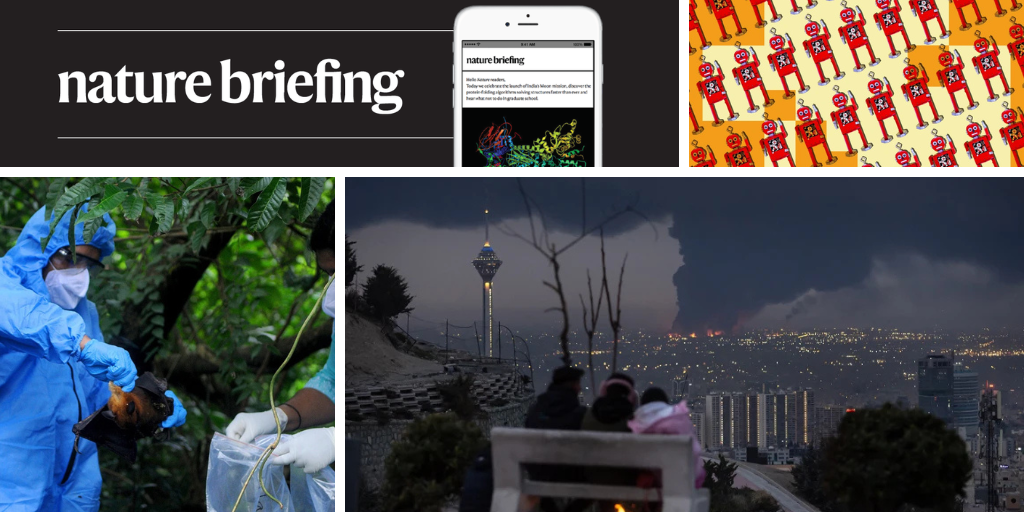
Fruit bats carry Nipah virus, which has infected people in India and several other countries.
Credit: C.
K Thanseer/DeFodi images via Getty
Vaccine-carrying mosquitoes inoculate bats
Aedes aegypti mosquitoes engineered to carry vaccines in their saliva have been used in the lab to inoculate bats against the rabies and Nipah viruses.
Researchers fed the mosquitoes blood that contained a vaccine against one of the two viruses, which were then passed on either when the insects fed on bats or when the bats ate them.
The team hopes that this method could be used to stop such viruses from spilling over’ from bats into humans .
But other researchers are sceptical that the method would be effective in the wild.
Reference: Science Advances paper
AI use could ‘same-ify’ human expression
People who use large language models are picking up writing patterns, reasoning methods and even opinions from the chatbots, some research suggests.
This pattern threatens to homogenize human writing and discourse , argue some computer scientists, and could even influence text written by people that aren’t first-hand AI users.
But not all researchers in the field agree.
In one study, a team of scientists found that certain groups of writers held on to their personal writing style after using AI, and some even developed one that was more markedly distinct from that of the LLM.
Reference: arXiv preprint 1 (not peer reviewed), Science Advances paper , Trends in Cognitive Science opinion piece & arXiv preprint 2 (not peer reviewed)
The consequences of ‘black rain’ in Tehran
After missiles damaged oil depots and refineries this week, Iran’s capital Tehran has been blanketed by pollutant-laden ‘black rain’ .
Experts say that this rain probably contains both soot, which can damage people’s lungs and eyes, and cancer-causing chemicals such as benzene and toluene, released by the burning of oil-refining byproducts.
The pollutants could be dispersed in the air if there are no new fires, says atmospheric chemist Gabriel da Silva.
But Tehran’s position in the Alborz mountain range can lead to temperature inversions, a meteorological phenomenon that traps polluted air masses.
Rain could also disperse the chemicals, but that could lead to contamination in soil and waterways, da Silva says.
Gut microbe fuels memory loss in mice
A species of gut bacteria that proliferates as mice get older plays a part in cognitive decline.
Researchers found that the bacterium, Parabacteroides goldsteinii , interferes with signalling along sensory nerves that connect the gut to the brain by producing fatty acids, which trigger the release of inflammatory molecules from immune cells.
Although the experiments were conducted in mice, the gut–brain circuit that the team identified “is likely conserved in humans”, says biochemist David Vauzour, which, if confirmed, could lead to gut-targeted therapies to reverse cognitive decline in people.
The United Kingdom is looking to make big changes to how it funds research — and physics is in the crosshairs .
The country’s largest research funder, UK Research and Innovation, is ending or reducing investment in projects in particle physics, astronomy and nuclear physics.
Some of the biggest cuts will hit UK physicists’ participation in international projects such as CERN, Europe’s particle-physics laboratory.
Nuclear physicist Paul Howarth, the new leader of the country’s Institute of Physics, tells Nature that “constructive dialogue” with the government is needed, or the country risks losing the next generation of scientists.
Do supplements work?
Answers are murky
By some estimates, some 60% of US and European adults take dietary supplements regularly — whether stalwarts such as omega-3 or up-and-comers such as collagen and lion’s mane.
But hard evidence for the effectiveness of some supposedly ‘evidence-backed’ supplements can be difficult to come by .
Compared with research on vitamins and minerals that treat nutrient deficiencies, “the science is rather more sketchy” on compounds thought to be beneficial to health, says nutritional scientist Paul Coates, who formerly led the arm of the US National Institutes of Health responsible for supplement research.
“It’s done by good people, often in model systems, but the effect sizes are pretty tiny.”
This article is part of Nature Spotlight: Nutrition
“I learnt, I grew, I discovered and I taught.
And I also just happened to publish.”
Astrobiologist Michael Wong published seven academic articles as either the first or corresponding author last year — but also has a five-year gap in his record during which he has no lead-author publications.
Producing papers shouldn’t be the metric by which his success as a researcher is measured, he argues.
( Nature | 7 min read )
doi: https://doi.org/10.1038/d41586-026-00825-0
Today I’m learning about physics through the medium of dance.
The piezoelectric effect — the generation of electricity in some crystalline materials when they’re subjected to mechanical stress — was central to physicist Sofia Papa’s research during her PhD, and she put her thesis in motion when she entered Science ’s 2026 Dance Your PhD contest .
Her entry, in which she and her colleagues dance in blue and red outfits to represent positive and negative charge, proved a winner.
Jacob Smith, associate editor, Nature Briefing
With contributions by Flora Graham
• Nature Briefing: Careers — insights, advice and award-winning journalism to help you optimize your working life
• Nature Briefing: Microbiology — the most abundant living entities on our planet — microorganisms — and the role they play in health, the environment and food systems
• Nature Briefing: Anthropocene — climate change, biodiversity, sustainability and geoengineering
• Nature Briefing: AI & Robotics — 100% written by humans, of course
• Nature Briefing: Translational Research — covers biotechnology, drug discovery and pharma
Daily briefing: A daily multivitamin slows the signs of biological ageing
Daily briefing: ‘Virtual cell’ simulates nearly every chemical reaction in the real thing
Daily briefing: Protein folding caught in real time
Daily briefing: How DNA testing can tell identical twins apart
CeMM is recruiting two scientists to join as Starting Principal Investigators within a new research program on pain and aging/healthy.
Research Center for Molecular Medicine (CeMM), ÖAW
Profile the cellular components of tissue microenvironments (TME) in healthy and inflamed sites.
Dortmund, Nordrhein-Westfalen (DE)
Leibniz-Institut für Analytische Wissenschaften – ISAS – e.V.
Postdoctoral positions exploring microbiota–stem cell interactions in development, disease & cancer using gnotobiotic models, organoids & multi-omics.
The Chinese Institutes for Medical Research (CIMR), Beijing
Join Huazhong Agricultural University
No.1 Shizishan Street, Hongshan District, Wuhan, Hubei Province, China
Huazhong Agricultural University (HZAU)
SUSTech School of Medicine offers equal opportunities and welcome applicants from the world with all ethnic backgrounds.
Southern University of Science and Technology, School of Medicine
Related Stories



Source: This article was originally published by Nature News
Read Full Original Article →
Comments (0)
No comments yet. Be the first to comment!
Leave a Comment