
Search author on: PubMed Google Scholar
You have full access to this article via your institution.
Hello Nature readers, would you like to get this Briefing in your inbox free every day?
Sign up here .
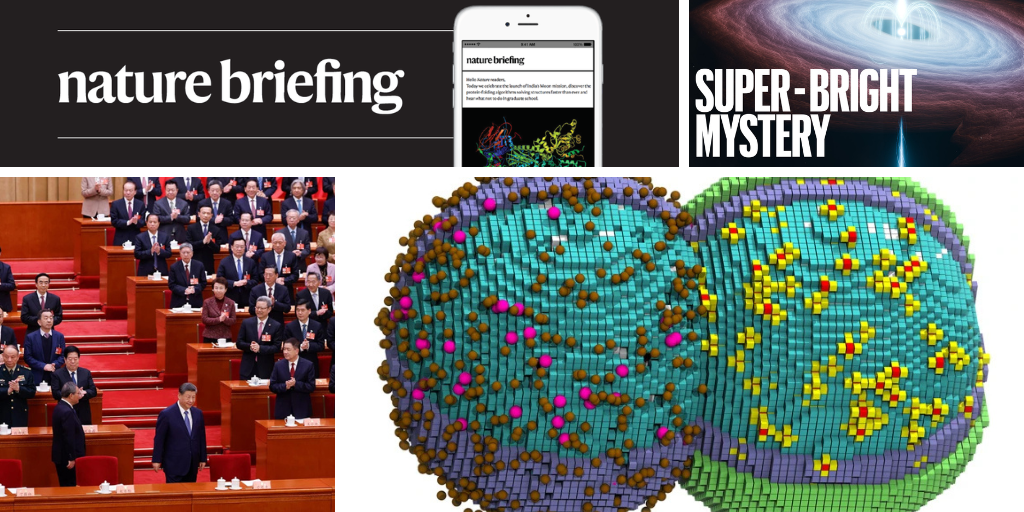
A computer generated illustration of a simulated cell in the early stages of division.
Credit: Zane Thornburg
Virtual cell models bacterial life
Researchers have created a 3D simulation that models DNA replication, cell division and nearly every chemical reaction in a living bacterial cell .
This ‘virtual cell’ isn’t a totally faithful recreation of the organism — the team used placeholders for some genes with unknown functions, for example.
But it could help researchers understand how the mix of molecules in a cell gives rise to actual life, says computational biophysicist and study co-author Zane Thornburg.
China ramps up support for science
The Chinese government has announced plans to increase two of its key science budgets at the country’s biggest political meeting.The government proposes to increase its science and technology budget by 10% this year, and its overall research and development expenditure by at least 7% per year over the next five years — a boost that translates to billions of extra dollars each year.
The latter target was set as part of China’s next five-year plan, which will serve as an overarching blueprint for the country’s policies from 2026 to 2030.
Mouse brains revived from frozen
Researchers have, for the first time, cryogenically frozen and then revived mouse brains with some of the brain functionality intact .
The team used an ice-free method called vitrification, which preserves tissue in a glass-like state, and a thawing process that preserves living tissue.
After the brains were warmed up, wafer-thin slices from the hippocampus showed signs that the structures that support learning and memory had survived.
Researchers are looking to test the method for human brains and organs, but observers note that the success rate was low for mice and the results might not translate to larger body parts.
There’s no shame in the right retraction
To tackle disease, look to how energy flows
“Both a cadaver and a thinking, feeling, living person are made up of molecules, cells, tissues and organs — the fundamental distinguishing factor is energy flow,” write mitochondrial psychobiologist Martin Picard and theoretical biophysicist Christopher Kempes .
Every biological process requires energy, whether chemical, thermal, mechanical or electromagnetic, yet much of biomedical research focuses on genes, proteins and molecular mechanisms.
Where this approach has not led to effective treatments — including for Alzheimer’s disease, mental-health conditions and some cancer types — researchers should start asking key questions about the energy trade-offs that might be involved, argue the authors.
AI helps formalize Fields-winning proof
Researchers have used Gauss, a language model developed to formalize mathematics proofs, to create an algorithmically checkable version of Maryna Viazovska’s Fields Medal-winning work on sphere-packing.
The tool took just three weeks to verify the result in 8 and 24 dimensions — a process that “until very recently, required years”, according to Math, Inc., the AI company that developed Gauss.
“When they reached out to us in late January saying that they finished it, to put it very mildly, we were very surprised,” says Sidharth Hariharan, who works with a formalization collaboration that provided much of the foundation for the Gauss project.
“But at the end of the day, this is technology that we’re very excited about.”
Read more: ‘Mathematics is an unknown land’: meet Fields Medal winner Maryna Viazovska (Nature | 7 min read, form July)
Reference: Math, Inc press release
The stats that underpin the world are at risk
“Official statistics are like the backbone of a nation’s data infrastructure,” says Steve Pierson, director of science policy at the American Statistical Association.
“Just like any other infrastructure — roads, bridges and highways — they cannot fail.” But some researchers are sounding the alarm over the official data sets that track crucial aspects of life in the United States, Argentina, the United Kingdom and India.
The crisis is unprecedented, they say, driven by overlapping factors such as falling response rates to national surveys, cuts to funding and, in some cases, government interference.
Video: why these supernovae are so bright
Superluminous supernovae are 10 to 100 times brighter than expected, and while different theories exist, no one is quite sure how that’s possible.
Now the wobbling signal from one of these super bright explosions has provided a possible answer.
“This is like asking, how do you think dropping an atomic bomb on New York City will affect the future of Broadway musicals?
This is a generational loss of innovation, technology, and economic power.”
doi: https://doi.org/10.1038/d41586-026-00815-2
Today I’m enjoying what the Rubin Observatory team is calling “the largest spot-the-difference effort EVER”.
And no, it’s not a search for Leif Penguinson.
The telescope has a new near-real-time alert system that’s expected to eventually issue seven million alerts per night documenting astronomical events from new asteroids to exploding stars.
The alerts signal when a new observation of a region of the sky — captured every 40 seconds during the night — differs from previous images of the same area.
Flora Graham, senior editor, Nature Briefing
With contributions by Jacob Smith
• Nature Briefing: Careers — insights, advice and award-winning journalism to help you optimize your working life
• Nature Briefing: Microbiology — the most abundant living entities on our planet — microorganisms — and the role they play in health, the environment and food systems
• Nature Briefing: Anthropocene — climate change, biodiversity, sustainability and geoengineering
• Nature Briefing: AI & Robotics — 100% written by humans, of course
• Nature Briefing: Translational Research — covers biotechnology, drug discovery and pharma
Daily briefing: A daily multivitamin slows the signs of biological ageing
Daily briefing: Protein folding caught in real time
Daily briefing: How DNA testing can tell identical twins apart
Daily briefing: White humpback whale and return of the snail
CeMM is recruiting two scientists to join as Starting Principal Investigators within a new research program on pain and aging/healthy.
Research Center for Molecular Medicine (CeMM), ÖAW
Profile the cellular components of tissue microenvironments (TME) in healthy and inflamed sites.
Dortmund, Nordrhein-Westfalen (DE)
Leibniz-Institut für Analytische Wissenschaften – ISAS – e.V.
Postdoctoral positions exploring microbiota–stem cell interactions in development, disease & cancer using gnotobiotic models, organoids & multi-omics.
The Chinese Institutes for Medical Research (CIMR), Beijing
Join Huazhong Agricultural University
No.1 Shizishan Street, Hongshan District, Wuhan, Hubei Province, China
Huazhong Agricultural University (HZAU)
SUSTech School of Medicine offers equal opportunities and welcome applicants from the world with all ethnic backgrounds.
Southern University of Science and Technology, School of Medicine
Related Stories



Source: This article was originally published by Nature News
Read Full Original Article →
Comments (0)
No comments yet. Be the first to comment!
Leave a Comment