
What do you love about coffee ?
Is it the caffeine boost in the morning, the creamy sweetness of a cappuccino or latte, the bucket of filter coffee you can sip on all day, or the quick kick of a good espresso?
Or is it the zen-like ritual of it all, the measuring of beans and the precision of the perfect extraction?
Good thing it's much better for you than science previously realized.
WIRED tests a lot of coffee machines —productivity would grind to a halt if we stopped.
But for this group blind test, we wanted to see what coffee professionals thought of the drinks produced by the “best” in fully automatic machines, without being influenced by any fancy design or brand awareness.
We’re not judging the machine’s usability here, the app's interface (there’s always an app), or how easy it is to clean.
We only want to know about the Joe.
Adam Cozens is the cofounder of Perky Blenders , a UK specialty coffee brand from coffee-shop-dense, hipster-populated East London.
He was joined in WIRED’s test café by his business manager and coffee aficionado Calum Hunt.
Launching in 2015 from a three-wheeled coffee cart, they now have multiple cafés and more than 100 retail partners across the UK.
For this test, they chose their Forest Blend beans, noted for their dark chocolate, molasses, and walnut notes, creamy body, low acidity, and a sweet, lingering finish.
Crucially, Cozens and Hunt know implicitly how the Forest Blend beans should taste, and they are ideally positioned to decide which of our machines produces the best coffee with the most accurate flavor profile from the beans provided.
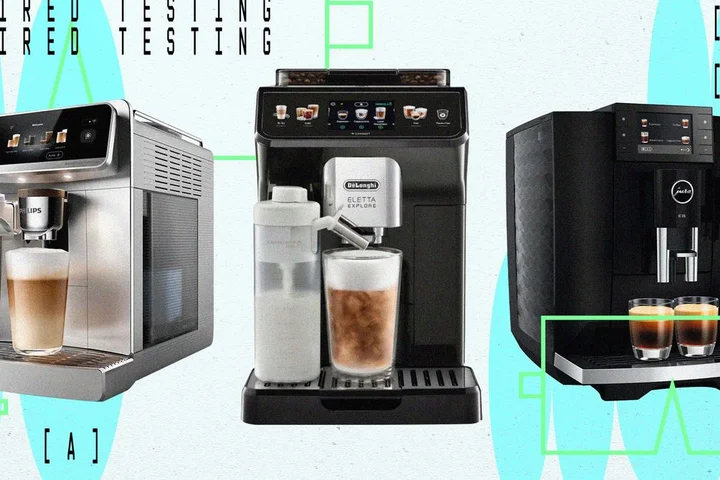
Each of the machines we chose is a fully automatic bean-to-cup behemoth capable of producing upwards of 50 types of coffee drinks at the push of a button; everything from espresso and cortado to iced lattes with syrup or a simple long black.
WIRED chose the latte—America’s most popular steamed-milk coffee order—and a classic espresso to blind taste test.
The latte allows us to test the milk-heating, frothing, and steaming mechanisms, while the espresso reveals any weaknesses in extraction and coffee flavor.
Per Cozens’ instructions, we used organic whole milk.
Our experts were blindfolded and then presented with one latte and one espresso from each machine.
Labelled A, B, C, and D, the machines were visible to the testers, but they had no idea which coffee came from which.
They then assessed each drink on looks, milk-steaming quality, crema (the golden aromatic foam on top of espresso), temperature, extraction, and flavor.
The coffees were then ranked in order from best to worst.
One of only a few machines capable of making espresso-based drinks and classic drip coffee , the TK-02, from NYC-based Terra Kaffe, is a gorgeous-looking piece of kitchen kit with premium components, a delightful glass milk carafe, a super-cool monochrome touchscreen, extensive personalization, and full app control.
De’Longhi’s latest machine can produce more than 50 “one-touch” drinks, including cold brew in just three minutes, via its scrolling 3.5-inch TFT touchscreen.
Two separate milk jugs offer different milk textures for hot and cold options.
The grinder has 13 coarseness settings, and, naturally, there’s an app for remote brewing and recipe customization.
Café Aromis 8000 Series Fully Automatic Espresso Machine With LatteGo Pro
What Makes the Perfect Caffe Latte?
A caffe latte uses a double espresso combined with steamed whole milk at 130 to 150 degrees Fahrenheit, textured into fine microfoam.
The ratio sits around 1:3 to 1:5 espresso to milk in a 6- to 8-ounce cup.
When poured correctly, the milk and espresso blend into a smooth, even drink with a thin foam layer.
The result is balanced, slightly sweet, but still a coffee, not a coffee-flavored milkshake.
What they’re looking for in a latte made with their beans, Cozens says, is “a flavor a little bit like molasses, with a little sugary sweetness to it, and a nice balance of nuttiness and chocolate.” Hunt also explains that when it comes to the milk, they’re “aiming for about 66 degrees Celsius (140°F), not just because that’s a nice temperature to have milk but because that’s the point where milk tastes the best.
And when we’ve got a drink that’s more than three-quarters milk, we want it to taste the best.”
To make espresso, water is forced at around 194 to 205°F through finely ground coffee at roughly 9 bars of pressure.
A typical shot takes 25 to 30 seconds to extract at a 1:2 ratio, producing a concentrated coffee with a dense body and crema on top.
WIRED’s automatic coffee machine individual judging scores, best to worst: Cozens—Lattes: C, D, B, A.
Espressos: D, A, B, C.
Hunt—Lattes: D, A, C, B.
Espressos: C, D, B, A.
Interestingly, our highly caffeinated, hugely experienced professionals contradicted each other at times, but they both agreed that, based on flavor, the Philips Café Aromis was the best machine on test.
It was the only option that nailed both latte and espresso.
Its shots had the best balance of sweetness and bitterness, with the clear chocolate‑nutty profile they were looking for from the beans they know so well.
De’Longhi came in a close second and had by far the best steamed milk texture, but the drinks proved more polarizing.
The Terra Kaffe TK-02 was more than drinkable but also oddly forgettable, producing weaker flavors and lackluster milk.
The Jura E8 was the real loser here.
Despite being $800 more than the nearest rival, it produced overheated milk and technically flawed shots that neither of our professional tasters enjoyed.
Cozens admitted that when he eventually saw the lineup of machines, the TK-02 looked the best, and he had hoped that “it performs as well as it looks.” After sampling the latte, he was impressed by how “coffee-forward” the drink was but reasoned that it was because it used quite a bit less milk than the other machines, which “means the sweetness I’d expect from a latte is missing a little.” Hunt also noticed that “in terms of milk texturizing, we haven’t got much [foam] created, which hasn’t helped the coffee aesthetically.”
It’s worth noting that the milk steamer on the TK-02 is adjustable for foamy or silky results.
Out of the box, the dial is positioned slap-bang in the middle, which is where it stayed for the duration of our test.
The espresso was also reasonably underwhelming, and Cozens admitted that “none of the espressos are perfect, but the TK-02 has a good balance, and pleasant taste, but lacks intensity and feels a little weak.” Hunt seconded this: “I just haven’t got enough strength or flavor coming through on it.
I haven’t got the bitterness, it’s just not really doing much in terms of flavor and as such is bottom of my list.”
Despite premium pricing, impressive features, and reputation, the Jura out of the box did not find favor with our professional tasters.
Hunt was quick to point out that the “milk tasted too hot, and so has almost ruined the espresso.
There’s too much foam on top to be a latte, too—it’s more of a cappuccino.” Cozens appreciated the look of the milk and the layering of the espresso, but was also quick to mention the milk's high temperature, which felt “hotter than the 65 to 66 degrees Celcius needed by a barista.”
Both Cozens and Hunt were also surprised to discover their least favorite espresso came from the Jura E8.
“This is a classic under‑extraction,” Cozens says.
“It’s quite a salty, sour taste that’s often described in the industry as tasting a bit seaweedy.” Hunt also called out the espresso's acidity and thought it was also “on the under‑extracted side, for sure.”
The De’Longhi latte was by far the prettiest of the four, and the milk made a good impression on both Cozens and Hunt.
“It's quite hot [like the Jura], but I think the microfoam is the best, helping to give the latte a little more of that signature sweetness,” Cozens says, while Hunt noted the “milk is the best we’ve had, although there’s more foam than I’d usually expect out of a latte.”
When considering the flavor, Cozens was pleased he could taste “a little bit more of the chocolatey flavor coming through, which I’d expect from the Brazilian Forest Blend.
It’s got a good nutty flavor, but, because of the amount of milk, it is a little sweeter than the others [Terra Kaffe and Philips].”
The espresso tasting was more polarizing for our pros, with Cozens disliking it and Hunt enjoying the extraction.
“There’s a reasonable amount of coffee flavor coming through,” Cozens says, “but it’s got a sharpness to it, which you shouldn’t experience with the Forest Blend.
It’s a little sour.” Contrary to his boss, Hunt enjoyed the shot.
“I can really taste the nuttiness of our beans on this, and while it’s a close call [with Philips], if I were buying on espresso alone, this is the one I’d choose.”
Despite not being a brand typically associated with coffee, Philips’ Café Aromis came out on top with both the latte and espresso.
This is especially impressive considering it has the lowest MSRP of the lot and given how “different” the latte looked, with, as Hunt noted, “a brown foam on top that suggests the milk was poured differently” than the rest.
But when it came to the taste, he was impressed.
“I have the chocolate-nutty taste I’m looking for in here, and there’s a bit more coffee coming through, with the right level of sweetness.
It’s an enjoyable latte, with the coffee and milk blended really nicely.”
Cozens wasn’t quite as effusive, but he did appreciate the “coffee-forward” nature of the drink, although there was a little bitterness.
“I’ve enjoyed latte C [De’Longhi] the most, but D [Philips] has more coffee flavor.”
Cozens did, however, enjoy the espresso.
“There’s a much better balance here, but it is still on the slightly acidic side.” Hunt also praised the flavor balance and didn’t dismiss it out of hand as he did with the “sour” options.
When the pair compared notes, they both conceded that the Philips espresso was “the only espresso that really nails the sweet–bitter balance and delivers proper intensity.”
The software-heavy nature of all our tested machines means you can delve into the settings and tweak the strength, volume, and temperature, and even adjust the frothiness of your milk.
This attention to detail is commendable and separates owners of these machines from the lazy coffee-pod lovers out there, but WIRED is not convinced many people buy a fully automatic coffee machine for the ability to micro-adjust the grind's coarseness.
The “automatic” nature is key here.
Yes, you’re paying for customization if you want, but you’re really paying for the machine to think for you.
Related Stories


Source: This article was originally published by Wired
Read Full Original Article →
Comments (0)
No comments yet. Be the first to comment!
Leave a Comment