
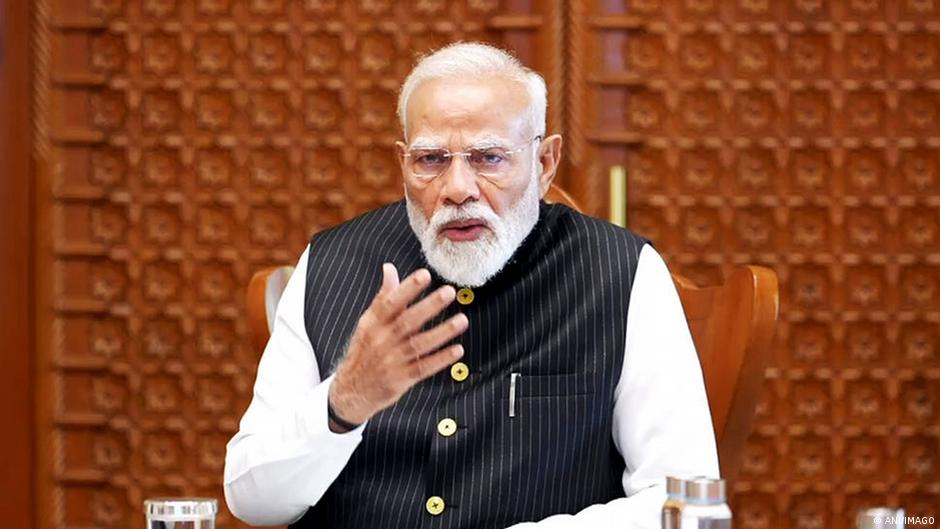
PM Narendra Modi said the Iran war is straining supply chains and trade routes, but stressed India's economic fundamentals remain strong.
DW has the latest.
Modi calls Middle East conflict “worrisome,” says India's economy remains resilient
Here are the latest news and analysis from India on Monday, March 23:
WATCH — Cost of a dream: Indian students in Germany
Germany is a popular dream for young Indian students seeking a better life.
But high tuition fees can push students into financial hardship.
What begins as hope, for some, becomes a vicious cycle of debt and exhaustion.
Follow the story of Chirag Esrani, an Indian student who went to Berlin to pursue a master's degree in International Management and now works as a delivery driver to pay off his loan.
To view this video please enable JavaScript, and consider upgrading to a web browser that supports HTML5 video
India can withstand Middle East turmoil, Modi tells parliament
Indian Prime Minister Narendra Modi on Monday called the situation in the Middle East "worrisome," but added that the fundamentals of the Indian economy are strong and will weather the "unprecedented challenges" posed by the conflict.
Addressing the lower house of Parliament, Modi highlighted that the Iran war was affecting global markets and supply chains, noting India's heavy reliance on the region for crude oil, gas through key trade routes, including the Strait of Hormuz.
"The situation in West Asia is worrisome.
This conflict has been going on for more than three weeks," the Indian PM said.
However, "the inherent strength of India's economic fundamentals has...
provided significant support to the nation during this period," he said.
During his speech, Modi said that India has trade relations with both "the warring and war-affected countries."
Modi said India was engaging diplomatically and urged for a peaceful resolution.
"War is not in the interest of humanity.
India is encouraging all sides to end it peacefully" he said, adding that attacks on commercial ships and the disruption of Hormuz Strait are "not acceptable."
WATCH — Mumbai’s Koli fisherfolk fight for their future
Mumbai’s Koli fishing community faces a turning point.
Climate change and shrinking catch levels deepen the divide within this centuries‑old fishing culture.
Generations that have relied on instinct and experience, are now facing falling catches, rising prices, and long‑standing middlemen, making survival harder.
Jaishankar has 'useful' talk with Wadephul
Indian External Affairs Minister S.
Jaishankar posted on X that he had a "useful conversation" with German Foreign Minister Johann Wadephul on the ongoing US-Israeli war against Iran .
The two ministers agreed to remain in touch, Jaishankar added.
Donation drive in Kashmir in support of Iranians affected by war
Some residents of India's Kashmir launched a humanitarian drive to support people in Iran affected by the war , local media reported.
Volunteers in Shia-majority region went door-to-door collecting donations, reports said.
The Iranian Embassy in India, in a post on X, thanked the people of Kashmir "for standing with the people of Iran through their humanitarian support and heartfelt solidarity," adding that "this kindness will never be forgotten."
Ayatollah Ali Khamenei, who was killed at the beginning of the war, was widely regarded as a religious figure among followers of Shiite Islam.
Indian stock markets fall amid Middle East uncertainty
Indian equities fell sharply on Monday, with benchmark indices sliding more than 2% in early trade amid escalating tensions in the Middle East and uncertainty over the Strait of Hormuz .
The Bombay Stock Exchange (BSE) Sensex fell about 2.6% while the National Stock Exchange's Nifty 50 fell 2.8%.
Within one hour of trading, investors lost Rs 11.78 trillion (€110 billion), NDTV reported.
Modi to address Parliament on Iran conflict
Indian Prime Minister Narendra Modi will address the lower house of Parliament on Monday outlining New Delhi's position on the ongoing Iran war, news agency ANI reported.
On Sunday, Modi chaired a meeting of the Cabinet Committee on Security to review the fallout of the war and discuss mitigation measures, the Prime Minister's office said.
The meeting addressed coal stocks at power plants, as well as diversification of imports for key sectors including chemicals and pharmaceuticals.
During the meeting, Modi directed government agencies to minimize the impact of the war on Indians.
India to revoke domestic airfare caps
The domestic airfare caps imposed on flight tickets in December will be revoked on Monday, authorities said.
The country's civil aviation ministry made the announcement on Saturday.
The temporary fare caps on domestic air tickets were introduced in December after market leader IndiGo cancelled thousands of flights .This led to a massive spike in fares as other air carriers hiked prices on popular routes amid the chaos .
The authorities had announced that a one-way economy fare for a journey up to 500 kilometers cannot be more than 7,500 rupees ($83, €72), whereas for journeys between 1,000 and 1,500 km, such as the New Delhi-Mumbai route, should be capped at 15,000 rupees ($167).
In December, the Ministry of Civil Aviation had said that the "caps will remain in force until the situation fully stabilizes."
With the price cap being removed the ticket costs are expected to rise.
Supreme Court to hear petitions against reach of privacy law
The Supreme Court of India on Monday is scheduled to hear challenges against a new privacy law that transparency activists and journalists say could curb access to information.
Four petitions are targeting amendments made through the Digital Personal Data Protection Act (DPDP) saying they will lead to "dilution" of India's Right to Information (RTI) Act.
Petitioners argue the changes would allow officials to withhold information of public interest and undermine transparency.
The government denies the allegations, saying the law balances privacy with the right to information.
Media groups have also raised concerns that the privacy law lacks clear protections for journalists and could hinder reporting by requiring consent from subjects of news reports.
The law allows fines of up to $27 million (€23.4 million) for non-compliance.
Hi!
This is Shakeel Sobhan from DW's studio in New Delhi, bringing you the major developments from across India on this rainy Delhi morning.
In case you are wondering, the current air quality (AQI) in New Delhi is 96, according to Swiss air quality monitor IQAir.
Today, the Supreme Court of India is scheduled to hear four lawsuits alleging that the government is diluting the Right to Information (RTI) law.
Additionally, the temporary fare caps on domestic air tickets, introduced in December after mass cancellations by IndiGo led to a spike in fares at other airlines, will be revoked today.
The impact on airfares remains to be seen.
Stick around as we bring you everything that is making news in India.
Related Stories



Source: This article was originally published by Deutsche Welle (DW)
Read Full Original Article →
Comments (0)
No comments yet. Be the first to comment!
Leave a Comment