
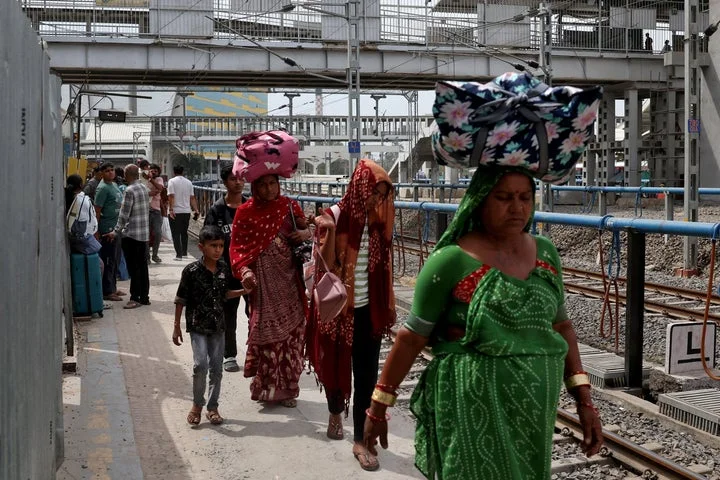
Caught in a situation where cooking gas is scarce and expensive and their daily wages are no longer enough to survive, migrant families are leaving cities.
Shweta Sharma speaks to workers in Delhi
B ulging rucksacks bigger than suitcases and tied tight with rope hang off the shoulders of migrant workers weaving through the crowds at Delhi’s main train station, carrying almost all their belongings as they quietly slip out of the bustling capital where they once came chasing work.
They are mostly informal workers and labourers going back to their villages and small towns as disruptions to energy supplies triggered by the US -Israeli war on Iran ripple through the global economy, threatening the fragile livelihoods of those on the bottom rung.
The exodus reflects mounting anxiety among labourers who survive on daily wages and now struggle to afford even basic meals.
At the heart of the strain is cooking fuel.
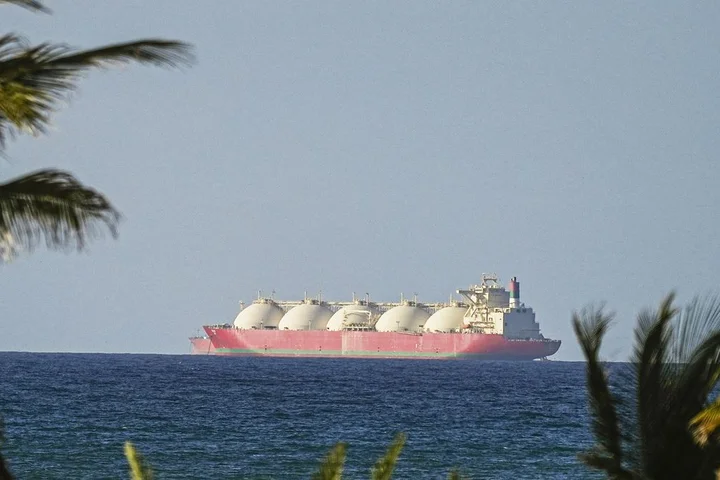
Iran ’s retaliatory closure of the Strait of Hormuz – a critical artery for energy shipments – has tightened supplies of LPG to India , turning household cooking gas cylinders into scarce and expensive commodities.
Though a fragile ceasefire has been agreed between Iran and the US, the Strait remains closed and oil prices still hover around $100 a barrel.
The gas scarcity has also shut down many small businesses and led to job losses, just some examples of the spiralling fallout of the Middle East war.
“We are going back” he says, putting down the oversized bag from his back.
“What’s here for us now when we cannot even eat?”
He complains that an LPG refill in the informal market now costs around Rs 400 (£3.20) per kg, about four times the usual price.
He earns Rs 400-450 a day as a labourer, meaning that it would take him a week's wages to pay for even a small 5kg cylinder.
He had packed his single-burner stove, a connecting pipe and some utensils into a white rucksack after selling his empty gas cylinder, which he had failed to refill despite repeated attempts, for Rs 250 (£2).
For India’s urban poor like Kumar, the impact of the war in the Middle East was immediate.
The South Asian nation imports nearly 60 per cent of the LPG it consumes and about 90 per cent of those imports pass through the Strait of Hormuz.
In the absence of piped cooking gas, most households depend on LPG cylinders – squat, metal containers placed on the kitchen floor and connected by a rubber hose to a stove.
While registered consumers can get subsidised refills through government-approved distributors, others depend on informal channels that are costlier and harder to access amid the supply crunch.
Not far from Kumar’s family, on the steps of the railway station, Ram Vilas Yadav waits with his wife, three children and brother for a train to Buxar in the eastern state of Bihar.
The family ran out of gas 25 days ago and were relying on meals from a nearby eatery.
“We have no option but to leave,” Yadav says.
“How long can we keep eating from the restaurant and burning our savings?
Even the local restaurants have raised prices.”
He had spent days trying to secure a refill.
“I stood in queues and almost begged people to help me, but everyone seemed helpless,” he says, holding his youngest child.
Standing beside him, his wife struggles to hold back tears.
“No one leaves by choice,” she says.
“It is these circumstances that are forcing us to go back.
It feels like we don’t belong here.”
At the same platform, Lakhe Chauhan, a construction labourer, is returning to his village in Bihar after failing to find work for almost two weeks.
Chauhan lived with his son, daughter-in-law, and their two children in a small two-room apartment in Delhi.
“The rooms are already so small here.
There’s no option to cook with firewood.
At least in Bihar we will be able to cook on a chullah,” he says, meaning a traditional firewood stove.
Chauhan says this is the second time he is being forced to leave the city after the Covid lockdown.
He’s unsure if he can face returning for a third time.
“There is no gas, no work, and no hope here,” he says.
“We don’t want to die here starving as we cannot afford outside food every day.”
Delhi is estimated to host up to three million of the 54 million migrant workers across the country, according to labour ministry data based on the 2011 census.
Experts say the actual number is likely much higher given years of population growth.
India has only just begun its first census in 15 years .
Now, many of them are scrambling to leave.
Asha Kumari, a domestic worker from Badaun in Uttar Pradesh state, is weighing her options as her gas cylinder is about to run out.
Widowed during the Covid pandemic, she supports two children on her own.
“I’m trying to stretch it as much as possible,” she says, adding that she is now cooking just once a day.
“Sometimes we get leftover food from the houses where I work, which helps.”
She knows that it is not sustainable and must leave once the cylinder is empty.
The Indian government insists its supply of LPG remains stable and sufficient while police claim they are cracking down on the black market.
On 6 April, the ministry of petroleum and natural gas said more than 180 million LPG cylinders had been delivered since 1 March, averaging about five million a day.
It also said 97 per cent of bookings were now made online and nearly 90 per cent of deliveries verified through one-time passwords to curb diversion.
That’s for people with legal connections that require housing proof, which migrants don’t possess.
The closest the government came to admitting the disruptions was when prime minister Narendra Modi urged people to remain calm and prepared as the war had created “difficult global conditions that may persist” during his address in the parliament.
Modi also invoked the Covid lockdown, urging the “nation to remain prepared and united, just as it had stood together during the Covid pandemic”.
“We faced similar challenges during the Covid crisis with unity.
Now again, we must prepare in the same way,” he said.
The remarks triggered anxiety online, with “India lockdown again” trending on X.
In a relief measure for migrants after the gas supply disruption began, the government started allowing migrant workers to purchase 5 kg LPG cylinders using only basic identification.
Still, labour advocates warn that the crisis exposes deeper structural gaps.
Nirmal Gorana, convener of the National Campaign Committee for Eradication of Bonded Labour, compares the situation to a disaster.
He flags the continued failure to properly register unorganised workers under the Interstate Migrant Workmen Act of 1979, which is meant to regulate their employment and welfare.
“This is an absolute injustice for migrant workers as the government is not able to ensure proper and accurate registration,” he says.
“If the state can get this right, it would be a crucial first step in restoring dignity to the largely invisible labour force that sustains our cities.”
“Right now, people are standing in long queues, and panic is inevitable.
Panic, in such circumstances, is only natural.”
Join thought-provoking conversations, follow other Independent readers and see their replies
Related Stories

Source: This article was originally published by The Independent
Read Full Original Article →
Comments (0)
No comments yet. Be the first to comment!
Leave a Comment