
When it comes to female pleasure, a heck of a lot of attention is given to the clitoris – and for good reason.
One 2024 study found that one-third of men (31%) believe most women can orgasm from vaginal penetration alone.
But in reality, only 18.4% of women can finish just from this kind of stimulation, and the majority either require or straight-up prefer exclusive clitoris touching.
For that reason, it’s become a pretty important facet of sex and intimacy for many vulva-having people.
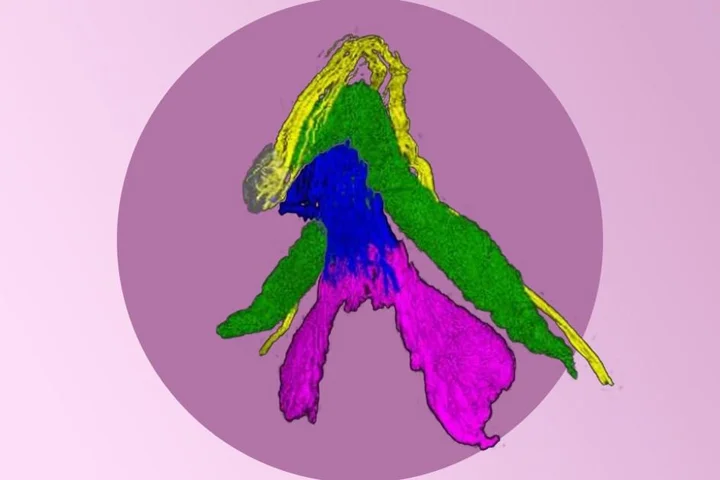
And now, we’ve finally got a 3D map of it.
That’s right: there’s now going to be no excuse for not being able to locate this crucial pleasure point (only one-third of men pay attention to it during sex, just FYI), as scientists have laid it out plain and clear.
The first-of-its-kind map has been published as part of a study from Amsterdam University’s Medical Centre, and to create it, the authors scanned two female pelvic samples using groundbreaking X-ray imaging.
We’ve long known just how sensitive the clitoris is, as it’s estimated to have about 10,000 nerve endings, which is how it came to be known as the only sexual organ with one sole purpose: pleasure, rather than reproduction.
However, the new study underlines that, actually, this little hooded bean is way more sensitive than we thought.
The cross-section of the nerves inside this female organ has been mapped out in completely ‘unprecedented’ detail, showing how the glans branches out in what the authors describe as being in a ‘tree-like’ fashion.
And it’s all come a good 28 years after the first-ever 3D map of the penis was laid out.
Sign up to The Hook-Up, Metro's sex and dating newsletter
Love reading juicy stories like this?
Need some tips for how to spice things up in the bedroom?
Sign up to The Hook-Up and we'll slide into your inbox every week with all the latest sex and dating stories from Metro.
We can't wait for you to join us!
It locates five branching nerves, the widest of which measures 0.7mm, and the smallest a mere 0.2mm.
The research, penned by Ju Young Lee, Demi Alblas, Adam Szmul and Daniel Doctor, said: ‘Early references to the clitoris can be traced back to ancient times, exemplified by the writings of Aristotle.
‘However, the cultural taboo around female sexuality has hindered its scientific investigation for centuries.
‘In [the] 16th century, the clitoris was described as the “shameful member (membre honteux)” by a French anatomist.
The standard anatomy textbook did not include the clitoris until the 20th century.
The study also references the fact that when it was finally included in the 38th edition of Gray’s Anatomy in 1995, it was actually referred to as a ‘small version of the penis.’ Of course, that turned out to be incorrect.
Looking to the future, the authors hope their findings will be used to inform operations performed exclusively on the vulva, including those related to childbirth, gender affirmation surgery, and reconstruction surgery.
Do people actually know what the clitoris is?
The timing of this new map couldn’t be more convenient.
Lovehoney recently launched a ‘Great British Cliteracy Test’ which surveyed 2,000 UK adults to determine how well they knew the female anatomy, and the results were telling.
Participants were shown a diagram, and hardly any knew they were looking at the internal anatomy of the clitoris.
However, 32% of Brits claimed they would be able to recognise the internal structure of the pleasure organ.
And it wasn’t just men who couldn’t put their finger on it; just 3% of women knew what the diagram showed, compared to 2% of guys.
When it came to wrong guesses, 24% of the UK thought it was the heart, 13% said it was the vagina, and 10% of people said the ovaries.
But it’s not just female internal structures we’re unfamiliar with.
Nearly all Brits (90%) claimed they knew the location of the glans clitoris (the visible part), but again, less than a third (30%) accurately labelled it on a diagram.
Women performed no better than men, with 29% of men labelling the glans clitoris correctly, and 30% of ladies doing the same.
‘Accenting’ is the lopsided masturbation technique loved by over four million women
While techniques like broadening involve applying pressure to the entire clitoral area hands-free, there’s a much more targeted masturbation method enjoyed by more than four million women in the UK.
‘Accenting‘ involves women using either a toy or their fingers to give certain parts of the clitoris more attention than other parts, rather than applying pressure evenly.
‘Most women have certain spots that feel best and giving extra pressure on those spots may be just what’s needed to turn up the pleasure,’ an expert for sex education site, OMGYES, says.
‘It’s like a good back massage—you give the whole back attention but if there’s a knot, it deserves a little extra love.’
According to the sex site’s survey of 20,000 women, one in eight said they love giving extra attention to one side of the clit specifically.
It may seem odd that neglecting certain parts of your pleasure organ in favour of others can actually enhance your experience, but sexual health expert for Lovehoney, Sarah Mulindwa, isn’t surprised women enjoy this.
‘The clitoris is said to have more than 10,000 nerve endings, but these aren’t evenly distributed throughout the glans,’ she tells Metro.
‘It’s very likely therefore that one side, or a particular spot, of the clitoris is going to be much more sensitive and attuned to pleasure than the other spot, which would lead to this sensation.’
Get in touch by emailing MetroLifestyleTeam@Metro.co.uk.
Related Stories



Source: This article was originally published by Metro UK
Read Full Original Article →
Comments (0)
No comments yet. Be the first to comment!
Leave a Comment