
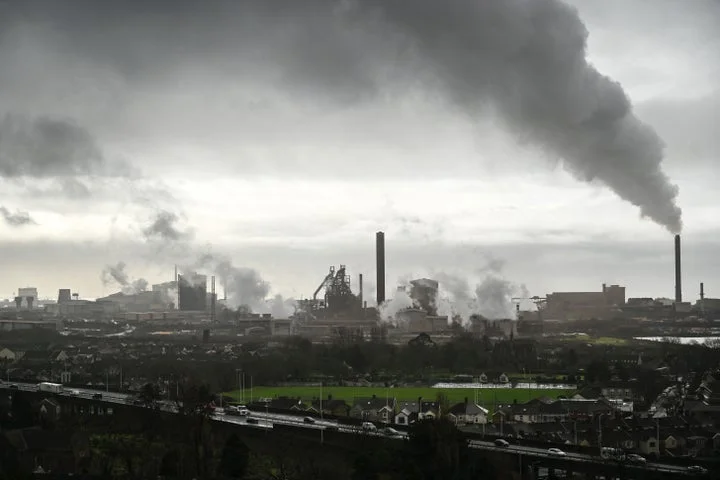
The ties between south Wales and Labour run deep, and Aberavon has long been one of the party’s safest seats.
But with the town of Port Talbot still reeling from the closure of the steelworks, Holly Evans meets locals who are, for the first time, considering a vote for a rival party
U ntil recently, lunchtime on a Thursday would have been a manic period for Steven Lightbrown, with a queue out of the door for fish and chips, pies and fritters.
But since the closure of the steelworks in Port Talbot in September 2024, the takeaway business that his father established 40 years ago in the industrial community of Taibach has taken a “massive hit”, losing almost half of its trade.
Locals remain loyal customers, but the drop in trade has forced Mr Lightbrown to reduce his hours at Steve’s Fish Bar to four days a week.
“Businesses have been heavily affected with the lack of people coming,” he tells The Independent.
“It’s affected morale, steelworkers were my main trade.
A lot of workers have now left the area, some have gone up to Hinkley Point, others have gone up to Trostre Steelworks.”
It has been 20 months since Tata Steel turned off the blast furnaces in the south Wales industrial town, with 2,000 workers made redundant after the company said the site was costing them £1m a day.
A new £1.25bn electric arc furnace is now being built and is due to open in 2028, but only 350 people are currently employed at the sprawling site.
It is a far cry from the 20,000 who worked there during its heyday in the 1970s, with a series of redundancies in 2014 and 2016 bringing a decade of uncertainty to the town.
Nigel Hunt was among those who lost his job 10 years ago and was forced to quickly rethink how to provide for his family.
“In September 2024, a lot of people were really disappointed that our working culture as a town had really been taken away from us,” he said.
“We felt that the steelworks had been surrendered by those in Westminster and when the equivalent threat happened in the north of England, we miraculously found money for that to keep steelmaking there.
This was their safest seat, and they surrendered the steelworks.
That will never go away.
Some people will never forgive them for that
“We’re a foundational industry which means we then supply car factories, Airbus and all the white goods factories throughout the UK.
There’s no long-term industrial strategy in the UK; it’s a shambles.
I think that people feel profoundly let down, and we’re going to see that in the election.”
Steelmaking has its roots in Port Talbot since the 1850s and has been the lifeblood of the town for generations, dominating the skyline from all angles.
Like steel, the Labour Party has a long-lasting association with Port Talbot, having been a red stronghold for more than a century.
Aberavon – the constituency now known as Aberafan Maesteg, in which Port Talbot sits – was held by Ramsay MacDonald, Labour’s first prime minister, and it has been one of the party’s most consistently safe seats for decades.
In fact, as recently as the 2017 election, Aberavon was the safest Labour seat in Wales.
However, with the tide turning against Sir Keir Starmer, the Welsh elections in May are proving to be divisive.
Nigel Farage visited the area in June and vowed that Reform UK would open new blast furnaces and would allow coal to be mined for use in the steelworks.
Plaid Cymru is also vying for power, with leader Rhun ap Iorweth promising to “breathe new life” into areas affected by industrial decline.
The Welsh nationalists have previously called for nationalisation and the introduction of clean, hydrogen-based steelmaking.
A sense of betrayal from Labour is clear among residents, with Welsh first minister Eluned Morgan’s party losing its hold on the local council in 2022.
“What will be interesting in the Senedd elections is, will they go to British nationalism or Welsh nationalism?
A lot of people see Reform as being an English nationalist party, they’ve got massive resources and some people are going towards them.
I find that really difficult to stomach, although I understand.
They give soundbites people don’t really look beyond.
“I find that particularly difficult because you’ve got the Valleys areas, which were decimated by the Conservatives in the mid-1980s.
Really, Reform are of that same political inclination, so for the Valleys people, that’s almost like turkeys voting for Christmas.
To me, I find the Welsh election quite a puzzle, an enigma.
What’s going to be interesting is the battle between Reform and Plaid Cymru: one believes in Wales and one that doesn’t really believe in it.”
While a spokesperson for Reform UK clarified that axing the Senedd would not appear in their Welsh manifesto, the party’s position on devolution remains complex.
In September, the caveat became “we do not want to shut the discussion down”.
Yet for many residents, it is answers they are seeking over how to continue their history as an industrial heavyweight in Britain, and how to ensure jobs for future generations.
A survey by Public Health Wales in July 2025 found that 44 per cent knew someone affected by the changes at the steelworks, with 83 per cent concerned it would impact people’s mental health and 89 per cent fearing for employment opportunities.
Mr Hunt said: “There’s a really big opportunity for the Welsh people to change from the Labour government, who have been here for years, and they’ve gotten stale.
“We didn’t really argue for what this means for the British and the manufacturing industry.”
On a positive note, more than three-quarters of residents told the recent survey that they felt the closures would have a positive impact on air quality in the area, after decades of smoke hovering over the town from the chimneys, with dust settling over cars and windowsills.
While steel is still produced at the works, the process now relies on imported slabs of steel, which are milled on site.
Driving along the five-lane entrance road to the industrial site, it is remarkably quiet with few lorries on the road, while the sea at Aberavon beach is no longer marked with ships entering the harbour.
The high street is also quiet, with several empty shopfronts – but the mood among the locals remains positive.
“I think the community has really helped each other, it’s one of those places, everyone rallies around to support,” local resident Daniel Nettle said.
“I don’t think it gets the attention it deserves.
We have the biggest steel industry in Europe and that’s just gone by the wayside.
Our biggest worry is what happens to Port Talbot, what happens to the jobs and the money that is no longer here.”
Mr Hunt, a former steelworker, turned to fashion after losing his job and established his own clothing brand, San Portablo, which has become renowned throughout south Wales for celebrating local culture.
Emma Wellington, who runs a local modelling agency encouraging young people to enter the arts, said: “I’d say Port Talbot is patriotic.
They are so proud of their town and beach.
“I would say it’s always been there, but there’s been a bigger push since the steelworks closed.
People loved them, it’s part of the history – everybody wants Port Talbot to succeed.”
Join thought-provoking conversations, follow other Independent readers and see their replies
Related Stories



Source: This article was originally published by The Independent
Read Full Original Article →
Comments (0)
No comments yet. Be the first to comment!
Leave a Comment