
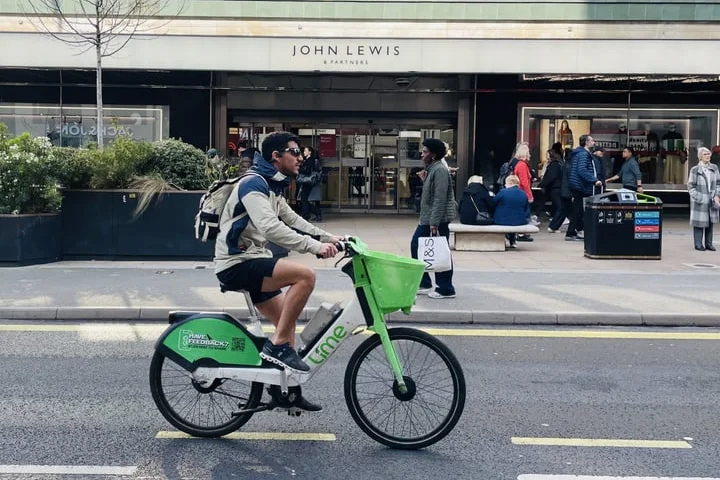
Two new cycle routes have been proposed as alternative ways to ride across central London after Oxford Street is pedestrianised.
Cyclists will be banned from the traffic-free section of Oxford Street once its western section – between Ikea and Selfridges – is pedestrianised by the end of the summer.
The removal of traffic – buses, taxis and bikes – is a central part of London mayor Sir Sadiq Khan ’s vision for transforming the street .
Westminster City Council has drawn up two proposed east-west routes, both to the north of Oxford Street, that it plans to develop as designated cycle lanes.
The one that will be prioritised will run via Manchester Square and will effectively loop around the top of the BBC after crossing Regent Street.
The other route, which would be subject to funding, follows an existing non-segregated cycle route (Cycleway 27) along New Cavendish Street.
However, neither is likely to be in place ahead of the pedestrianisation of Oxford Street.
The aim is for construction of the first of the cycleways to begin in about 18 months - meaning work would start by the end of 2027.
The council has abandoned consideration of a cycle route on Wigmore Street - the most popular alternative to Oxford Street that emerged from its consultation – due to the road’s narrow width and the fact it has been earmarked by Transport for London as the route for a number of buses that will be diverted off Oxford Street.
The council, currently under Labour control, has included the new cycle lanes in a £12.7 million five-year programme that was approved by councillors last month.
Both TfL and the mayor’s walking and cycling commissioner Will Norman are understood to back the plans, which are being driven forward by Westminster’s cabinet member for streets and “cycling champion” Max Sullivan.
TfL has contributed £835,000 to Westminster’s cycleway expansion programme in 2025/26, and provisionally a further £475,000 in 2026/27.
However, the plans could be ditched if Labour does not retain control of the council in May’s local elections.
The Manchester Square route would begin at Upper Berkeley Street and continue via Queen Anne Street, Duchess Street and Foley Street.
It has been chosen “due to the quiet nature of the streets and low traffic volumes”, making it safer for cyclists.
It would mean that some streets that are currently one-way for vehicles would be converted into two-way for cyclists.
Cyclist in life-threatening condition after bus crash in east London dies in hospital from his injuries
Anti-terror gates on Oxford Street will prevent cyclists riding through Sadiq Khan's 'pedestrian plaza'
Oxford Street bombshell as Labour chief describes Sadiq Khan quango as 'dangerous for democracy'
Oxford Street pedestrianisation gets go-ahead from Sadiq Khan with traffic ban this summer
Compared with other routes, “conflict points” with other traffic are judged to be minimal.
The Manchester Square alignment also connects with other cycle routes and would be “easy to follow”.
In addition, the council plans to consult on an east-west route to the south of Oxford Street, connecting Hyde Park through Mayfair to Soho.
The council says that the exact level of segregation on the Manchester Square route will be considered as part of the design process, with the aim of creating a “high-quality and suitable” cycling route that met TfL and national safety standards.
Related Stories



Source: This article was originally published by Evening Standard
Read Full Original Article →
Comments (0)
No comments yet. Be the first to comment!
Leave a Comment