
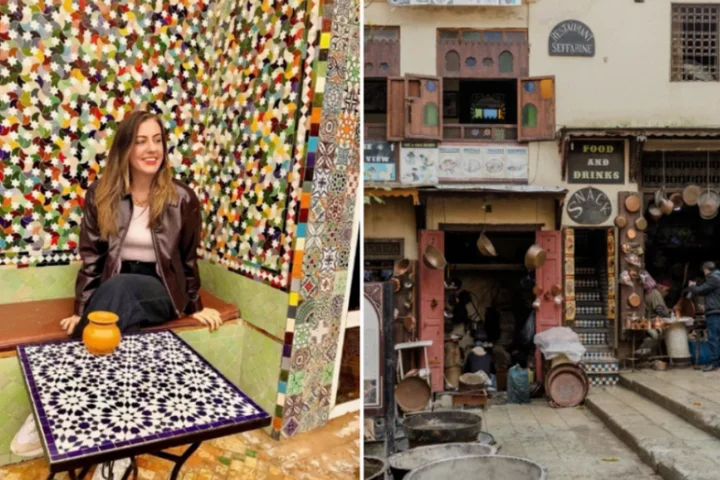
I recently returned from Fez, Morocco’s oldest city, where the streets are a a kaleidoscope of colourful tiled mosaics, and the people — who are fiercely proud of their heritage — welcome tourists with open arms.
More than just the name of the tasseled cap, founded in 808AD, Fez attracted creatives, philosophers and scholars in its heyday, becoming the country’s capital on and off for roughly 800 years.
The world’s first university can also be found here, built in 859AD by a woman, Fatima al-Fihri.
Best of Metro Deals
Get deal now
Get deal now
Get deal now
There are plenty of reasons to visit this one-of-a-kind place, but if I went back again, there a few things I’d change .
Here are all the things I’d do — and definitely wouldn’t — the next time I visit.
Do go to the Medina
There’s no traffic here, as the UNESCO-listed site is entirely pedestrianised, although you might have to step aside for the odd donkey and cart.
It’s wonderfully chaotic — and a little overwhelming.
To make the most of your time in the Medina (and to make sure you don’t get lost) book onto a walking tour.
I joined the Fes: Museum, Al Attarine Madrasa & Tannery and Medina Tour, available through Get Your Guide, which for a three and a half hour tour was a bargain at jut £10 per person.
Lead by an expert guide, the tour also ticked off sites such as the Nejjarine Fountain, the Chouara Tannery, and the Bou Inania Madrasa (a type of university).
We also stopped for lunch at the Palais Mnebhi, a 20th century palace and where the Treaty of Fez was signed.
Today, it’s a Moroccan restaurant was was frequented by none other than Madonna, who visited last year.
For something more low-key, head to Fez Cafe, a plant-filled terrace in the middle of the Medina, offering up local cuisine.
Do enjoy traditional cuisine with a cooking class
Originally from Hong Kong, Jessica met her husband while on holiday in Morocco 10 years ago.
He was working in the Riad she stayed in and, as Jessica told me, ‘it was love at first sight.’
Now, as far as she knows, she’s the only Hong Kong ex-pat in Fez, where she lives with Mohamed, his family, and their two-year-old daughter.
The class starts with our head chef, Yassin, asking us what we want to cook, while we’re treated to a delicious array of Moroccan biscuits.
Do not pass up the ghriba — a peanut shortbread.
Next, it’s a trip to the market with Mohamed to buy ingredients.
Whatever you might want to eat, goes into the basket.
Then, it’s back to the kitchen and the cooking begins.
Yassin and his sister do a good job at making us feel like we’re being useful — we chop, slice, season and sauté — but their skills are impressive, even if they try desperately not to show them off.
The vibes in this small kitchen were impeccable.
Moroccan music plays as delicious smells came from tagines and pots boiling on the stove.
At one point, there’s an impromptu dance break, as Yassin plays the garagab (sort of iron castanets), and let’s us try — and fail — to give them a go too.
And then, finally, the feast is ready.
There was vegetable tagine, tagine kafta (tagine with meatballs), lamb with fried eggplant… the list goes on.
The star of the show was undoubtedly the giant pastilla, a traditional savoury-sweet pie made with shredded chicken, spices and almonds.
You have to try one while you’re in Fez.
The hygiene here was of professional standard but if you’re worried about food poisoning, as I was, avoid raw fruit and vegetables, ice in your drinks, and undercooked eggs.
Do go in the spring
When I visited Fez in early February, I had hoped for some winter sun.
However, after seven years of drought, the city has welcomed unprecedented winter rain — ‘the worst rainfall in 40 years,’ was a phrase that kept getting banded around.
And it’s a trend that climate change experts predict could continue.
There’s also not much in the way of heating or insulation — my hotel mattress had not one but two electric blankets on it.
Whether it was lying in a hotel bed or eating at a restaurant, I wasn’t warm enough (and yes, I’d packed my big coat) at any point.
Instead, I’ll be returning in spring, where average temperatures sit at a balmy 25C.
Don’t get cash out before you go
Knowing that there’d be treasures everywhere I turned in the souks, I thought I’d want some cash to spend.
However, I probably should have done a little more research, rather than charge off to the nearest bureau de change I could find with Moroccan dirhams (MAD).
What I didn’t realise is that the MAD is a closed currency, meaning you can only only buy up to 2,000 in the UK, about £160.
I didn’t think I’d need much, so I only purchased around £80.
The problem was that when I didn’t spend my cash, returning it was a total nightmare.
The amount I’d paid £80 for, was only worth about £30 to sell back.
So, the next time I go to Morocco, I’ll make sure I exchange my cash at the airport, like every other savvy traveller.
That way, you’ll get a much better exchange rate.
Be prepared for a conservative city
Fez is regarded as more conservative the other Moroccan cities.
While alcohol is not illegal — and is available in more upscale hotels and in the Ville Nouvelle — you won’t find it widely served.
You’ll also likely notice that men and women don’t appear to mix all that much.
It was after a morning in the Medina that I realised I’d seen men hanging around and chatting, but not women.
None of these points are necessarily reason not to visit Fez, but it’s worth knowing, and deciding whether you’re comfortable with this, before booking a flight.
Don’t just stay in the city — go further afield
The city can be overstimulating, and if I go back, I’ll take a break and explore further afield.
Perhaps the most popular day trip is to Meknes, often described as a more laid-back alternative to Fez.
You’ll find a Medina here too, as well as a city gate, Bab Mansour, much bigger than the one in Fez.
In fact, an inscription on it reads ‘I am the most beautiful gate in Morocco’.
This trip is also often combined with a visit to Volubilis, an ancient city that was abandoned by the Romans around 300AD.
UNESCO listed, it’s the best-preserved archaeological site in Morocco.
Another popular excursion is to Chefchaouen, Morocco’s famous ‘Blue City’.
However, be warned, travel time is around four hours each way.
Nestled in the Rif Mountains, this artsy village is painted blue, a tradition which was believed to be started by Jewish refugees after WWII.
Today, it means that tourists head to Chefchaouen to wander among it’s azure streets.
Hikers can also walk out of the village and into the mountains, or take a 30 to 45 minute trip by car to the beautiful Akchour, famed for it’s waterfalls.
Flights & Accommodation
- Flights with Ryanair from London Stansted to Fes return start from £140
- A deluxe room at Riad El Kadi/La Maison Bleue starts from £200 per night
- For 5 star luxury, a deluxe room at Hotel Sahrai starts from £278 night
Get in touch by emailing MetroLifestyleTeam@Metro.co.uk.
Related Stories
Source: This article was originally published by Metro UK
Read Full Original Article →
Comments (0)
No comments yet. Be the first to comment!
Leave a Comment