
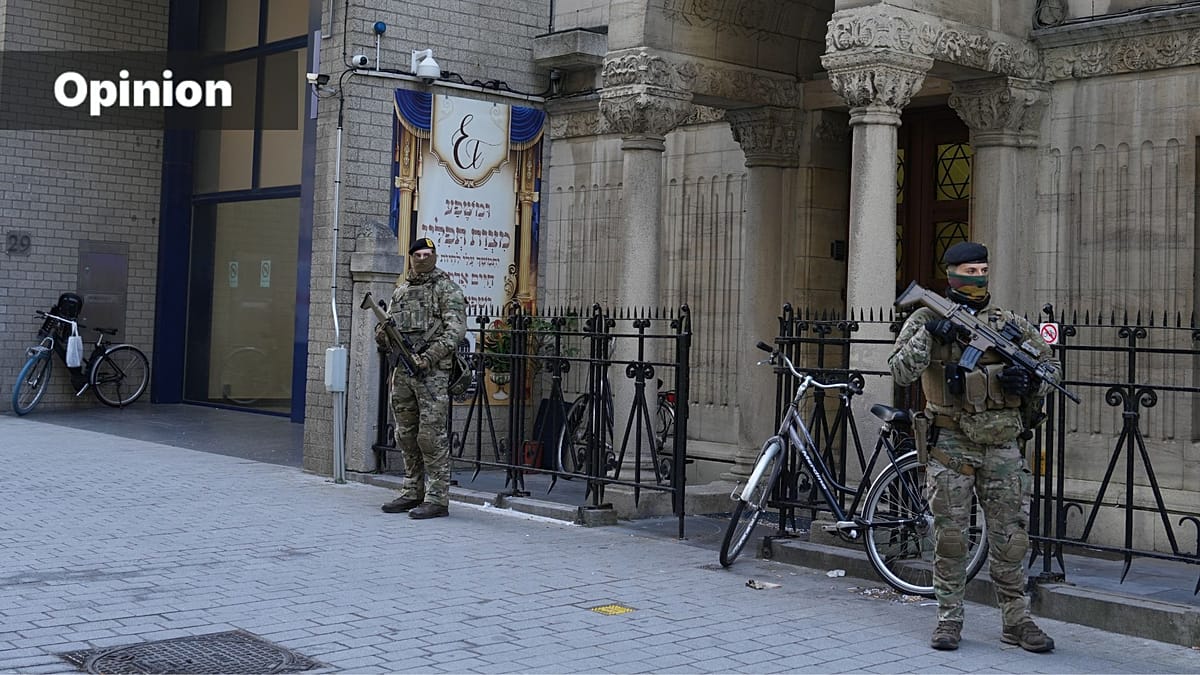
Two Belgian army soldiers patrol in front of a synagogue as part of a security deployment of soldiers outside Jewish institutions in Antwerp, Belgium, March 25, 2026
-
Copyright
AP Photo/Virginia Mayo
Copyright AP Photo/Virginia Mayo
By Sacha Roytman Dratwa, CEO of Combat Antisemitism Movement (CAM)
Published on
25/03/2026 - 18:27 GMT+1
The opinions expressed in this article are those of the author and do not represent in any way the editorial position of Euronews.
In an opinion piece for Euronews, Sacha Roytman Dratwa, CEO of the Combat Antisemitism Movement, warns that Jewish life in Europe is increasingly lived behind barriers - a sign, he argues, the continent is failing its post-Holocaust promise.
In 2004, I left Belgium as a young Jewish boy with a feeling I could not fully articulate at the time, but one that was already deeply present: as a Jew, I was not fully welcome
It didn't always come in the form of violence
Nevertheless, it was there; in the atmosphere, in the tension, in the quiet understanding that being openly Jewish came with a price and made you a target
More than twenty years later, I look back and what is most striking is not that things have improved
It's that they have gotten far worse
'Today, Jewish life in parts of Europe exists behind barriers'
Today, Jewish life in parts of Europe exists behind barriers that should never have been necessary
Synagogues are guarded, schools are protected by armed soldiers, and children grow up walking past military personnel just to enter their classrooms
This is not normal, and yet, it has become normalised
UK police investigate Jewish charity ambulance arson attack as hate crime
In London, ambulances belonging to a emergency openly service run by Jews yet serving all parts of the population were set on fire outside a synagogue, a deliberate act of intimidation
Golders Green in London, Monday, March 23, 2026 after an apparent arson attack on four vehicles belonging to a Jewish ambulance service, Hatzola Northwest
AP Photo/Alberto Pezzali
In Belgium, the country I left, a synagogue in Liège was targeted in an explosion
In Amsterdam, a Jewish school was attacked, part of a broader pattern of violence against Jewish institutions
More soldiers deployed to protect Jewish schools and synagogues
80 years after the Holocaust, Jewish children need military protection
Let that sink in
Eighty years after the Holocaust, Jewish children in Europe once again need military protection to go to school
This is not a security reality, it is a societal failure
My own family still lives there
My sister walks the streets of a European capital and makes a conscious decision every day not to wear any visible Jewish symbol
Not because she is ashamed but because she is afraid
Afraid of being targeted and attacked
That is the reality of being Jewish in Europe today
Explosion damages Jewish school in Amsterdam with no injuries reported, mayor says
My grandparents, who survived the Holocaust, did not live to see this moment
They believed, as many did, that Europe had learned, that their grandchildren would grow up in a different world
A world where being Jewish would not require fear
What makes this reality even more difficult to grasp is the comparison that so many Jews are now forced to make
It faces rockets, terror attacks, and constant external threats
And yet, in Israel, Jewish life is open
Synagogues are open, and communities are visible
Jewish identity is not something that needs to be hidden or protected behind visible military presence
More than 160 people injured following two Iranian missile strikes on southern israel
How is it that in Europe, a continent that built its modern identity on the memory of the Holocaust, Jews feel less secure than in a country under constant threat
The answer is uncomfortable, but clear
In Israel, Jewish life is the foundation of society
In Europe, Jewish life is increasingly treated as something that must be secured, contained, and protected
When a society reaches that point, it has already failed.
When I left Belgium in 2004, it felt like a personal instinct; something I couldn't fully explain
Today, it feels like a warning sign that was ignored, because what was once a feeling has now become reality
Belgian PM denounces 'antisemitic act' as police probe Liège synagogue blast
'Should we stay or should we go?'
Jewish communities across Europe are asking themselves questions that should have disappeared from history: Should we hide who we are
Should we remove our symbols?Should we stay or should we go
No child should grow up asking those questions, and yet, today, many do
Eighty years after the Holocaust, the promise was clear, that Jewish life would flourish freely in Europe not behind barriers, not under military protection, not in fear
That promise is now being broken
If Europe cannot ensure that a Jewish woman can walk safely wearing a symbol of her identity, that a synagogue does not need soldiers, that a Jewish school is not a target then something fundamental has gone wrong
It is about what Europe has become and what it is willing to tolerate
Sacha Roytman Dratwa is CEO of the Combat Antisemitism Movement (CAM), a global coalition engaging more than 1,000 partner organisations and seven million people from a diverse array of religious, political, and cultural backgrounds in the common mission of fighting the world's oldest hatred.
Belgium summons US ambassador in dispute over antisemitism accusations
Don’t shoot the messenger, Mark Rutte is right — for now
It’s ‘wrong’ and ‘concerning’ to cancel Israeli conductor from festival – EU Commission
Related Stories



Source: This article was originally published by Euronews
Read Full Original Article →
Comments (0)
No comments yet. Be the first to comment!
Leave a Comment