
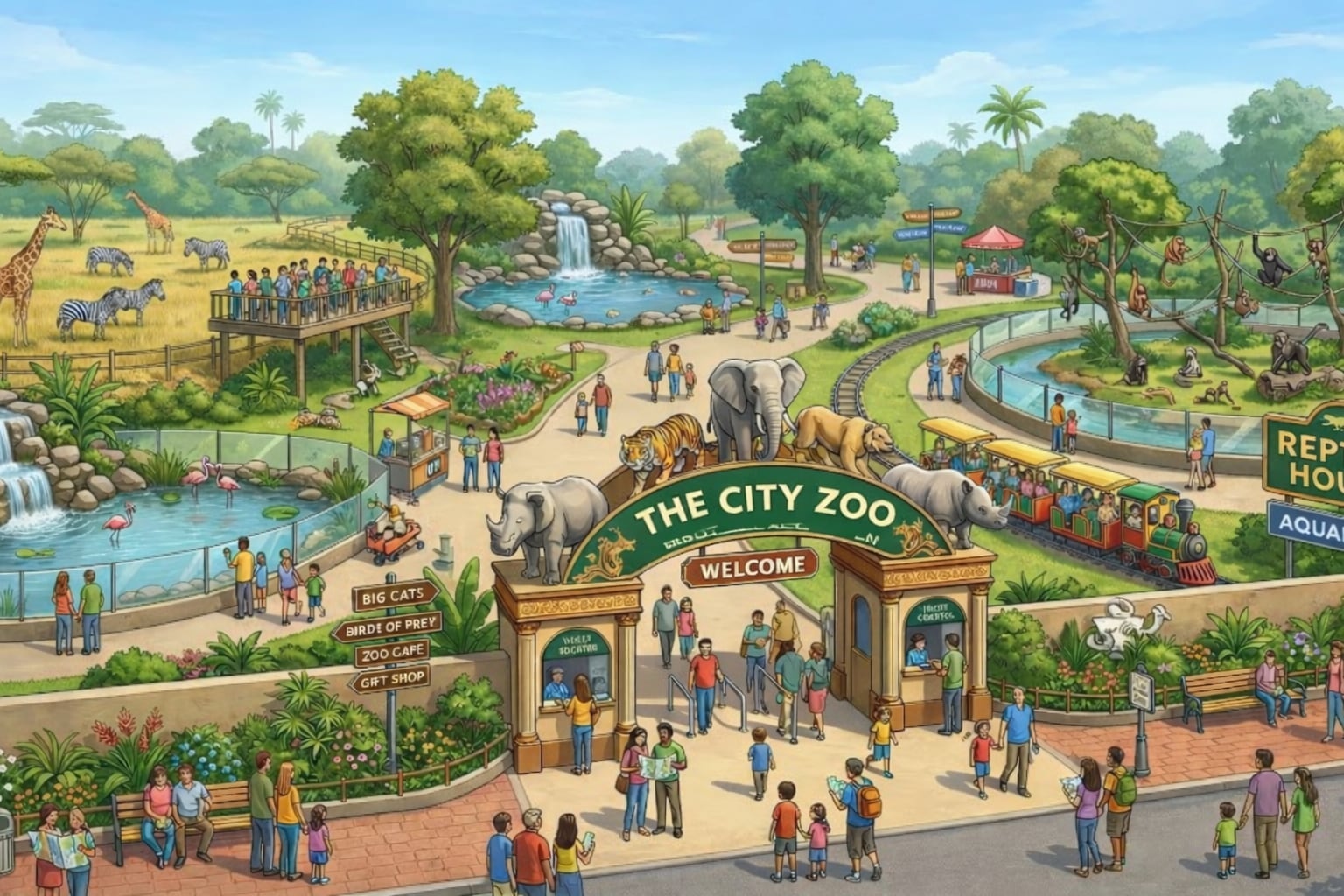
The paws 🐾 behind the iron bars 𐂺 cannot walk to the court, so a man did.They cannot file a petition, they cannot argue before a bench, and they certainly cannot walk through the gates of justice.
Recognising the battle of caged animals who lack the “craft to protest” against their confinement, theGauhati High Courthas stepped in as a powerful voice, taking note of a massive Rs 345.67 crore transformation that aims to turn the zoo enclosure into a dignified habitat.
Humans outrageously resist boundaries – even the slightest threat to their space sparks conflicts.
Yet, for an animal living in captivity, the zoo enclosure is their entire world.
Keeping this in mind,Prachurjya Borboruahfileda public interest litigation (PIL) seekingprotectionand better living conditions for animals, birds and other creatures kept in zoos across Assam.
A bench of JusticesAshutosh KumarandArun Dev Choudhuryheard Borboruah’s plea, which sought directions to zoo authorities in Assam, ensuring strict compliance with the guidelines for housing exotic animals under the Zoo Rules, 2009.
The Assam State Zoo-cum-Botanical Garden serves as a rescue andrehabilitationcentre for wild animals in distress, especially the exotic animals rescued from smuggling attempts by illegal traders in international markets.
The zoo serves as a temporary or, at times, even permanent shelter for the animals.
However, the PIL pointed out that the rescued animals are often kept in restricted spaces after being rescued.
D Gogoi, counsel for the Forest Department, submitted an affidavit indicating that the state government has already taken a policy decision to undertake a major overhaul ofzooslocated in Assam, with a special focus on the Assam State Zoo-cum-Botanical Garden.
The project is aimed at modernising the zoo’s infrastructure for animals, staff and visitors alike.
The court was informed that a work order for modernisation has been issued by the Chief Engineer, Public Works Department.
The project is valued at approximately Rs 345.67 crore and is scheduled to be completed by November 29, 2026.
The plan is expected to significantly upgrade the existingfacilitiesand transform the zoo into a modern wildlife conservation and visitor education centre.
Once on the brink of extinction, this species has made a resilient recovery across the floodplains of Assam and Nepal — a landmark conservation success story.
Recognizable by its golden coat, this primate is restricted to a narrow corridor between Bhutan’s Black Mountains and the Brahmaputra River.
India’s only ape species, known for haunting vocal duets.
Populations have collapsed by nearly 90% in 30 years due to relentless deforestation.
An elusive, arboreal predator with the largest canine teeth relative to body size of any feline — the “modern-day saber-tooth” of the Northeast rainforests.
A specialist of tall, wet alluvial grasslands that builds unique thatched nests with roofs.
Presumed extinct until rediscovered in 1971.
Its presence signals the health of an entire grassland ecosystem.
Gogoi informed the bench that the project includes a comprehensive redesign ofanimalenclosures.
The specifications are being revised and upgraded in accordance with the guidelines issued by the Central Zoo Authority, which prescribed minimum space requirements and structural standards for housing exotic and indigenous animals.
The objective would be to ensure that the animals were kept in enclosures that provide sufficient space, environmental enrichment and conditions closer to theirnaturalhabitats.
It was further submitted that, as part of the ongoing modernisation project, these rescue facilities would also be upgraded.
The authorities will make all efforts to ensure that the housing arrangements for rescued exotic species also comply with the prescribed guidelines on enclosure dimensions and animal welfare standards.
Taking note of these assurances, the bench observed that the concerns raised by Borboruah in the PIL had been adequately addressed by the stateauthoritiesthrough the proposed modernisation initiative.
The court expressed satisfaction that the government had taken concrete steps to align zoo infrastructure with the applicable guidelines and rules governing animal welfare.
While closing the PIL, the court made an important observation to safeguard the interests of captive animals.
The bench clarified that if the petitioner, upon examining the architectural illustrations, structural designs or any other relevantmaterialsrelating to the modernisation project, finds that the guidelines of the Central Zoo Authority are not being adhered to, he would be at liberty to seek revival of the petition “by filing a two-page affidavit,” in which situation, the PIL will be addressed again.
For now, theGauhati High Courtmight have closed the PIL, but it has kept its doors open for future interventions if necessary, ensuring that the interests of animals who cannot approach courts themselves remain protected under the rule of law.
For living creatures that cannot speak human language, covering the distance to justice remains a challenge, but assurance matters.
Anenclosurethat defines their world, and ours too.
Like cherished childhood memories, the zoo still plays a prominent role in connecting their world to ours.
A promised home and humane care rest on humans who hold the keys to those locked cages.
The pleaders might not knock on the courtroom with their paws, but a human again would.
We all shall have access to justice till there is someone choosing to listen.(With inputs from Sumit Kumar Singh)
Somya Panwar works with the Legal Desk at The Indian Express, where she covers the various High Courts across the country and the Supreme Court of India.
Her writing is driven by a deep interest in how law influences society, particularly in areas of gender, feminism, and women’s rights.
She is especially drawn to stories that examine questions of equality, autonomy, and social justice through the lens of the courts.
Her work aims to make complex legal developments accessible, contextual, and relevant to everyday readers, with a focus on explaining what court decisions mean beyond legal jargon and how they shape public life.
Alongside reporting, she manages the social media presence for Indian Express Legal, where she designs and curates posts using her understanding of digital trends, audience behaviour, and visual communication.
Combining legal insight with strategic content design, she works on building engagement and expanding the desk’s digital reach.
Somya holds a B.A.
LL.B and a Master’s degree in Journalism.
Before moving fully into media, she gained experience in litigation and briefly worked in corporate, giving her reporting a strong foundation....
Read More
Related Stories


Source: This article was originally published by The Indian Express
Read Full Original Article →
Comments (0)
No comments yet. Be the first to comment!
Leave a Comment