
If you have a cardiac arrest outside of hospital, your chance of survival is pretty slim, with just 1 in 10 making it.
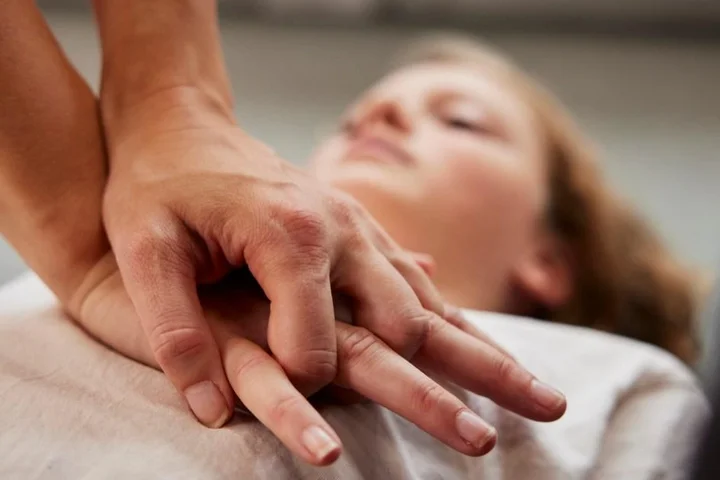
But immediate CPR can be life-saving — doubling or even quadrupling your chances of recovery.
If there’s a defibrillator available, and its used within three to five minutes of collapse, your chances of living to tell the tale shoot up even further, to 50 to 70%.
There are plenty of stories of heroic strangers coming to the aid of people in need.
But if you’re a woman, you’re actually less likely to receive help compared to men, all because people feel too awkward.
A 2024 US study found that women were 27% less likely to be given help, while data released by Thames Valley Air Ambulance earlier this month found that one in three women who suffer a cardiac arrest receive no CPR before emergency crews arrive.
The charity said that it’s not because ‘bystanders don’t care, but because they hesitate,’ with chief executive Amanda McLean saying ‘modesty should never get in the way of saving a life’.
She added: ‘Many people feel unsure about touching a woman’s chest, removing clothing or cutting through a bra to apply defibrillator pads.’
While CPR can be performed over clothes, a defibrillator needs to be placed on bare skin to deliver the shock.
Now, some first-aid charities have started using female mannequins to help build confidence.
Footage from a training session with East Anglian Air Ambulance shows community training programme manager, Josh Lawrence, explaining how to effectively help female patients.
He explains: ‘Make sure those [defibrillator] pads are touching the chest, and we can do that by either removing the bra completely, or moving the bra out of the way.’
Legal concerns are often one of the reasons people may not feel sure enough to help.
On Metro’s social channels, thousands of comments expressed their concern over getting into legal trouble when coming to a person’s aid.
‘Sorry, but I refuse to get sued for trying to help someone,’ wrote one commenter on TikTok.
While another added: ‘Best I’m doing is calling an ambulance.’
And a third said: ‘I’m trained and confident with CPR, but I’m so scared of being sued for trying to help someone.’
However, the SARAH (Social Action, Responsibility and Heroism) Act 2015 offers Good Samaritans protection.
According to the government website, the bill is ‘intended to reassure people, including employers, that if they demonstrate a generally responsible approach towards the safety of others during a particular activity, the courts will take this into account in the event they are sued for negligence.’
The act makes it extremely unlikely that a person could be sued for providing first aid, as long as that individual is acting ‘responsibly and heroically.’
In the UK, public awareness and confidence in performing CPR is low, but it can be the difference between life or death.
If you’d like to get clued up on how to perform this life-saving action, there are lots of tools at your disposal.
- The British Heart Foundation offers RevivR, a free online CPR training tool, which is free to use on your phone or tablet, and takes just 15 minutes.
- The St John Ambulance resource hub includes training videos and resources.
Many community hubs, including schools and clubs, as well as your workplace, may also provide CPR training.
Out-of-hospital cardiac arrest
Cardiac arrest is a critical medical emergency, where the heart stops pumping blood around the body.
Unless treated immediately, it leads to death within minutes.
• There are more than 40,000 out-of-hospital cardiac arrests (OHCAs) in the UK each year.
• The estimated survival rate in the UK is less than one in ten.
• Every minute without cardiopulmonary resuscitation (CPR) and defibrillation reduces the chance of survival by up to ten per cent.
• Early CPR and defibrillation can more than double the chances of survival.
• It’s estimated that public-access defibrillators (PADs) are used in less than ten per cent of OHCAs in the UK.
Get in touch by emailing MetroLifestyleTeam@Metro.co.uk.
Related Stories



Source: This article was originally published by Metro UK
Read Full Original Article →
Comments (0)
No comments yet. Be the first to comment!
Leave a Comment