
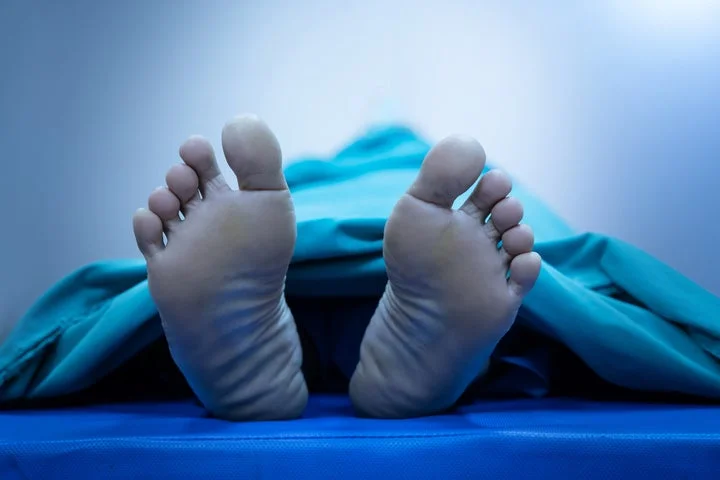
Cadaver tissue injections are becoming popular among US weight loss jab users who want their boobs and bum back.
Lydia Spencer-Elliott asks experts if they think the macabre product will soon make it across the pond
W ould you want fat from a dead body pumped into yours for a little added oomph?
It’s a morbid question many answered with a resounding “yes” when the so-called “zombie filler” slowly emerged on the US market in 2024.
Today, stateside clinics now have months-long backlogs of plump-seeking patients waiting to get their hands on vials of sterilised cadaver tissue.
Read: Brazilian butt lifts (BBLs) and boob jobs are now being sourced from the morgue.
Zombie filler – real name alloClae – was first released by manufacturer Tiger Aesthetics to a select group of doctors across the pond in 2024.
When people donate their bodies to science after their death for altruistic acts like organ donation, tissue banks often collect their fat, too.
Tiger Aesthetics then purchases it, screens it for diseases, sterilises and processes it, before selling it to surgeons in a little branded syringe, with the deceased’s fat now resembling severely curdled cake batter.
The main perk of having a dead person’s fat injected into your body is a reduced recovery time.
For a BBL, while the buttocks still have to heal, there will be no other areas of liposuction (where fat is taken from donor areas) to heal as well.
And while a boob job or BBL would normally require general anaesthesia and days of healing time, patients can have zombie filler injected into the desired areas with local anaesthesia – on their work lunch break.
It also means that slim people with no excess fat of their own to funnel into the areas where they desire curves can now get it from somewhere (or, rather, someone) else.
This, in the age of Ozempic , Wegovy and Mounjaro, is big business.
People have shifted the excess weight they didn’t want – but now they’re clambering to add a touch back in.
Nora Nugent, President of the British Association of Aesthetic Plastic Surgeons, says that she is seeing increasing numbers of weight loss patients at her surgery in the UK.
“I wouldn’t say most patients know about alloClae yet, but in the last six months or so, I’ve had patients specifically ask about it when I’ve talked to them about procedures like fat transfer, particularly for breast surgery.
It’s coming into people’s awareness.”
Right now, alloClae is only officially available in the US.
Tiger Aesthetics did not respond to requests for comment on whether they planned to expand to the UK in the future.
“At the moment, it’s not licensed by the Medicines and Healthcare products Regulatory Agency (MHRA),” explains Nugent.
“Ultimately, it will probably come to market in the UK – but it’s not right now.
If you’re offered it, something has gone wrong.”
Founder of Safety in Beauty – a UK-based support organisation for the industry – Antonia Mariconda takes this warning one step further: “Any current use will be off the radar on the black market offered by a handful of questionable non-medical individuals,” she says, adding there’s “growing speculation within the industry” that the product and others like it will enter the UK market legitimately “in the near future”.
Black market zombie filler is – as you might have guessed – bad news.
“Inadequate cleaning, incorrect autoclave use, or lack of validation can lead to cross-contamination and serious infection,” says Mariconda.
“Similarly, if fat is not harvested and processed under strict aseptic conditions, there is a risk of bacterial contamination, reduced tissue viability, and complications such as infection, fat necrosis, or inflammatory reactions.” Essentially, the fat could get lumpy and die.
If you don’t know where backstreet fat has come from, then you can’t verify how well it’s been processed or sterilised.
“Poor documentation and lack of traceability further increase risk by limiting the ability to respond effectively to incidents,” Mariconda notes of the risk to patients.
As with all new products, experts have very little idea of how zombie fat could look or feel as it ages.
“The jury is still out on long-term longevity,” says Nugent.
“It’s promising, but we don’t have very long-term data on it.
So, we don't know if there could be unknown issues in 20 years’ time.”
Despite its ability to be administered while you’re still awake, Mariconda also warns that zombie filler shouldn’t be considered in the same blase way as many see procedures like dermal fillers or Botox.
“One of the key concerns we’re observing is the potential for these treatments to be positioned alongside standard injectable procedures, when in reality they require a higher level of medical expertise, clinical governance and patient consent,’ she says.
“There remains a lack of clear, consistent guidance around who is suitably qualified to perform such procedures – and in what setting.”
And even if it were, Nugent notes that alloClae has altruistic potential: “A lot of breast cancer reconstruction patients have fat transfer as well,” she says.
“So, its use wouldn’t be entirely restricted to purely cosmetic purposes.
But, for donors, it will be a very individual decision.
Most people will assume their tissue will be used for someone badly in need.”
Should fat be flown across the Atlantic, there would be an expiry date – but transportation is possible without the fat breaking down.
“It’s sterilised, so it has a shelf life,” says Nugent.
“It’s not a living tissue anymore, so it doesn’t need to be in a freezer or cold storage.”
That being said, demand is so high that America may not have much to spare.
And, as cadaver fat is now a precious and finite resource, the procedure, including surgeon fees – can cost up to $100,000 (£73,792), Business Insider reports, depending on how many cubic centimetres of fat you want.
As far as modern society is concerned, it’s akin to sterilised gold.
Earlier this year The Sun reported that Taylor Frankie Paul of Secret Lives of Mormon Wives was known to have received the treatment.
If it does come to the UK, a similarly high price tag is expected initially.
“Alloclae is the first of its kind, so other companies will be looking at this and developing their own products,” says Nugent.
“Over time, it would likely become cheaper or more alternatives would become available,” she says.
No end of warnings have been issued about the sale and use of cheap dermal fillers and Botox available online.
With the demand for zombie filler predicted to soar, Nugent predicts a similar race to the bottom could take place if the right quality control measures aren’t enforced.
“It depends on whether knockoff versions come to the market,” she says, “and on the company's sales policy, which, I've no reason to think, is anything other than above board at the moment.”
Safety aside, zombie filler initially seems like an Adam’s Family nightmare that opens up the unforeseen ethical conundrum: Is it right to have somebody else’s fat injected into your body?
“I'm not against it coming to the UK,” says Nugent.
“For me, it’s in the same realm as donated skin for burn patients – or organ transplants.
It’s no spookier than that.”
Join thought-provoking conversations, follow other Independent readers and see their replies
Related Stories


Source: This article was originally published by The Independent
Read Full Original Article →
Comments (0)
No comments yet. Be the first to comment!
Leave a Comment