
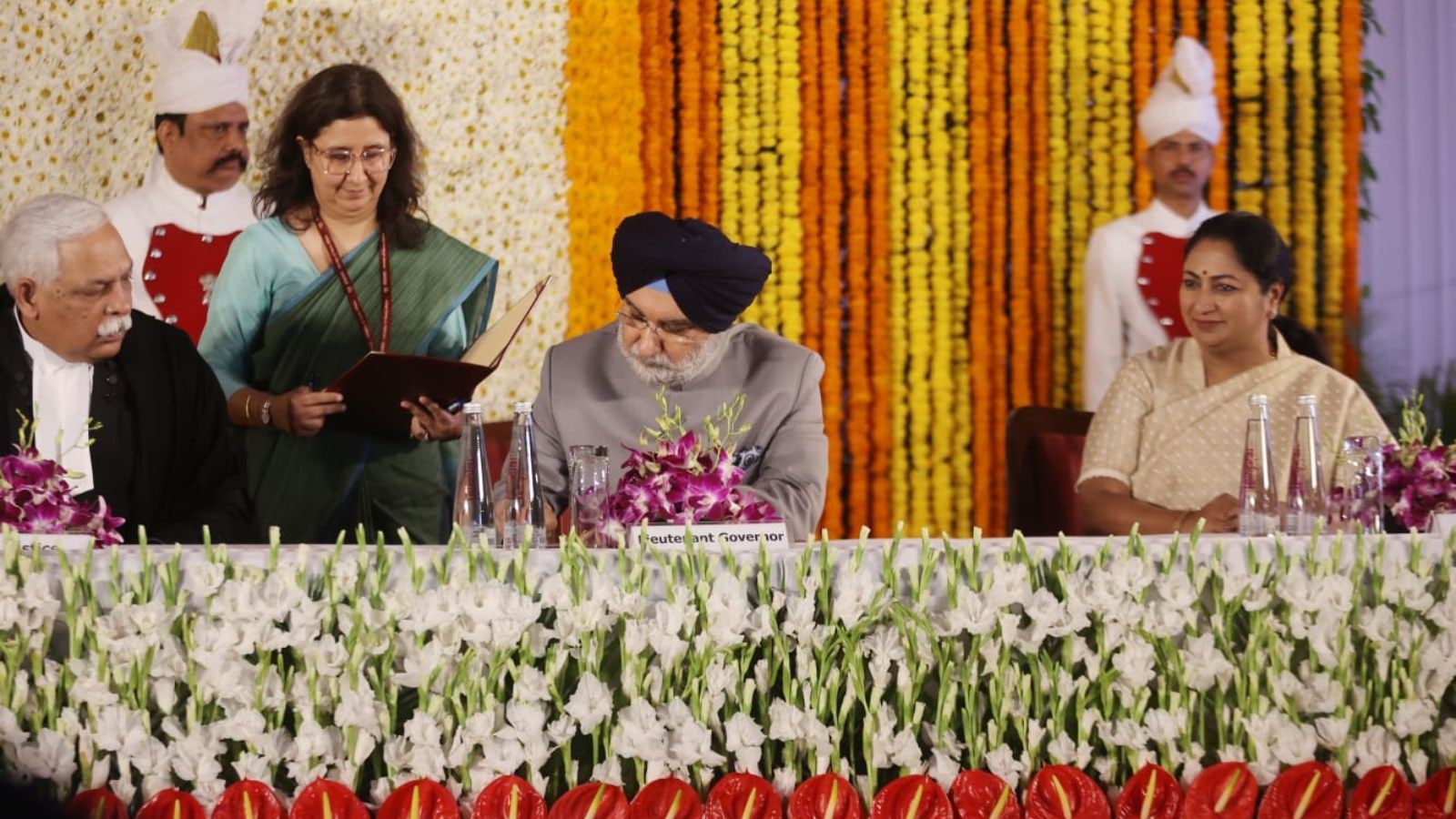
Development of the Yamuna riverfront and parks, unlocking the national capital’s real estate market: newly sworn-in Lieutenant Governor of DelhiTaranjit Singh Sandhuhas several important tasks at hand as he also assumes charge as Chairman of the Delhi Development Authority (DDA) and will be responsible for pushing through reforms and policies.
Cleaning and rejuvenating the river was one of the key promises of the Bharatiya Janata Party (BJP) in its Assembly poll campaign last year, and has been reiterated by Prime Minister Narendra Modi and Chief MinisterRekha Guptaas one of the government’s top priorities.
A significant element of the plan is building the Yamuna riverfront, which will be done by the DDA.
TheIndian Expresshad previously reported that the riverfront will come up near Sarai Kale Khan, at the site of the erstwhile Millennium Park Bus Depot.
The government wants to replicate Gujarat’s Sabarmati riverfront model in the Capital.
The riverfront project is also part of the DDA’s plans to redevelop the 22-km stretch of the Yamuna between Wazirabad barrage and Okhla barrage.
Eleven floodplain projects are to be developed on the floodplains on 1,500 hectares, out of which five are ready.
Work is still on for the Kalindi Biodiversity Park adjacent to the DND Flyway; the Mayur Nature Park near Nizamuddin Bridge; a new Eco-tourism area near Rajghat; Yamuna Vansathali; and Hindon Sarovar.
As chair of the DDA, Sandhu will also be at the forefront of bringing out theDelhiMaster Plan (MPD) 2041, which will shape the national capital’s land use and housing and infrastructure for the next two decades.
While the DDA and previous L-G V K Saxena had approved a draft of the MPD 2041, it is pending for approval with the central government since 2023.
The DDA has since sought to push through major components of the plan as standalone policies such as the land pooling policy.
Part of MPD 2041 initially, the land pooling policy was aimed at opening up large areas of land in Outer Delhi areas like Bawana and Najafgarh — currently under small-scale agriculture and haphazard unauthorised development — for large-scale planned development by the private sector.
But there has been very slow progress on it.
Amendments to speed up land pooling have also been pending with the Centre since 2022.
The DDA recently released the latest version of its transit-oriented development (TOD) policy — also part of MPD 2041 — which seeks to open up large areas of the city near Metro corridors for more construction by granting those land parcels higher Floor Area Ratio (FAR).
The previous policy did not see much participation from the private sector.
Delhi’s slum rehabilitation policy, which encourages private developers to rehabilitate slum dwellers on one part of the land, while using the rest of it for commercial profit, has also failed to take off.
Only one project, the Kathputli Colony rehabilitation, being carried out by Raheja Developers was started but has not been completed.
All these three policies, if successfully implemented with the participation of the private sector, will lead to the creation of housing and infrastructure needed to support Delhi’s more than 2-crore population.
Apart from pushing these policies and securing approval of MPD-2041, L-G Sandhu will play a critical role encouraging the private sector to participate in Delhi’s development.
Devansh Mittal is a Correspondent at The Indian Express, based in the New Delhi City bureau.
He reports on urban policy, civic governance, and infrastructure in the National Capital Region, with a growing focus on housing, land policy, transport, and the disruption economy and its social implications.
Professional Background
Education: He studied Political Science at Ashoka University.
Core Beats: His reporting focuses on policy and governance in the National Capital Region, one of the largest urban agglomerations in the world.
He covers housing and land policy, municipal governance, urban transport, and the interface between infrastructure, regulation, and everyday life in the city.
Recent Notable Work
His recent reporting includes in-depth examinations of urban policy and its on-ground consequences:
An investigation into subvention-linked home loans that documented how homebuyers were drawn into under-construction projects through a “builder–bank” nexus, often leaving them financially exposed when delivery stalled.
A detailed report on why Delhi’s land-pooling policy has remained stalled since 2007, tracing how fragmented land ownership, policy design flaws, and mistrust among stakeholders have kept one of the capital’s flagship urban reforms in limbo.
A reported piece examining the collapse of an electric mobility startup and what it meant for women drivers dependent on the platform for livelihoods.
Reporting Approach
Devansh’s work combines on-ground reporting with analysis of government data, court records, and academic research.
He regularly reports from neighbourhoods, government offices, and courtrooms to explain how decisions on housing, transport, and the disruption economy shape everyday life in the city.
X (Twitter): @devanshmittal_
Email: devansh.mittal@expressindia.com...
Read More
Stay updated with the latest -Click here to follow us on Instagram
Related Stories



Source: This article was originally published by The Indian Express
Read Full Original Article →
Comments (0)
No comments yet. Be the first to comment!
Leave a Comment