
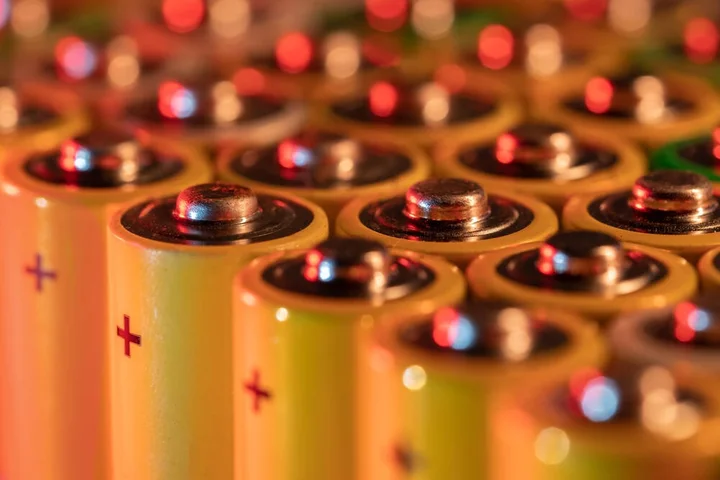
It won't provide much juice, but its creator calls it a 'nanowatt nuclear power plant'
It's illegal and impractical to construct a nuclear power plant in your backyard.
But a DIY tritium nuclear battery is far less dramatic - just don't expect any appreciable amount of energy from it.
You don't even need any specialized supplies, as YouTuber and electrical engineering enthusiast Double M Innovations demonstrated in a recent video .
Don't expect to get much energy out of the whole mess, but all it takes for aspiring nuclear electricians to whip up, in the YouTuber's words, a "nanowatt nuclear power plant" is a couple of old solar-powered calculators, some tritium gas vials, and tin foil.
The idea is a relatively simple one: Tritium vials glow because beta decay excites a phosphor coating, and that emitted light can generate a small current in solar cells, albeit far less efficiently than natural light.
Tritium gas can be purchased cheaply in small vials online, or in the form of keychains, which can usually be easily opened to remove the vial.
Sandwich those vials between a pair of solar cells pried from cheap calculators, insulate 'em, and wrap them in tin foil to block out the light, and voilà: A very small, very ineffective nuclear battery that should run for around 12 years, which is the half-life of tritium.
Again, this didn't exactly get Double M much in the way of usable energy.
Before he wired the two solar cells together, the contraption only produced around half a volt and no measurable current.
Once the two cells were wired together, the current rose to the nanoamp range, which still isn't enough to produce much measurable electricity.
Produce it did, however - at least when left alone for an extended period of time.
After hooking the battery up to a capacitor and leaving it for a day, the capacitor managed to reach 2.8 volts.
To give an idea of how little energy the battery was actually putting in, measuring the voltage with a meter caused it to drop quite quickly, as the video demonstrates.
This, obviously, won't be transforming energy paradigms anytime soon, with Double M only describing it as a proof of concept following limited success with an alpha particle version of the battery in a prior video .
"I am getting some energy from my poor man's nuclear battery," Double M noted in the video.
"But it's just a teeny tiny amount - maybe enough to flash an LED every once in a while."
Beta decay batteries, like the one made by Double M in this new video, are used in niche low-power applications where extremely long service life matters more than output, including remote sensors, some implantable medical devices, and space-oriented research.
Many higher-power nuclear battery concepts, by contrast, rely on alpha-emitting isotopes or decay heat.
Alpha radiation has more potential to generate energy, as well as being more dangerous to humans, which has made it the preferred power source for agencies like DARPA, which recently commissioned the private sector to develop high-powered nuclear batteries that use alpha particles.
DARPA's dream batteries would be used in remote environments, like space, meaning the alpha decay they give off, even if easily blocked, wouldn't be a risk to humans.
In other words, don't expect a few keychains and broken calculators to generate any appreciable power - at the very least, it's a neat concept.
Alternatively, if one had enough time, budget, and space, they could build a massive keychain battery with enough power to do something crazy like charge a smartphone.
Bored investors, feel free to inquire with us if you have the funding.
It sure beats being arrested for building a full-fledged DIY nuclear reactor .
®
Related Stories



Source: This article was originally published by The Register
Read Full Original Article →
Comments (0)
No comments yet. Be the first to comment!
Leave a Comment