
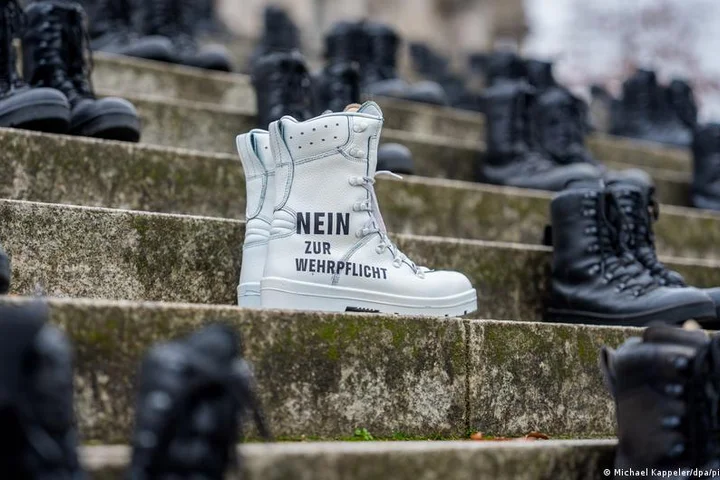
Military service remains voluntary in Germany.
However, with the Bundeswehr needing more soldiers, conscription could soon return.
But an increasing number of young men are choosing to opt out.
Phil Werring is thinking about refusing to serve in the military.
He does not want to join the German army, the Bundeswehr .
"They always say it's about defense," the student told DW.
"But I don't see the threat situation and therefore I have no interest in completing compulsory service in the army."
Military service remains voluntary in Germany, but that could soon change.
The army needs at least 60,000 additional soldiers in the next few years.
It's considered unlikely that many Germans will willingly sign up — not only by military experts.
Werring doesn't think so either: "It's only a matter of time before compulsory military service is implemented."
Together with like-minded people, Werring has helped organize the nationwide "School strike against compulsory military service." Werring, who attends a high school in the western city of Münster, is one of the initiative's spokespeople.
He turns 18 this year and the issue of conscription is a big one for him and his friends.
This is also because of Germany's new military service laws : Since the beginning of 2026, the army has been sending all young men a questionairre around their 18th birthday to which they are obligated to respond.
"Are you interested in becoming a soldier?" is one of the questions.
Young men can answer on a scale of zero to 10, with zero meaning they have "no interest." There are further questions about physical fitness and educational achievement.
But filling in the questionnaire isn't the end of it.
Even people who have expressed "zero interest" in becoming a soldier can't avoid muster — that is, a medical examination by an army doctor.
This has also been mandatory for young men born from 2008 onwards since the beginning of this year.
Women can volunteer to serve in the army, but only men can be legally obliged to complete the physical examination or military service.
The Bundeswehr's intensified recruitment campaign, the possible return of conscription, the discussions about a possible attack by Russia against NATO territory — all of that has consequences.
For many young men, it has prompted them to consider applying for conscientious objection to military service.
If someone is recognized as a conscientious objector, he cannot be called up to serve in the military, even to defend the country.
Germany looks at conscription to boost military numbers
To view this video please enable JavaScript, and consider upgrading to a web browser that supports HTML5 video
Right to conscientious objection enshrined in German constitution
"Nobody must be forced into armed military service against his conscience," it states in Germany's Basic Law , the constitution, a reaction to the experiences from the two world wars and the National Socialist dictatorship.
It is irrelevant whether or not conscription is currently in effect.
Active soldiers and reservists also have the right to refuse military service.
Germany had compulsory national service for decades, with young men offered a civilian service option if they did not want to be in the army.
This was suspended in 2011.
In subsequent years, the army was greatly reduced in size and only a few people refused military service.
The situation changed with the full-scale Russian invasion of Ukraine in 2022 .
Since then, the number of conscientious objectors has continually risen.
In 2025, a new high was reached with 3,879 applications, a spokesperson for the Federal Office for Family Affairs and Civil Society (BAFzA), told DW.
The trend continued for the first two months of this year: by the end of February, about 2,000 applications for conscientious objection had been registered.
Making such an application is not trivial, and requires preparation.
As a result, advisory organizations that counsel people through the conscientious objection process have seen an increasing number of inquiries.
The German Peace Society — United War Service Resisters (DFG-VK) has now established a nationwide network of more than 200 volunteer advisers.
Germany seeks to recruit 80,000 more active soldiers
Personal moral dilemma is deciding factor
In recent weeks, Lothar Eberhardt has facilitated numerous counselling interviews for the DFG-VK in Berlin.
These focus mostly on the core element of the application: The personal reason someone cannot perform military service for reasons of conscience.
"What is the moral dilemma and the individual circumstances of the person that have led him to say no to war?" That is what he is trying to draw out of the people he counsels, Eberhardt told DW.
Such a conversation could take an hour or more.
Eberhardt himself is a recognized conscientious objector and has been an adviser on this matter for about 50 years.
Formulaic submissions and general arguments are of no help to the applicants — their personal statement must convince the expert assessor.
"If somebody has thought through their reasoning and credibly articulated their moral dilemma and conflicts, then generally nothing should stand in the way of recognition," Eberhardt said, according to his experience.
However, applications are rejected from time to time.
Phil Werring is also considering applying to be a conscientious objector.
He can imagine getting together with friends and classmates to explain that they want to refuse military service.
"Then we will show in a high-profile public action that we have no interest in being sent to war," he said.
In any case, when his Bundeswehr questionnaire arrives, he will answer "no interest."
This article was originally written in German.
Related Stories



Source: This article was originally published by Deutsche Welle (DW)
Read Full Original Article →
Comments (0)
No comments yet. Be the first to comment!
Leave a Comment