
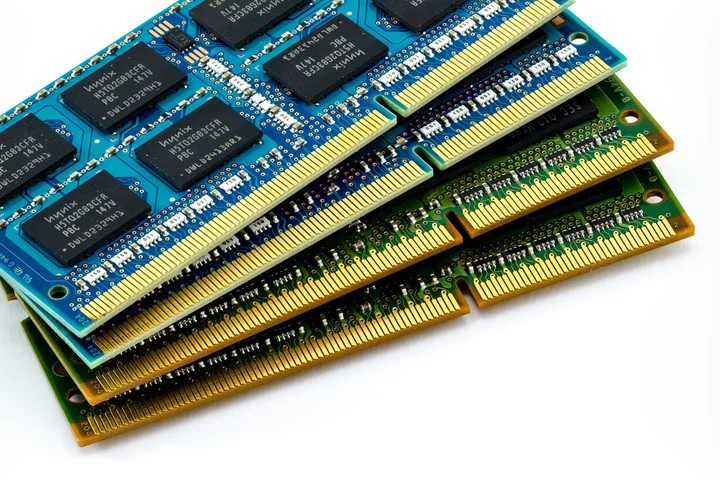
What are you doing to solve the memory crisis?
If you follow PC hardware prices, you’ll know AI demand has pushed memory prices higher as manufacturers prioritize memory for datacenters.
To deal with that, you can pay through the nose, buy less memory, or ...
try to build your own DRAM.
Dr.
Semiconductor is a YouTuber who joined the platform in February and has only published two videos so far.
One shows his process of turning a backyard shed into a cleanroom tidy enough to make his own semiconductors, while the other shows him producing working sample memory cells.
The YouTuber opens his second video on the making of his sample chips with an acknowledgment that the whole experiment has been driven by RAM prices skyrocketing last year and into the beginning of 2026 , leading to vendor quotes that constantly fluctuate and even delays in broadband expansions caused by a lack of memory chips.
Against that backdrop is Dr.
Semiconductor, whose video walks through the process inside a tiny cleanroom equipped to make DIY RAM cells.
Like any good RAM manufacturing process, Dr.
Semiconductor started by designing a 5x4 array of capacitors and transistors - barely a fraction of the number of cells on a modern DRAM chip - then transferring the design onto silicon, coating it with photoresist for patterning and etching, and doping parts of the chip with phosphorus to increase conductivity.
He then built up microscopic layers one by one without any of the industrial automation available to Samsung, SK hynix, or Micron.
After making a few small sample chips, Dr.
Semiconductor tested them using his parameter analyzers.
Some additional DIY manipulation was necessary to probe the tiny chips, as the 5x4 array is small enough that the device had to be measured with micromanipulators and extremely fine probe tips.
"Because the devices are at the nanoscale you can't just attach regular wires," the self-described doctor explained.
"So for testing purposes I have a number of micromanipulators with some incredibly fine probe tips in order to feed current and voltage into the device."
The tests showed that the DIY RAM cells all functioned as expected, though higher voltage led to punch through due to the source and drain portions of each RAM cell being just a single micron apart.
This "shows the trouble with scaling," according to Dr.
Semiconductor, but he said it won't be a problem unless he tries to feed higher voltage into his memory.
Unfortunately, the capacitors in the DIY RAM cells in his test chip were only able to hold a charge for around 4 milliseconds - far less than commercial RAM, which he noted can retain charge for more than 64 milliseconds.
That said, the fact that it's an array of just 5x4 cells means this RAM isn't going to meet any important memory metrics anytime soon.
AI memory demand may become more efficient, and there may be early signs of pricing pressure easing, but the shortage is unlikely to end anytime soon.
Buckle up, or consider building your own fab.
®
Related Stories



Source: This article was originally published by The Register
Read Full Original Article →
Comments (0)
No comments yet. Be the first to comment!
Leave a Comment