
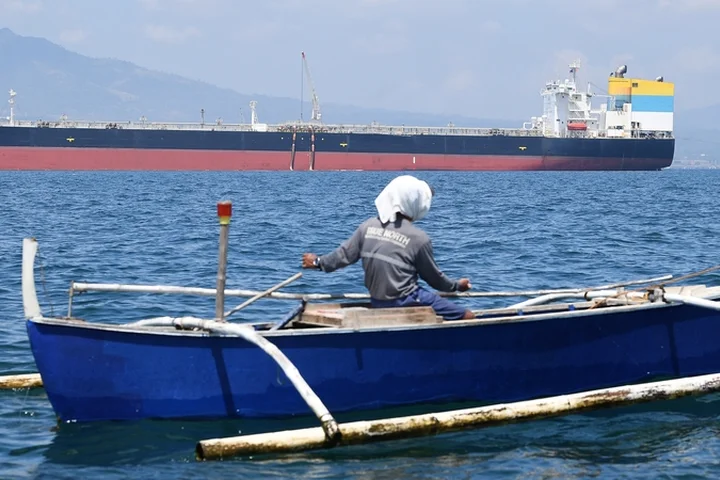
Ukrainian President Volodymyr Zelensky has said he wants energy sanctions to be reinstated on Russia following a US-Iran ceasefire agreement that should reopen the Strait of Hormuz waterway, vital to global energy supplies.
"Now a ceasefire is beginning in the Middle East and the Gulf.
And I am waiting for sanctions on Russian oil to be fully reimposed, as they were before," Mr Zelensky said.
The United States eased some oil sanctions on Russia last month to tackle surging energy costs caused by the Middle East war.
Kyiv and its allies warned the move could help fund Moscow's war against Ukraine.
The US waiver allowed countries to purchase Russian oil that was already at sea until 11 April.
The Kremlin welcomed the decision by urging the United States to go further.
The general surge in oil prices since the start of the war in the Middle East has helped to replenish Russia's coffers, depleted by more than four years of war against Ukraine and international sanctions.
Mr Zelensky added that Ukrainian partners had asked Kyiv to halt long-range strikes on Russian oil sites against the backdrop of price hikes linked to the Iran war.
"I won't say who asked us to do this.
But partners did ask - it's a fact.
They asked at different levels, from political to military leadership," he said.
Ukraine has intensified its retaliatory attacks on Russian infrastructure including refineries, oil depots and ports in the past weeks, repeatedly striking the major Baltic ports of Ust-Luga and Primorsk.
Both Ukraine and Russia have been targeting each others' energy sites since Moscow invaded in February 2022, sparking the bloodiest war in Europe since World War II.
Mr Zelensky also said that Ukrainian military experts had downed Iranian drones in several Middle East countries.
Kyiv dispatched dozens of anti-drone personnel to at least four countries in the Middle East after US and Israeli strikes on Iran sparked a wave of retaliatory drone attacks.
"This was not about a training mission or exercises, but about support in building a modern air defence system that can actually work.
Yes, they were shooting down Shaheds," he said, referring to the Iranian drones.
Mr Zelensky had said earlier this week that the Ukrainian drone units would remain in the region even after the United States and Iran agreed a two-week ceasefire.
Ukraine and Russia to cease fire for Orthodox Easter
The two sides have agreed to cease fire for the Orthodox Easter holidays, a rare 32-hour halt in fighting.
The four-year war previously saw limited and short truces, but both countries were quick to trade accusations of violations.
With talks on ending the four-year-old conflict derailed by the Middle East war, Ukrainian President Volodymyr Zelensky said this week that he had made a holiday truce proposal through the United States.
In a statement, the Kremlin said that "a ceasefire is declared from 16:00 (13:00 GMT) on April 11 until the end of the day on 12 April 2026" by Russian President Vladimir Putin, "in connection with the approaching Orthodox feast of Easter."
The Kremlin's statement made no mention of Kyiv's initial proposal.
Hours later, Mr Zelensky responded that "Ukraine has repeatedly stated that we are prepared to take reciprocal measures.
We proposed a ceasefire this year during the Easter holidays and will act accordingly."
"People need an Easter free from threats and real progress toward peace, and Russia has a chance to avoid returning to hostilities after Easter," he added.
Mr Putin instructed the Russian General Staff "to cease combat operations in all directions for this period," the Kremlin said, adding that troops were ready to "counter any possible provocations by the enemy".
"We assume that the Ukrainian side will follow the example of the Russian Federation."
Over the past few years, fighting on the front has come to a near standstill.
Russia has made small territorial gains at a high cost.
However, Ukraine recently managed to push back in the southeast and Russian advances have been slowing since late 2025, according to the US-based Institute for the Study of War (ISW).
Apart from Ukrainian counter-attacks, analysts attributed the slowdown to Russia being banned from using SpaceX's Starlink satellites and Moscow's own efforts to block the Telegram messaging app.
The satellite and the messaging app were widely used by troops for communications, especially for coordinating drone attacks that have come to dominate the war.
The situation is, however, unfavourable for Ukraine in the Donetsk region, towards the cities of Kramatorsk and Sloviansk, according to the ISW.
Russia wants Ukraine to pull troops from both cities without a fight as part of any peace accord.
Ukraine has in recent days stepped up assaults on Russian energy targets, especially oil-exporting ports after prices spiked on the back of the Middle East war.
Several rounds of US-led talks have failed to bring the warring sides closer to an agreement and US attention is now focused on Iran.
The negotiations have become deadlocked, with Russia demanding territorial and political concessions that Mr Zelensky has ruled out as tantamount to capitulation.
Russia occupies just over 19% of Ukraine, most of which was seized during the first weeks of the conflict.
Latest stories from Russia's invasion of Ukraine
Related Stories

Source: This article was originally published by RTÉ News
Read Full Original Article →
Comments (0)
No comments yet. Be the first to comment!
Leave a Comment