
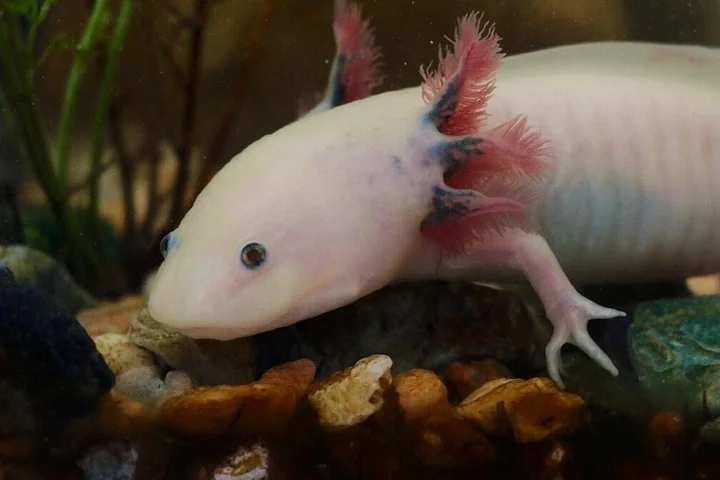
A bizarre creature known for its enigmatic smile may hold the key to humans being able to regrow limbs, according to scientists.
The axolotl is a critically endangered amphibian native to the lakes and wetlands south of Mexico City.
Named after Xolotl, the Aztec god of fire, lightning and twins, it has been dubbed the Peter Pan of the salamander world as it stays in tadpole form forever and ‘never grows up.’
But the reason scientists are so interested in it is because of its ability to regrow entire limbs and even parts of major organs.
The axolotl is being studied alongside mice and zebrafish, each chosen for its particular regenerative ability.
Zebrafish can repeatedly regenerate their tail fins and several internal tissues.
Mice, while far more limited, can regrow the tips of their digits – a capacity also seen in humans when the nail bed remains intact.
In research published in the Proceedings of the National Academy of Sciences, the team say they have identified a common genetic mechanism that could one day support therapies to regrow human limbs.
‘This significant research brought together three labs, working across three organisms to compare regeneration,’ Josh Currie, assistant professor of biology at Wake Forest University, said.
‘It showed us that there are universal, unifying genetic programs that are driving regeneration in very different types of organisms, salamanders, zebrafish, and mice.’
Globally, more than one million limb amputations take place each year due to conditions such as diabetes, injury, cancer, and infection, according to Global Burden of Disease estimates.
That figure is expected to rise as populations age and rates of diabetes increase.
The scale of the problem has prompted researchers to look beyond prosthetics towards treatments that could restore the complex sensory and motor functions of a natural limb.
However, the team believe their research can help humans resolve this issue by regenerating limbs like these animals.
They focused on so-called SP genes, which they found to be essential for regeneration in all three species studied.
Researchers found that regenerating skin in all three species activated two genes, SP6 and SP8.
They then investigated how these genes function.
Using gene-editing techniques, scientists removed SP8 from axolotls, preventing proper regrowth of limb bones.
Similar effects were seen in mice lacking SP6 and SP8.
Building on these findings, researchers developed an experimental gene therapy using a regeneration enhancer identified in zebrafish.
The therapy delivered a molecule known as FGF8, helping to stimulate bone regrowth in mice and partially compensate for the missing genes.
Although humans do not naturally possess this level of regenerative ability, the findings suggest it may be possible to replicate aspects of the process.
Professor Currie, whose lab studies the Mexican axolotl, said: ‘We can use this as a kind of proof of principle that we might be able to deliver therapies to substitute for this regenerative style of epidermis in regrowing tissue in humans.’
Researchers caution that significant work remains before such approaches could be applied to humans.
However, they describe the study as an important step towards future treatments.
‘Scientists are pursuing many solutions for replacing limbs, including bioengineered scaffolds and stem cell therapies,’ Professor Currie added.
‘The gene-therapy approach in this study is a new avenue that can complement and potentially augment what will surely be a multi-disciplinary solution to one day regenerate human limbs.’
He said that collaboration across different fields and model organisms was key to the breakthrough.
‘Many times, scientists work in their silos: we’re just working in axolotl, or we’re just working in mouse, or just working in fish,’ he explained.
‘A real standout feature of this research is that we work across all these different organisms.
That is really powerful, and it’s something that I hope we’ll see more of in the field.”
The study involved collaboration between scientists including David A.
Brown, a plastic surgeon at Duke University, and Kenneth D.
Poss of the University of Wisconsin-Madison.
Related Stories



Source: This article was originally published by Metro UK
Read Full Original Article →
Comments (0)
No comments yet. Be the first to comment!
Leave a Comment