
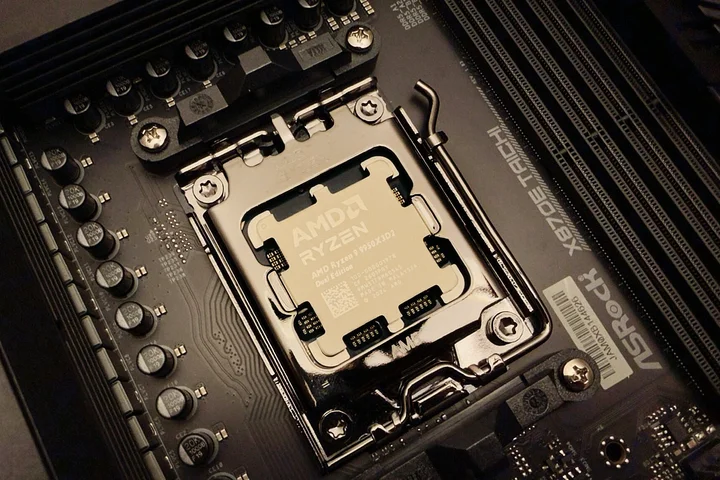
Review Ever since AMD's cache-stacked Ryzen 7 5800X3D closed the gap with Intel in gaming, folks have wondered: if one V-Cache chiplet is good, surely two must be better.
With the launch of the Ryzen 9 9950X3D2 Dual Edition (DE), we finally have our answer.
The part crams 16 Zen 5 cores and 208 MB of system cache into a single AM5 socket, arguably making it AMD’s first, true halo CPU.
It’s positioned in much the same class as Intel’s KS family of enthusiast processors used to fill, delivering a no-compromises experience in any workload, bar none.
The flagship tops our charts, but the gains probably aren't as big as you'd hope, considering the eye-watering $899 MSRP.
What performance uplift it does deliver doesn’t come cheap.
Today, Intel doesn't have anything in this performance class, not to mention price bracket, which means AMD is really competing against itself.
But – spoiler alert – for gaming, the 9950X3D2-DE offers no benefit over the much, much cheaper Ryzen 7 9850X3D.
Meanwhile, in production workloads, our benchmarks show that the extra cache only translates into a three- to nine-percent uplift over the $200 cheaper 9950X3D with its single V-Cache compute die.
But, then again, halo products are rarely good value, and it's a position every chip in this class inevitably finds itself in.
Cache rules everything around me
AMD Ryzen 9950X3D2-DE - click to enlarge
The main selling point of the 9950X3D2-DE is its massive 208 MB of total system cache.
More cache keeps workloads resident on the processor longer, hides latency, and generally boosts performance in data-intensive workloads.
AMD has used TSMC's advanced packaging tech to strap SRAM tiles, which it calls 3D V-Cache, to its compute chiplets, going back to the Ryzen 7 5800X3D and HPC-centric Milan-X Epycs in early 2022.
However, until now, AMD's consumer platforms have only ever featured a single V-Cache chiplet, regardless of whether you opted for an 8-core Ryzen 7 or 16-core Ryzen 9.
With the 9950X3D2-DE, each of the 16-core processor's core complex dies (CCDs) now comes equipped with a 64 MB SRAM tile, boosting the total L3 to 192 MB — 64 MB baked into the CCDs and 128 MB of V-Cache sitting underneath them.
This configuration gives the part a 64 MB advantage over the standard 9950X3D, but comes at the cost of a slightly lower max boost frequency and a higher thermal design power (TDP).
As you can see, the Ryzen 9 9950X3D2-DE is really just a 9950X3D with two V-Cache chiplets on board, and that means the memory controller on the I/O die remains unchanged.
Officially, AMD's 9000-series processors support JEDEC speeds up to 5600 MT/s.
However, DDR5 6000 MT/s remains the recommended configuration for these parts, as it allows for a tighter 1:1 ratio between the memory clock and controller.
If AMD is to be believed, DDR5 8000 MT/s memory should be relatively easy to get running on the X870 platform.
Unfortunately, we haven't had the chance to test this just yet.
And with 32 GB kits of DDR5 8000 retailing for $500-$800, it may be a while before we get the opportunity.
According to AMD, customers can expect to see between 5 and 13 percent higher performance in production workloads, with gaming performance on par with the 9950X3D.
And, at least in our testing, the chip largely lives up to those claims.
AMD provided us with the Ryzen 9 9950X3D2 Dual Edition along with 32 GB of DDR5 6000 MT/s memory, and a high-end ASRock X870E Taichi motherboard to facilitate our review.
We were also provided with a NZXT 360 mm all-in-one (AIO) cooler and a 1 TB Samsung 9100 Pro SSD, but opted to stick with our 990 Evo Plus and Arctic Liquid Freezer 3 AIO to keep things consistent with our earlier testing.
Future testing will be conducted using PCIe 5.0 storage.
Our benchmarks were run using the motherboard's default settings with the EXPO 1 memory overclocking profile enabled.
As we mentioned earlier, AMD is really competing against itself with its latest flagship.
To help identify its strengths and any weaknesses against the rest of its X3D lineup, AMD also provided us with the standard Ryzen 9 9950X3D and recently-launched Ryzen 7 9850X3D for testing.
Our lineup also includes AMD's 12-core Ryzen 9 9900X, eight-core Ryzen 7 7800X3D, and Intel's value-packed Core Ultra 200 Plus series processors, which we detailed in our review last month.
Intel's latest chips are in an entirely different price category with MSRPs of $200 for the Core Ultra 5 250K and $300 for the Core Ultra 7 270K.
Despite this, they performed remarkably well in our production benchmarks thanks to their higher core counts and faster DDR5 7200 MT/s memory support.
In our gaming benchmarks, we used an Nvidia RTX 6000 Ada.
The 48 GB workstation card is certainly an odd choice, but with 10 percent more CUDA cores than a 4090, it's currently the best GPU at our disposal and the one least likely to bottleneck.
Before we dive into production and gaming performance, we like to run a couple of synthetic benchmarks to get a sense of the processor's boost algorithm and power consumption.
While these benchmarks aren't necessarily representative of real-world performance, they can help us identify anomalous behavior early in our testing and ensure they actually work as advertised.
Single Threaded Stress NC INT64 - Click to enlarge
Single Threaded Primesieve - Click to enlarge
The Ryzen 9 9950X3D2-DE technically has a 100 MHz lower boost clock than its non-Dual Edition sibling, reaching 5.6 GHz under optimal conditions.
But while the chip's boost clock is technically lower, its TDP is higher, which could help it maintain higher boost clocks for longer.
Starting with single-threaded performance, the Dual Edition had no problem reaching and even exceeding its advertised boost frequency by 66 MHz when subjected to a pure integer stress test.
This continues AMD's tradition of underpromising and overdelivering on core clocks.
As we'd expect, clocks do tick down somewhat in our AVX-512 heavy Primesieve stress test, which saw boost clocks top 5.55 GHz under a single-core load.
SIMD instructions like AVX are notoriously taxing even on modern CPUs.
The fact that the processor only drops about 100 MHz here is actually quite a strong showing, and in line with what we've seen from other 9000-series processors.
Note: At the time of publication, our frequency and power validation benchmarks only run on Ubuntu 25.10 Desktop.
This provides a less noisy and more repeatable environment for frequency and power monitoring, but we are investigating ways to replicate its functionality on Windows in the future.
All other tests in this review were conducted using Windows 11 25H2, unless otherwise noted.
Multi-Threaded Stress NG INT64 - Click to enlarge
Multi-Threaded Primesieve - Click to enlarge
Under an all-core integer load, the Ryzen 9 9950X3D2-DE hit 5.4 GHz, putting it roughly 30 MHz ahead of the 9950X3D.
That gap grew considerably as we moved onto our AVX-512-heavy Primesieve stressor, where the Dual Edition's higher TDP gave it a 300 MHz advantage, topping 4.7 GHz across all cores.
The performance delta shows that AMD's first dual V-Cache part is more than a cache bump.
Note: While we have provided package temperatures in our charts, these tests weren't conducted in a temperature-controlled environment.
Instead, these data points were used to identify any thermal throttling, which thankfully wasn't an issue.
The 9950X3D2-DE's higher sustained boost clocks do come at the expense of increased power consumption.
Officially, AMD claims a 170 W default TDP for the 9950X3D and a 200 W default TDP on the Ryzen 9 9950X3D2-DE.
However, advertised TDP doesn't always correlate to real world power draw, and we see this in our testing.
CPU Power Profile - Click to enlarge
Under an all-core integer load, both the 9950X3D and its Dual Edition counterpart report a package power of around 200-207 watts, with the latter trending higher.
If we had to guess, our 360 mm radiator was keeping thermals low enough that AMD's boost algorithm was able to push past its rated TDP.
Where things got interesting is when we fired up an all-core Primesieve load.
The 9950X3D again reported a roughly 200 watt package power draw, but the Dual-Edition part leapt to 225 watts as reported in our S-TUI monitoring software.
This explains why the part's all-core integer frequencies were so close, but the 9950X3D2-DE's all-core boost was able to achieve much higher clocks in our SIMD stressor.
Memory Bandwidth - Click to enlarge
Higher clock speeds usually lead to better performance, but that's only true if the memory is fast enough to keep those cores fed.
Particularly when it comes to things like computational fluid dynamics and machine learning, memory can be a bigger bottleneck than compute.
Here, AMD's new flagship is a bit of a mixed bag.
With the 6000 MT/s DIMMs we're working with, AMD unsurprisingly trails Intel with its 7200 MT/s memory support.
The 9950X3D2-DE achieved 72 GB/s (corrected) of bandwidth out of roughly 94 GB/s that the dual channel platform is theoretically capable of delivering.
Note: The Stream benchmark doesn't account for write-allocate overheads.
To account for this, a 1.33x correction factor is applied.
We provide both raw and corrected metrics for your reference.
While on the topic of memory bandwidth, it's worth highlighting that, thanks to AMD's 3D V-Cache chip stacking tech, workloads won't necessarily see a performance penalty as a result of slower memory as the extra cache serves to hide the latency.
Gaming is the poster child for this, but HPC and other 3D rendering tasks also benefit to varying degrees.
Moving onto Geekbench 6, the 9950X3D2-DE unsurprisingly tops our charts with a single core score of 3,562 and a multi-core score of 24,393, giving it a 4.4-6.1 percent lead over the Intel 270K.
Compared to the standard 9950X3D, AMD's flagship is between 2.1 and 6.4 percent faster in this test.
However, as we'll see a little later, while Geekbench can be helpful for judging single-core performance, we've found its multi-core scores aren't always representative in the real world.
Primesieve is one of our go-to burn-in tests because it's one of the few workloads out there that can really test a core's mettle.
The test itself is quite simple: count all the prime numbers under a trillion, with the result measured in millions of primes per second.
The workload parallelizes extremely well, which is helpful for seeing how efficiently chips scale from one to many cores.
Primesieve also takes full advantage of SIMD instructions like AVX-512, which is why we use it as a synthetic load in our frequency validation tests.
In terms of single-core performance, the 9950X3D2-DE isn't much faster than its cheaper single V-Cache die toting sibling.
However, in multi-core scenarios, the chip's higher TDP gives it a 7.5 percent advantage.
7-zip compression/decompression
7zip Compression - Click to enlarge
7-zip's LZMA compression algorithm offers a different view of the 9950X3D2-DE's performance.
In this test, the flagship jumped straight to the top of our charts with an 18.9 percent increase in single-threaded performance compared to 9950X3D, but just 3.9 percent higher under a multi-threaded load.
LZMA isn't a SIMD workload, so we have to believe the extra 64 MB of L3 may be doing some of the heavy lifting here.
7zip Decompression - Click to enlarge
It's a slightly different story as we look to LZMA decompression.
The 9950X3D2-DE still tops this chart, but it only just barely.
Performance is nearly identical to the 9950X3D.
Perhaps the most impressive showing here is just how close Intel's $300 Core Ultra 7 270K comes to the X3D parts in this test.
While still slower than AMD, if the metric were MIPS per dollar, it'd be on top.
Speedometer 3.1 - Click to enlarge
The story doesn't change much as we move onto web-app performance.
Our go-to for this remains Speedometer 3.1.
With so much of our lives spent on the web, the benchmark can be useful for determining how snappy a chip is going to feel in day-to-day life.
And, at least in Firefox, the 9950X3D2-DE's larger caches and higher TDP help it claim an 8.9 percent performance uplift over the 9950X3D.
Moving over to Chrome, the gain isn't nearly as great.
Having said that, all of these are high-end desktop processors and your choice of browser is likely to have a bigger impact on performance than which CPU you opt for.
With our synthetic benchmarks out of the way, we can look at the fun stuff: real world applications that you might actually run on these chips.
Handbrake x265 - Click to enlarge
Moving on to HandBrake, we have our first true workstation workload.
The video transcoding test converts a 10-minute 4K 60 FPS H.264 video file to 1080p using the x265 video encoder at the medium preset and a constant quality of 18.
Once again, the 9950X3D2-DE finds itself at the top of the heap, delivering a 5.8 percent uplift over the 9950X3D and an 11.5 percent uplift over Intel's 24-core 270K.
It's a measurable lead, but we're not sure it's worth paying $200 extra for a second V-Cache tile.
Meanwhile, Intel's 200-Plus series parts remain the value kings, at least as far as CPU-based video transcoding.
Next up is Blender, one of the most popular and widely used 3D modeling and rendering suites out there.
This test measures how quickly each CPU can render Classroom, Monster, and Junkshop test scenes with the result measured in samples per minute.
Blender parallelizes quite nicely, so more cores usually translates into faster renders.
As has become the halo product theme, AMD's latest Ryzen 9 again takes the top spot, beating out both Intel's 24-core Core 270K Plus and the bog standard 9950X3D in this test.
Despite having eight fewer cores than the Intel part, the strength of the Zen 5 architecture and extra L3 cache really shine here, with the 9950X3D2-DE claiming a 16.6 percent lead in Junkshop and 13 percent edge in Classroom.
Meanwhile, against the 9950X3D, AMD's new flagship is only about 6-7 percent faster.
Rendering isn't the only way to kill time on a PC.
Code compilation is another common area where the 9950X3D's extra 3D V-Cache shines.
LLVM Compile - Click to enlarge
The 9950X3D2-DE managed to compile LLVM from source using Clang, the LLD linker, and Ninja via MSYS2 on Windows in less than five minutes, making it about 6.6 percent faster than the 9950X3D, and about 10 percent faster than Intel's latest chip.
Is spending an extra $200 worth shaving 21 seconds off a code compile?
Probably not, but for those working with larger projects, like Chromium, the time savings could be substantial.
With an MSRP of $899, the Ryzen 9 9950X3D2-DE may not be a workstation part, but it's certainly encroaching on entry level Threadripper and Xeon W territory.
This could make it an attractive option for those in the sciences or dabbling in machine learning and generative AI.
To see how AMD's new flagship might fare in these environments, we benchmarked the chip against two of the more common HPC simulations: GROMACS for molecular dynamics and OpenFOAM for computational fluid dynamics (CFD) both running in Ubuntu 25.10.
If you're not familiar, GROMACS is a framework for simulating the behavior of proteins, lipids, and nucleic acids over time.
In this case, we measure how quickly a processor can complete our Alcohol Dehydrogenase benchmark, which simulates a 134,000 atom system for 50,000 time steps and returns a result in nanoseconds per day.
In terms of performance, there's really no competition.
The 9950X3D2-DE is the fastest chip we've tested, simulating 143.56 nanoseconds a day, making it about 9.3 percent faster than the cheaper 9950X3D and nearly 60 percent faster than Intel's Core Ultra 7 270K.
The chip's large caches and full support for AVX-512 make a big difference here and show that loads of small efficient cores aren't always better than a smaller number of well-fed ones.
Moving to computational fluid dynamics and our OpenFoam 13 motorbike benchmark, the Ryzen 9 9950X3D-DE's slower memory comes back to haunt it.
The test simulates the flow of air around a motorcycle and is sensitive to both compute and memory bandwidth bottlenecks.
The chip is still the fastest part in our roundup, but only manages to beat out the $300 Core Ultra 270K Plus by a mere 2.7 percent.
The reason for this is simple.
Intel parts support faster DDR5 7200 MT/s out of the box and therefore deliver more memory bandwidth to the cores.
The only leg up the AMD part has is that it's got twice as many performance cores fed by 192 MB of last level cache, which helps the chip keep intermediary processes resident on chip.
We'll note that, in its marketing materials, AMD claimed a 26 percent performance uplift for OpenFoam when running as part of the SpecWorkstation 4 benchmark suite, representing one of the biggest gains over the 9950X3D.
We have no reason to believe those figures aren't accurate, but involve a much smaller 2D Reynolds Averaged Simulation.
We suspect the smaller mesh may allow for more of the workload to fit into the chip's L3 contributing to the higher performance.
Moving to local AI, GPUs may offer better performance, but often lack the VRAM necessary to run larger models, which makes CPU-based inference an attractive use case for those interested in dabbling with LLMs without compromising their privacy.
Inference is a particularly interesting workload as it can be broken into two phases: the computationally heavy prefill phase during which the prompt is processed and the model's short term memory (key-value cache) is formed, and the memory bandwidth intensive decode phase in which the model generates a response auto-regressively one token after another.
AMD's beefy cores and deep caches put the Ryzen 9 9950X3D2-DE at the top of our charts for prefill, but the chip is still slower than Intel's in decode.
If you want your local chatbot to help you summarize large documents, the faster prefill processing afforded by AMD's AVX-512 instructions really pays off here.
But if you're mostly doing interactive chat, Intel's faster memory support is going to make the Core Ultra series feel more interactive.
Large language models are usually the kind of thing we'd recommend running on GPUs, not CPUs.
In fact, we've got multiple guides on the subject ranging from how to spin up Ollama or Llama.cpp on your local PC to deploying vLLM in production .
But, when it comes to things like voice-to-text transcription, you don't really need a GPU to get good results.
In our testing, the Ryzen 9 9950X3D2-DE managed a 6.3x speed up when transcribing a 10-minute audio clip using the Whisper Medium EN model running in Whisper.cpp.
Compared to the $699 Ryzen 9 9950X3D, the extra cache and higher TDP don't offer much benefit.
In fact, sheer core count is what really wins out here, with Intel's 24-core part matching the AMD flagship's performance.
As we've mentioned in the past, The Register isn't a gaming-centric publication.
But, then again, AMD's Ryzen 9 processors haven't really been gaming-focused parts historically.
They've traditionally been positioned as high-end desktop processors that bridge the gap between chips aimed at casual computing and enthusiast gaming and true workstation parts like Threadripper or Xeon-W.
That changed with the launch of the Ryzen 9 7900X3D and 7950X3D back in 2023.
The processors paired a standard six or eight-core CCD to one sporting the chip biz's 3D V-Cache tech.
The result was a pair of chips that balanced high-core count with the gaming chops that AMD's cache-stacking tech is now famous for.
However, these chips came with a couple of downsides, the most glaring being higher temperatures.
The V-Cache SRAM tiles trapped heat, requiring AMD to clock those chips lower.
With the launch of AMD's 9000-series X3D parts in late 2024 and early 2025, the chipmaker addressed this problem by moving the V-Cache chiplet from the top of the CCD to the bottom, reducing thermal interference and enabling the parts to boost much, much higher.
The technology has made AMD's X3D parts the fastest gaming CPUs on the market.
Intuitively, you'd think that adding a second V-Cache tile to the mix would make the 9950X3D2-DE even faster, but that simply isn't the case.
We'll keep this section short because the story is pretty much the same across our entire suite of gaming benchmarks: the Ryzen 9 Dual Edition performed marginally better than the 9950X3D in most tests, while trailing the 9850X3D by an imperceptible degree.
Cyberpunk 2077 - Click to enlarge
Borderlands 3 - Click to enlarge
Shadow of the Tomb Raider - Click to enlarge
Total Warhammer 3 - Click to enlarge
We need to talk about core parking
This functionality was extended to all multi-CCD Ryzen processors with the 9000-series, and works by parking one of the compute dies when a supported application or runtime is detected.
When active, a chip like the 9950X behaves more like an eight-core part.
With both of the 9950X3D2-DE's CCDs now supporting AMD's 3D V-Cache tech, your intuition might be that this wouldn't be a problem, but nope.
In fact, while core parking was first implemented on AMD's 12- and 16-core 7000-series X3D processors, it actually has less to do with whether one CCD is sporting V-Cache and more to do with how the chiplets talk to each other.
The two eight-core CCDs found on the 9950X aren't actually connected to one another.
Instead, each CCD connects to the I/O and memory die, via a 64 GB/s GMI link.
If a core on one CCD tries to access data stored in cache on the other, it has to walk the I/O die to get to it, which introduces latency and can harm performance.
For production workloads, this doesn't appear to be much of a problem, but for gaming, this latency can tank frame rates, making core parking a must-have on these chips.
Unfortunately, this means AMD's new flagship doesn't offer any performance benefit in gaming over either of its eight or 16-core X3D parts.
The Ryzen 9 9950X3D2 Dual Edition is the fastest chip we've tested, topping nearly all of our production benchmarks and roughly matching AMD's earlier flagships in gaming.
It is exactly what it purports to be: gratuitous overkill in chip form, and it's priced as such.
With an MSRP of $899, the 9950X3D2-DE comes across a little tone deaf in the current economy.
It's a tough time to be a PC enthusiast.
Memory and storage prices have surged more than 3x since this time last year.
Building a PC has become prohibitively expensive for many.
But is there ever a good time to launch a halo product?
AMD's latest flagship is a show piece that demonstrates the engineering that helped it overtake Intel in the desktop arena, and damn if it's not an impressive one.
And for those for whom spending $900 on a CPU just isn't in the cards, AMD is clearly playing on our lizard brains to make the 9800X3D, 9850X3D, and 9950X3D look like a bargain by comparison.
"Delivers 90 percent the performance in production workloads and/or matches our flagship processor in gaming at a $200-$400 discount" isn't a bad sales pitch for the 9950X3D or 9850X3D.
That comparison probably won't help with sales on the Dual Edition, but we doubt AMD expected to sell all that many of them in the first place.
In the end, our take boils down to this:
Have a workload you'd like us to benchmark?
Canned benchmarks sound great on paper, but don't always translate into real world performance.
We're looking to expand our benchmark suite to encompass the real-world production workloads that actually influence your buying decisions.
If there's an app you'd like us to test, let's chat at tobias.mann@theregister.com ®.
Related Stories


Source: This article was originally published by The Register
Read Full Original Article →
Comments (0)
No comments yet. Be the first to comment!
Leave a Comment