
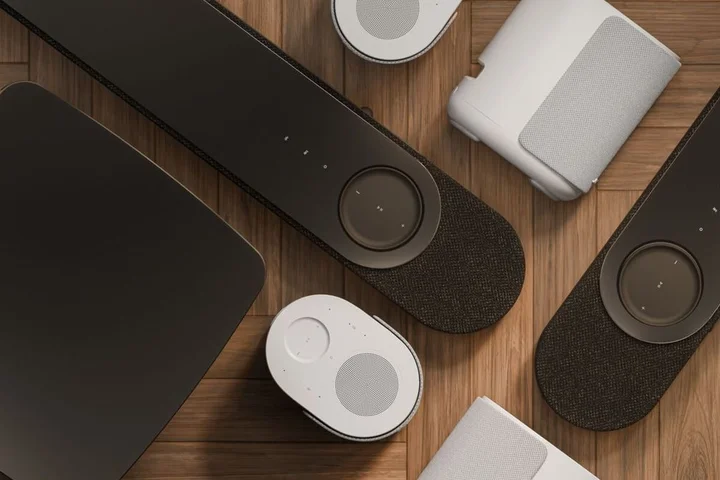
To no surprise, Bose says the Ultra Soundbar is the “best soundbar we have ever made,” and that the Ultra Speaker might even be one of the company's best in its storied history.
The wireless speaker starts at $299, with a $349 limited-edition model in Driftwood Sand; the soundbar costs $1,099, and the subwoofer is $899.
They're available for preorder now and go on sale May 15.
Bose Luxury Ultra Speaker in Driftwood Sand.
These Wi-Fi-enabled speakers support AirPlay, Google Cast, Spotify Connect, and, uniquely, are the first to integrate with Alexa+ (in the US only), allowing you to ask Amazon's chatbot to play music through the speakers via voice commands.
There's also Bluetooth support, and even an auxiliary input for connecting the Ultra Speaker to a turntable.
On the audio front, the Ultra Speaker notably features an upward-firing driver for Dolby Atmos–like spatial audio, along with two front-facing drivers.
(It doesn't seem to support Dolby Atmos Music at this time.) The company is also touting its CleanBass technology, which pairs Bose's QuietPort acoustic opening with the woofer for deep sound that performs better than its size suggests, though we'll have to hear it for ourselves to see if it lives up to Bose's claims.
Bose says the Lifestyle Ultra Soundbar is its first major redesign in over a decade.
That's not to say it hasn't introduced new soundbars in recent years—we reviewed the Bose Smart Soundbar in 2024 —but these have been minor iterations for a long time.
The new soundbar features two up-firing drivers, four front-facing drivers, a center tweeter, and two PhaseGuide drivers that focus the sound on the sides to help fill the room.
It also features the same CleanBass technology with the QuietPort, not to mention SpeechClarity tech that uses AI to enhance dialog.
Before, if you wanted to tailor the sound to the room's acoustics, you had to use Bose's proprietary ADAPTiQ headset during setup to get the most out of the system.
Now, Bose says you can use an iOS or Android microphone via the Bose app as a reference point to optimize the audio.
No need for a separate accessory that you'd probably lose after six months.
“We've been working on this for about three years,” Haungs tells WIRED.
“This has been a plan of Bose for quite some time to enter back into this space and make sure we're doing it right.
Maybe that meant we got some additional market insights and learnings along the way.”
Related Stories



Source: This article was originally published by Wired
Read Full Original Article →
Comments (0)
No comments yet. Be the first to comment!
Leave a Comment