
Online purchase scams are now the most common form of fraud in Ireland, according to the Central Bank.
New research from the Central Bank shows online purchase scams account for almost half of all fraud victims, while official figures show reported payment fraud reached €160 million in 2024, a 24.5% increase on the previous year.
These scams typically involve consumers paying for goods that never arrive and are increasingly carried out through scam sites designed to mimic legitimate Irish businesses, according to people who Prime Time spoke to who monitor such activity online.
They often use social media advertising campaigns driven by AI‑generated imagery and stolen content to lure customers.
Many operate through drop-shipping models, which allows sellers to take payments without holding stock or fulfilling orders themselves.
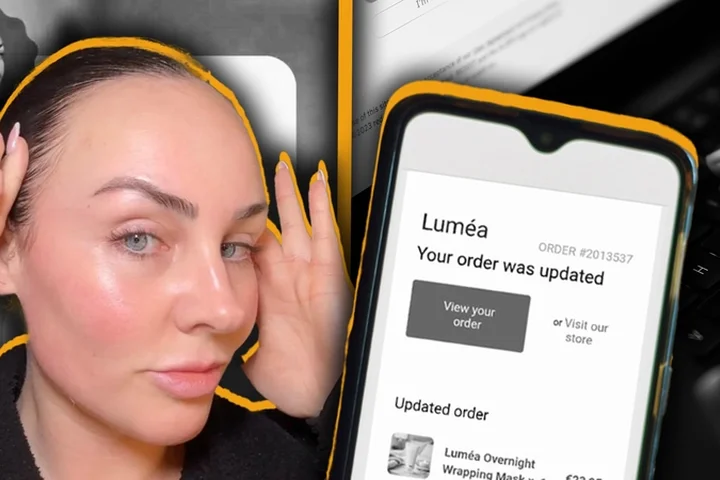
Among the latest examples are a fake skin care business using the name "Luméa" and a fake clothing website called 'The Murphy Sisters Kinsale' claiming to be based in west Cork.
Neither Luméa, using the Instagram handle @healthlumea, or ‘The Murphy Sisters Kinsale’ should be confused with other legitimate businesses with similar names, some of which remain active.
Recent analysis by Bank of Ireland shows the number of purchase scam cases rose by 47% in the first half of 2025, with the value of losses also increasing.
To try to boost their credibility, some of the scam advertisers steal video or images from real Irish content creators, which they alter and use in their own digital adverts.
She told Prime Time she first became aware of the video when a family member sent it to her.
"At the end of March my aunt reached out to me and sent me the Instagram page of me using this product that was not actually the product I was using in my original video," she said.
"She was asking me if the product was any good and I clicked into it and it was this whole Instagram page of fake product linked to a fake website.
"I knew instantly that it was fake because the website wasn't the same name as the product I was using but they were saying they were an Irish skincare brand and had me plastered all over their page and website as if I was endorsing it," she added.
The scammers lifted a video of Ms Nolan using a different product on her skin and mashed it together with other videos of people using skincare products making it look as though she was endorsing their product.
They also created an AI version of Ms Nolan where she was speaking using an AI-generated voice in a video advert on social media.
"When I saw it, I felt disgusted and it freaked me out for many reasons," she said.
"The cheek of someone to use my content to scam people felt so icky.
I didn’t like it at all."
As soon as Ms Nolan became aware of the scam, she took to her social media to warn her followers that she had zero affiliation with the scam site and urged people to only use trusted sites to buy their skincare products.
She said that a few of her followers had been in touch to let her know they had fallen victim to the scam.
According to Ms Nolan, the page removed videos of her from their website after she posted warnings to people about the scam.
"It damages my reputation as a content creator and it’s just wrong that they're scamming people out of their hard-earned money – it's just wrong on so many levels," she said.
One of those who fell victim to the scam was Joyce McMahon, who said she encountered an ad featuring Britney Nolan while browsing Facebook.
"I saw this ad for the overnight wrapping mask, and it was an Irish woman promoting it, so I thought it looked really good and I'm all for supporting Irish businesses," she said.
"I decided to order for my daughter and I and thought it would be something really nice we could do together."
She continued to order the product and saw that there was an offer for buy one and get one free and paid for the items.
Later, Ms McMahon realised she had fallen victim to a scam when she saw a video from content creator and digital marketing consultant Muriel Foley warning people about the scam.
"It looked so real and I'm still kicking myself I’m not sure how I fell for it, but €44.31 later I ordered it," she said.
"I just got completely suckered in and it's so frustrating because I'm online all the time and sell my own products from Facebook, Instagram and TikTok and yet I still fell for it so it's really disheartening."
Ms McMahon said what convinced her that it was a real product was the fact that the advert had a girl talking with an Irish accent and said that it "caught her off guard".
"I lost the money but it wasn’t just about that it was also the fear that they had my bank details that they were going to keep taking money out so the fear of them coming back to take more was there for me," she said.
"They haven’t taken any more money, but I phoned the bank anyway and put a block on that particular company taking any out because I was afraid."
Ms McMahon never received the purchased product.
Going forward Ms McMahon said she is "extremely sceptical" about buying things online, especially with AI as she said she "cannot tell what is real anymore".
38% of fraud victims never report their experience
According to the Central Bank of Ireland, nearly two-thirds of fraud victims in Ireland lose money, with online purchase scams now the most common type.
The research also found that behaviour, such as buying from unfamiliar websites, is the strongest predictor of being targeted, outweighing factors such as age or income.
The study also found that 38% of fraud victims never reported their experience to their bank, An Garda Síochána, or any authority, despite a "clear correlation" between reporting fraud and recovering lost funds.
It said that among victims who reported fraud to their bank, An Garda Síochána or another relevant authority, 57% were able to recover their money.
However, just 13% of those who didn't report the fraud recovered their funds.
The 30 April edition of Prime Time at 9.35pm on RTÉ One and RTÉ Player will feature a report about online purchase scams.
Related Stories


Source: This article was originally published by RTÉ News
Read Full Original Article →
Comments (0)
No comments yet. Be the first to comment!
Leave a Comment