
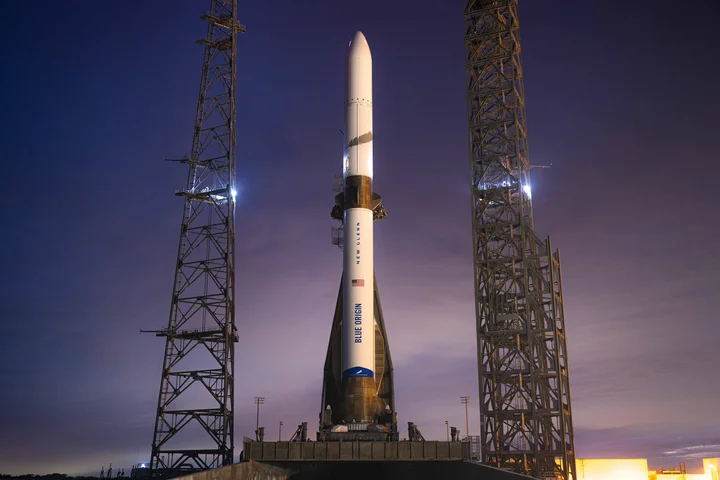
One of two second stage engines misbehaved, administration must sign off report before flights resume
Blue Origin's New Glenn loss of a satellite has been classed as a "mishap" by the US Federal Aviation Administration (FAA), triggering a mandatory investigation.
The flight - the third launch of the New Glenn rocket - had a split result : the first stage performed flawlessly, landing and recovering as planned, but the second stage fell short - literally.
AST SpaceMobile's BlueBird 7 satellite was left in an orbit too low to be useful, and the customer wrote it off shortly after.
Blue Origin CEO Dave Limp took to X, Elon Musk's social media mouthpiece, to acknowledge the failure :
"We clearly didn't deliver the mission our customer wanted, and our team expects," he said, before offering an early diagnosis.
"Early data suggest that on our second GS2 burn, one of the BE-3U engines didn't produce sufficient thrust to reach our target orbit."
"GS2" is the name of the second stage - New Glenn has two BE-3U engines.
Limp's statement raises some interesting questions.
If one engine had an anomaly, could the other have been run longer after a bit of gimballing?
And if not, why not?
Perhaps the failure was energetic, damaging the propellant system, or maybe attitude control was lost.
Or there's the possibility that Blue Origin spotted the issue and did the responsible thing by ditching the payload and conserving enough fuel for a safe de-orbit of the second stage using the remaining good engine.
Another variant of the BE-3 is used by Blue Origin's New Shepard sub-orbital rocket, although the company confirmed in January a pause in flights for at least two years as it focuses on lunar activities.
The FAA said it was "aware that Blue Origin New Glenn 3 experienced a mishap during the second-stage flight sequence following a successful launch on Sunday, April 19.
"The FAA is requiring Blue Origin to conduct a mishap investigation.
The FAA will oversee the Blue Origin-led investigation, be involved in every step of the process, and approve Blue Origin's final report, including any corrective actions."
The FAA's classification will affect the company's launch schedule.
Blue Origin leads the investigation, but the FAA must sign off on the final report and any corrective actions before flights resume.
"A return to flight of the New Glenn vehicle is based on the FAA determining that any system, process, or procedure related to the mishap does not affect public safety," the FAA said.
®
Related Stories


Source: This article was originally published by The Register
Read Full Original Article →
Comments (0)
No comments yet. Be the first to comment!
Leave a Comment