
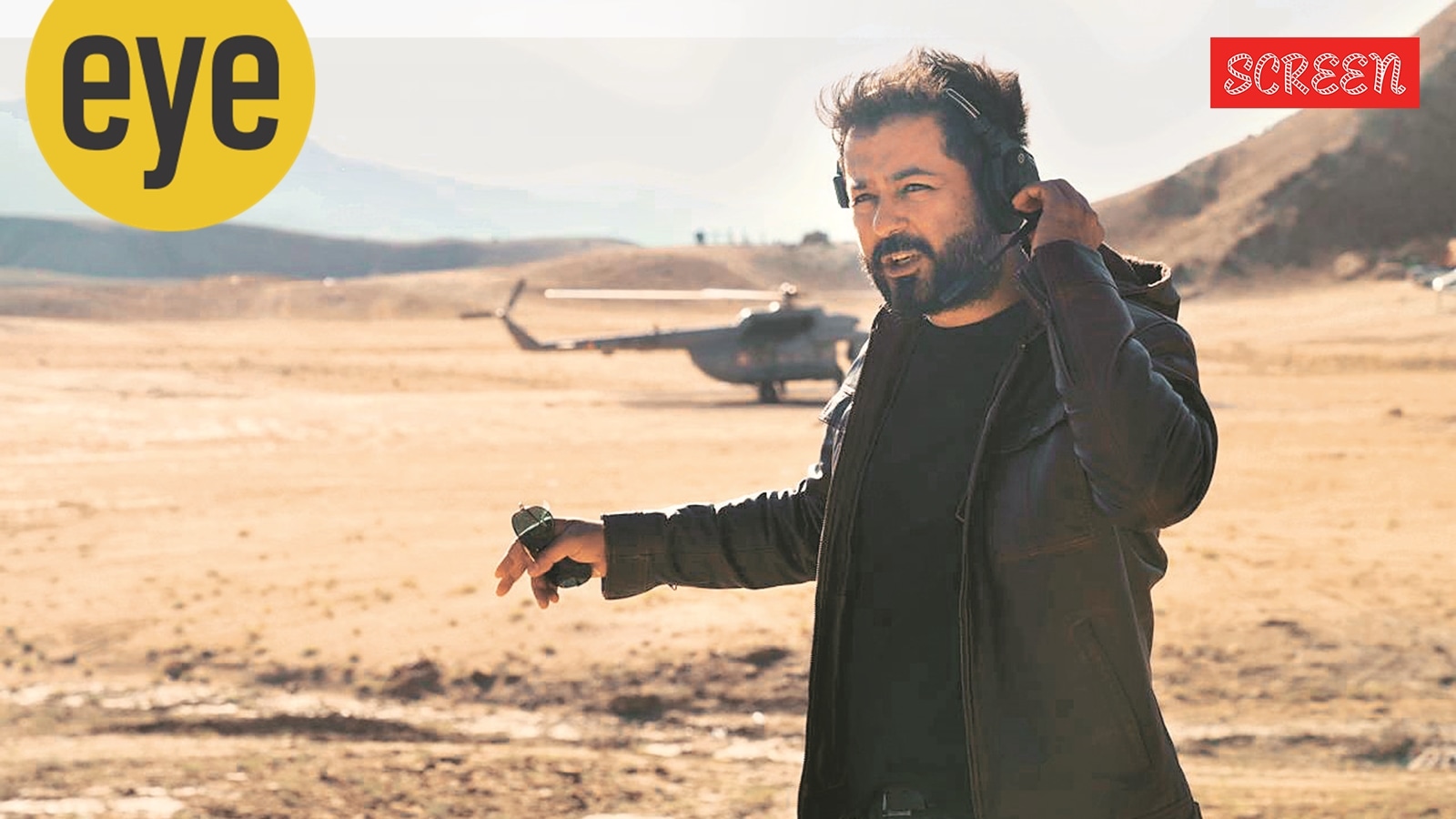
After multiple false starts and losing scripts to others, writer-director Aditya Dhar was finally days away from beginning the shoot of Raat Baaki — hislong-awaited directorial debut,a romantic action film, starring Fawad Khan and Katrina Kaif — when the September 18, 2016, Uri terror attack changed everything.
In the tense political climate that followed, the film’s producer Karan Johar came under strident attack and publicly shared a video announcing that he “would not engage with talent” from Pakistan.
Raat Baaki was shelved overnight, leaving Dhar without a project.
As a surgical strike was carried out by the Indian Army about 10 days later, Dhar, a Kashmiri Pandit, found himself drawn to these developments.
For the next six months, he immersed himself in researching the incidents, met several journalists and Army officials and gathered details about the operation.
When he heard that some other filmmakers, too, were contemplating making a film on the same subject, he confined himself at home and wrote the screenplay in 12 days.
Things moved fast after that.
Producer Ronnie Screwvala came on board and Vicky Kaushal was cast as Major Vihaan Singh Shergill, a character inspired by the Indian Army officers who led the mission in retaliation to the Uri attack.
When Uri: The Surgical Strike released in January 2019, it became a major success with its worldwide box-office collections crossing Rs 340 crore.
The film won four National Film Awards — Best Director for Dhar, Best Actor for Kaushal (which he shared with Ayushmann Khurrana for Andhadhun), Best Background Score for Shashwat Sachdev and Best Audiography (Sound Designer) for Bishwadeep Chatterjee.
ALSO READ | Before Dhurandhar and Uri, Aditya Dhar’s National Award-winning film Boond gave a peek into his raging revenge streak
Nearly seven years later, Dhar returned with his sophomore directorial outing Dhurandhar — designed as a large-scale blockbuster.
The action-thriller follows an Indian spy Hamza, played by Ranveer Singh, who infiltrates the gang of Rehman Baloch (Akshaye Khanna) in Pakistan’s Lyari that has witnessed intense gang wars and political fights.
With a runtime of 214 minutes, the espionage saga blends real incidents such as IC-814 hijacking in 1999, the 2001 Parliament attack and the 2008Mumbaiattacks with Hamza’s story.
Dhurandhar released on December 5, 2025, went on to create a box-office record with worldwide collections of Rs 1,305.35 crore, including India gross Rs 1,005.85 crore (source: sacnilk.com), even though critics were divided over its political views.
With his two directorial outings, Dhar has established his distinct cinematic style.
The nationalistic narratives deftly weave fictional elements and characters with real incidents.
The storytelling is gripping, fast-paced while the performances are compelling and music is catchy.
The director, in a conversation hosted by the Screenwriters Association (SWA) in 2019, had mentioned that he wanted to take up a fresh challenge with each new project while ensuring that the audience loves it.
“Choosing the next project depends on the gut feeling.
It’s a bit like putting money in stocks,” the 43-year-old director said.
With Dhurandhar, his choices paid off as it became the highest-grossing Hindi film of all time in India, overtaking Pushpa 2’s Hindi run of Rs 812 crore.
The advance booking for its second part, Dhurandhar: The Revenge, which has a runtime of 235 minutes, opened on March 7 — much ahead of its release on March 19 — already generating a buzz.
WHEN DHAR moved to Mumbai in 2006 to pursue a career in filmmaking, for an outsider like him, there were many hurdles to cross.
“It’s a miracle I succeeded here.
I am severely dyslexic.
I was weak in studies but good in dramatics,” recounted Dhar, who is a hotel management graduate, at the SWA conversation.
His mother, Sunita Dhar, was the dean and head of the Faculty of Music and Fine Arts at the University ofDelhi.
“Musicians and artists would often visit our home,” said Dhar, whose Dhurandhar has a strong musical element.
For several years, he worked as an assistant director and also wrote lyrics for movies such as Kabul Express (2006); dialogues for Aakrosh (2010) and Tezz (2022).
Though the opportunities to direct came in 2009 and again in 2013, they did not work out.
Dhar has even spoken about one instance when his script was “stolen” and made into a successful film.
The thought of quitting did cross his mind.
However, several prominent film personalities, including Robin Bhatt, Priyadarshan and Vishal Bhardwaj, encouraged him to stay on.
While his brother Lokesh Dhar remained his biggest support, his mother assured him that “God is testing you and will shower you with success when the time comes”.
Uri’s success became a major turning point — personally and professionally.
During its promotions, Dhar and actor Yami Gautam grew closer.
The couple tied the knot on June 4, 2021, and welcomed their son Vedavid on May 10, 2024.
After Uri’s release, Dhar set up the production company B62 in 2019 with Lokesh, who has worked in leading film studios of India and the US for about two decades.
The company is named after their childhood house in south Delhi.
“The house was located between two cinema halls — Sapna and Alankar — in Delhi.
Every Sunday, our parents would take us to one of these theatres to watch a film.
That’s how our love for cinema was ignited,” recounted Lokesh at the trailer launch of B62-produced Article 370 (2024) and shared that their production house planned to provide a platform for talented “outsiders”.
Featuring Yami in the lead role, Article 370 is co-written by Dhar and directed by Aditya Suhas Jambhale.
Dhar has also co-written and co-produced Dhoom Dhaam (2025) and the Manav Kaul-led series Baramulla (2025).
His success might be delayed but it is not an accident.
“From Uri to Dhurandhar, one can see tremendous growth in him as a director and writer.
He has found the pulse of commercial cinema.
In Dhurandhar, he is precise in characterisation and plotting.
So, every scene in the film works.
That newness is what the audience loved,” says writer-producer Bhatt.
He had recommended Dhar to assist director Priyadarshan after watching the National Award-winning short film Boond (2009), which was co-written by him.
What has contributed significantly to Dhar’s success as a writer-director, according to those close to him, are his detailed writing, meticulous preparation, understanding of craft and remarkably cool temperament on set.
Actor Arjun Rampal, who plays ISI officer Major Iqbal in Dhurandhar, says Dhar stands out for the clarity and composure he brings to filmmaking.
“I haven’t experienced a filmmaker with such command over not only his craft but also a temperament that is focussed and encouraging.
His clarity is razor sharp.
He creates a calm atmosphere for everyone on set.
Aditya makes a film from his heart and uses his head to execute that vision,” Rampal says.
Once, when actor Gaurav Gera asked Dhar how he managed to stay so calm while heading a massive team, he credited his efficient crew.
“In between shots he would even play Candy Crush,” Gera says with a laugh, adding that Dhar arrived on set having completed exhaustive pre-production.
The two share a long association.
They had acted together in the Delhi Musical Theatre’s production of West Side Story.
“Aditya must have been around 12 and I was 23,” Gera recalls.
“Before I reached the set of Dhurandhar, he told everyone I was his senior from theatre.”
Commenting on Dhar’s working style, casting director Mukesh Chhabra praises the filmmaker’s trust in his collaborators.
“The freedom he gives his team, the clarity of his vision and the trust he places in his HoDs make the entire process incredibly inspiring.
His briefs are always precise.
He knows exactly what he wants, yet allows everyone the space to bring their best to the table.
The respect and encouragement he shows his team is the reason people around him are always willing to go the extra mile,” Chhabra says, adding that the casting process for Dhurandhar went through several changes before the final ensemble came together.
Though Dhar has spoken about trying out “anti-casting” in Uri, his choices are also guided by instinct.
As a debutant director, he convinced actor Rakesh Bedi to travel to Serbia for a brief scene.
“I refused a couple of times.
Then Aditya called me and said, ‘You don’t know me but I can only visualise you in this scene.’ After the shoot, he told me, ‘One day, I will pay you back for this.’ Two years ago, he called again and asked me to block the dates for Dhurandhar,” recalls Bedi.
Despite Dhar’s formidable box-office success, his films have attracted criticism, with several commentators labelling them “propaganda”.
Addressing such accusations at the Article 370 event, Dhar said, “I don’t care about the people who label it as propaganda.
The Indian audience is smart and knows what is propaganda and what has the right intent.
The intent of my films will always be right.
The day it isn’t, I will stop making films.” Soon after Dhurandar’s release, however, several movie critics faced online trolling and threats for their criticism of the film’s tone and violence.
ALSO READ | Dhurandhar pushes a bigoted vision, gaslighting the audience into accepting it as entertainment
Since Aditya and Lokesh belong to a Kashmiri Pandit family, they say their background has influenced the subjects they explore.
They spoke about this connection during the promotion of Article 370, which is based on events around the Indian government’s 2019 decision to revoke the special status ofJammuand Kashmir.
They revisited this link with Baramulla, a supernatural thriller that follows a cop, played by Kaul, investigating a series of child disappearances in Kashmir.
Several other movies tapping into the subject of nationalism and patriotism, however, have not been able to create the impact that Dhar’s movies have.
That’s because Dhar’s craft has won him praises even from those who don’t agree with his movies’ politics.
About Dhurandhar, filmmaker Anurag Kashyap wrote on Letterboxd, “A spy cannot be a spy if he doesn’t have hate and angst against the enemy state… All his (Dhar’s) films are about Kashmir.
He is a Kashmiri Pandit who has suffered.
Either you argue with him or let him be.
The filmmaking is top-notch.”Sound designer Bishwadeep Chatterjee, who collaborated with Dhar on both Uri and Dhurandhar, calls him a “trendsetter”.
“Even though his filmography is still short, Aditya has brought a shift in Hindi cinema much like filmmakers such as Sanjay Leela Bhansali, Rajkumar Hirani and Shoojit Sircar did,” says Chatterjee who first met him on the sets of Eklavya: The Royal Guard (2007), when the latter was assisting Vidhu Vinod Chopra.
He found Dhar to be a “quiet and talented young man”.
Bhatt believes that as a filmmaker, Dhar is “going only up and up”.
The screenwriter adds, “Now, Aditya has to better himself.
He is not competing with anyone but himself.
His next has to be bigger and better.”
Addressing aspiring writers, Dhar had once said, “Mumbai (the film industry) will give you a chance if you wait and work hard towards it.
Tenacity is crucial.
Even when you have lost all hope, you should give it one more try.” It’s a lesson Dhar held on to as he journeyed through years of uncertainty before transforming into one of contemporary Indian cinema’s striking success stories.
Alaka Sahani is a prominent film critic and journalist based in Mumbai.
With a career spanning over two decades, she has established herself as one of India’s most authoritative voices in cinematic journalism, known for an analytical approach and insights that transcend the standard cycle of celebrity journalism.
Expertise & Accolades
In 2014, Alaka was honoured with the National Film Award for Best Film Critic.
Her Swarna Kamal (Golden Lotus) citation specifically lauded her for "highlighting facets of cinema beyond glamour and gossip" and for her ability to delve into the contemporary relevance of iconic filmmakers.
Her commitment to journalistic integrity was further recognised in 2019 with a Special Mention at the Red Ink Awards for her investigative feature, 'In Search of a Star'.
Her article titled 'People Like Us', published in The Indian Express on March 27, 2022, was shortlisted for Red Ink Award, 2023.
Global Industry Leadership
Alaka’s expertise is sought after by major international and domestic film bodies:
Golden Globes: In 2025, she joined the international voting body for the 83rd Annual Golden Globes.
National Film Awards: She served on the prestigious jury for the 68th National Film Awards, helping select the finest contributions to Indian cinema.
Global Perspective: Her work consistently bridges the gap between commercial Bollywood A-listers and emerging independent talents, offering nuanced insights into both Indian regional cinema and international film trends.
Focus & Vision
Beyond the screen, Alaka is a dedicated observer of Mumbai’s vibrant theatre scene and the historical evolution of the moving image.
Through her long-form articles and deep-dive interviews, she continues to challenge "tried-and-tested" templates, providing readers with a deep understanding of the artistic and systemic workings of the Indian and global film industry....
Read More
Related Stories


Source: This article was originally published by The Indian Express
Read Full Original Article →
Comments (0)
No comments yet. Be the first to comment!
Leave a Comment