
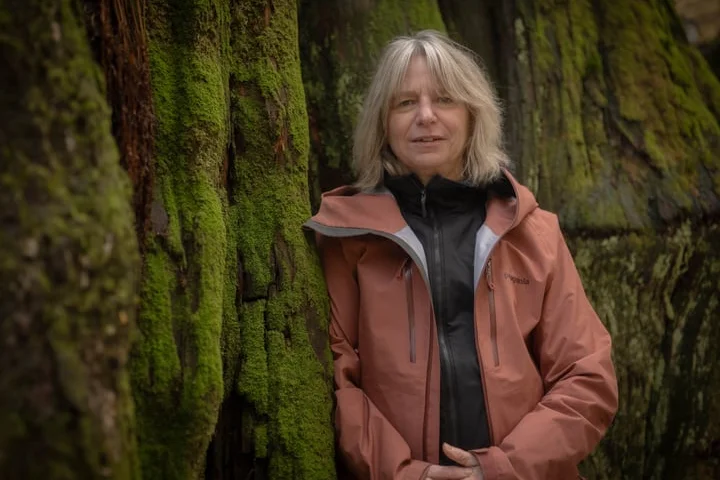
Appropriately, I meet the woman who changed the way we think about forests — through her 2021 eco-blockbuster, Finding the Mother Tree — in a tree-themed hotel in London.
Suzanne Simard, the great Canadian forestry ecologist, appears with a wide smile.
We settle on some patchwork sofas but can’t escape the disco “background” beats.
“I’m worried you won’t be able to hear me,” she says.
Her gentle voice is more suited to quiet forests; perhaps that’s true of all of us.
Thanks to her, our understanding of forests can be divided into two periods: After Darwin and After Simard.
While Charles Darwin didn’t write that much about trees in his On the Origin of the Species in 1859, he specified that plants “struggle with each other for existence”.
That was enough to cast forests as collections of individual trees locked in competition for light, water and nutrients.
“I’ve done all this science, but it wasn’t reaching the world”
Simard earned her PhD in the 1990s, by tracking the movement of carbon between trees using radioactive isotopes in the Douglas fir forests of British Columbia.
She published the results in Nature magazine towards the end of that decade.
It was the Nature editors that first dubbed her findings the “Wood Wide Web”.
Her 2016 TED talk — “How trees talk to each other” — racked up millions of views, then Finding the Mother Tree became a bestseller.
Her work is at odds with the forestry industry and traditional forest science; it shows that cutting out the oldest trees and turning forests into monocultures destroys the intelligence and resilience that keep the whole system alive.
Naturally, there was pushback.
Some said she anthropomorphised trees.
One scientist called for “less hype.
More hyphae”.
That must have stung?
“Some of the critics have been very harsh but it’s only a handful,” she says, but admits “it was really hard and affected my person, my soul”.
She highlights a reductionist culture in Western science that trusts only research done in isolation, on small plots.
That’s not her style.
Her new book, When the Forest Breathes, follows research from Simard’s Mother Tree Project , which encompasses nine forests in British Columbia that cover an area the size of Denmark.
The project is designed to run for 500 years.
It is hard to imagine anyone else working at this scale, or in this way.
“People need to be on the land, doing this work and caring about it as though our lives depended on it”
Her science is often co-produced with indigenous communities.
“All of Canada is indigenous land and it’s been shaped by indigenous people since the last ice age,” she says.
“Indigenous people enhance the forest.
They enhance the salmon populations.
They enhance the clam beds and the root gardens.
This demonstrates we all have it in us to do this.
But we hand over the responsibility of managing forests to corporations that don’t care.
Why would they?
They’re not people.
They’re not on the land.
“People need to be on the land, doing this work and caring about it as though our lives depended on it… which they do.” When the Forest Breathes is a wild ride.
Simard moves from the vast landscape experiments that underpin her work, to tinderbox mega-fires to indigenous ceremonies and forestry boardroom culture.
Too poor to live long?
A London clinic is championing affordable health membership
A day in the life: Alchemist Charlotte Pulver
Would you pay £110 for a 20-minute nap?
(If it made you a functioning human again)
Art After Dark is back with an exciting calendar of cultural events
This is a deeply personal journey too — and she interweaves the rhythms of family, of love and loss alongside forestry discoveries.
For me, the secret sauce is her ability to describe the workings of the forest with both precision and poetry, something I got from her first book, too.
On my way to meet Simard, I glance at the environmental headlines on my phone.
Not good.
New research suggests the Atlantic current system (known as the AMOC) appears significantly more likely to collapse than previously thought .
The implications for life in the UK, from weather to farming, are unfathomable.
Climate chaos is already here.
Four of the nine Mother Tree forests have been hit by wildfires; one was lost.
“We’re in the phase of a catastrophic climate world,” Simard acknowledges.
“But if we manage our ecosystems well, we can reverse that trend and make it a more stabilised system.”
When the Forest Breathes: Renewal and Resilience in the Natural World by Suzanne Simard is out now (Allen Lane, £25)
Related Stories


Source: This article was originally published by Evening Standard
Read Full Original Article →
Comments (0)
No comments yet. Be the first to comment!
Leave a Comment