
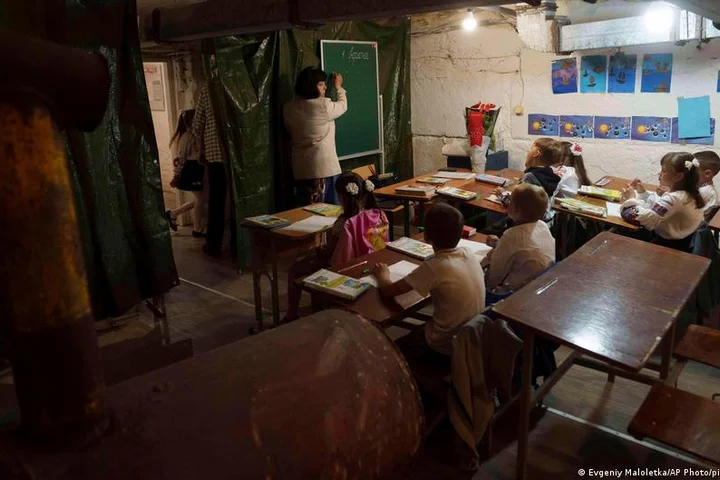
The number of teenage victims of bullying is rising in Ukrainian schools.
Experts attribute this to war trauma and chronic stress among teenagers.
The boy has tears in his eyes.
He stares blankly at the floor, having long since given up any resistance.
But the classmates standing around him show no mercy.
One by one, they step out of the semicircle and punch him in the face, while the rest of the group laughs mockingly.
A bystander films the scene on a phone.
Videos like this have been circulating increasingly in Ukrainian Telegram groups and on TikTok and other social media platforms for months.
For Nadiya Leshik, an education official, they are the expression of an underestimated but growing problem in Ukrainian schools.
"At the start of the war, we were all preoccupied with other things," she said.
"But since then, we've seen a steady rise in the number of cases of violence."
For her, the reasons are obvious: minors are particularly affected by the consequences of Russia's war in Ukraine .
"When young people hear an explosion, it affects them psychologically," she explained, adding that, in particular, anxiety disorders and depression have increased dramatically among teenagers.
A study by the Kyiv-based team of the Mindset research institute concluded that three-quarters of all Ukrainian students suffered from symptoms of stress.
The Ukrainian teen who stood up to Russia's invasion
To view this video please enable JavaScript, and consider upgrading to a web browser that supports HTML5 video
Teenagers react differently to stress
The study's authors emphasized that each teenager reacted differently to stress.
Many withdrew, while others became aggressive.
Instead of feeling like victims, they tried to boost their self-esteem by belittling others — sometimes using violence.
"Some of them have experienced trauma themselves and now want to act like alpha males at the expense of others," said 14-year-old David, a student at High School 45 in the Ukrainian capital Kyiv.
"Somehow, people find it easier now to insult others," added his 15-year-old classmate Jana who was herself bullied after she fled her village and started at a new school.
"At some point, I stopped going to class altogether," she said.
The authorities are now actively trying to address the problem.
Police teams regularly visit High School 45.
In addition to teaching students how to respond to air raid sirens and how to deal with landmines and stay safe, they talk about bullying.
"These days, it's mostly cyberbullying ," explained police officer Yana Vitalievna.
"Psychological violence takes place in the digital realm."
Russia exploits vulnerability of teenagers
After years of war and distance learning, many small children in Ukraine have smartphones and apps warning them about Russian attacks.
If an air raid siren sounds, they can quickly contact their parents via Messenger and other such platforms.
According to Leshik, Russian authorities are exploiting their vulnerability.
"They are conducting massive propaganda campaigns on social media and using methods to deliberately make children and teenagers aggressive," she said.
For some time now, the Ukrainian government has also been warning that Russian intelligence agents are active in Telegram groups predominantly used by young Ukrainians.
Using language that appeals to young people, they try to turn adolescents against each other and incite them to violence.
Leshik said that Ukrainian schools were overwhelmed and could not deal with the problem on their own.
She said that parents had to pay closer attention if their children exhibited unusually aggressive behavior.
She added that families that have been displaced and might have lost loved ones were often not in a position to do this.
But she pointed out that when a whole generation was growing up with war trauma, bullying by teenagers could not be tolerated.
"If a teenager hits another person in a group of young people and others watch or even film the incident," she said, "it's very clear who the perpetrator is and who the victim is."
This article was translated from German.
Related Stories


Source: This article was originally published by Deutsche Welle (DW)
Read Full Original Article →
Comments (0)
No comments yet. Be the first to comment!
Leave a Comment