
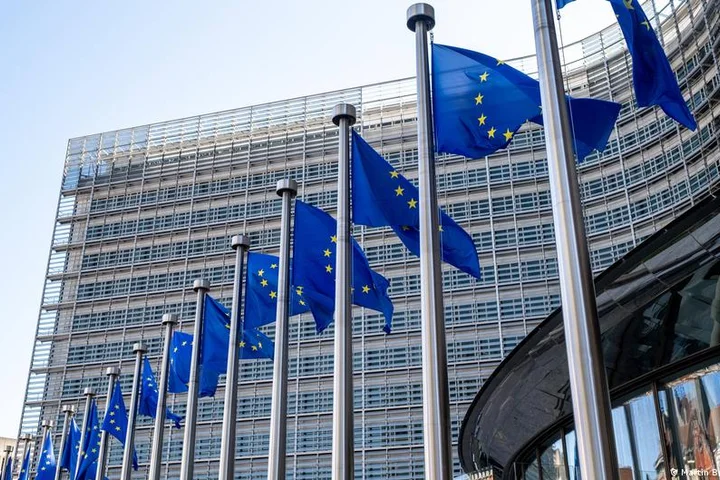
The battle over the next long-term EU budget has begun.
The EU's institutions have staked out their positions and are seeking significantly more funding, but it is the 27 member states that will ultimately decide.
The adoption of the Multiannual Financial Framework (MFF), the European Union's long-term spending plan, is one of the most sensitive political issues in the bloc.
The negotiations are currently entering a critical phase.
The question is not only how much the EU will cost its member states from 2028 to 2035, but also what they will receive in return.
For the EU institutions, it is also a matter of external autonomy: "In a time of geopolitical instability, the budget will allow Europe to shape its own destiny, in line with its vision and ideals," said European Commission President Ursula von der Leyen last July when she unveiled her proposals for the long-term budget.
On Tuesday, the European Parliament voted to increase the EU budget.
But ultimately, it is the bloc's 27 member states who will have the final say.
Last week, EU leaders met at an informal summit in Cyprus and there were already signs of disagreement.
While the European Commission had proposed a budget of €1.76 trillion ($2.05 trillion) (adjusted for inflation), the European Parliament opted to go even further.
EU member states divided over budget
Member states are divided on this issue.
For example, Germany and the Netherlands have spoken out against the Commission's proposals.
Other member states, however, particularly net recipients that receive more funds than they contribute, believe that the budget is too low given the tasks at hand, Janis Emmanouilidis from the Brussels-based think tank European Policy Center told DW.
According to a study by the Cologne-based German Economic Institute, net recipients in 2024 included Greece, Poland, Romania, Spain and Hungary.
Emmanouilidis also said that at the same time the largest net contributors to the EU, such as Germany, France , Italy, the Netherlands and Sweden, also had an interest in keeping their contributions as low as possible.
EU leaders in Cyprus celebrate Ukraine loan approval
To view this video please enable JavaScript, and consider upgrading to a web browser that supports HTML5 video
Reduced funding to farmers and regions
According to the European Commission's plans, the new budget will reduce funding to agriculture and to regional development, but make payouts more flexible.
The EU will also invest more in competitiveness and in increasing Europe's role in the world, by increasing defense spending and aid to Ukraine for example.
Nils Redeker, the acting co-director of the Jacques Delors Center, has his doubts about the political feasibility of these proposals for reform.
He told DW that in principle all the member states had understood the necessity of investing more in defense, industry and economic development, but that some would find it difficult to accept fewer funds for agriculture and regional development.
Emmanouilidis told DW that during the negotiations, both small and large member states were primarily concerned about what their citizens would effectively receive from the EU budget while the question of how to jointly derive the greatest benefit from the budget played a lesser role.
New sources of own revenue for EU
The EU budget is made up not only of contributions from member states but also from the bloc's own sources of revenue.
In its proposal, the European Commission calls for the creation of five new sources of revenue.
These include a levy on large companies, a tobacco tax and increased revenue from the EU Emissions Trading System.
On Tuesday, the European Parliament called for a digital tax on big tech companies.
Redeker told DW that it would be difficult to reach an agreement on these new resources of revenue, just as the debate over whether to repay the debts from the €750 billion COVID-19 recovery fund using own resources had lasted years and not yet come to fruition.
Some EU states fear the burden on their economies.
Another bone of contention is likely to be the question of the deadline by which these debts should be repaid.
According to news agencies, French President Emmanuel Macron recently said it would be "idiotic" to pay back the funds immediately and advocated his idea for more joint debt in the form of Eurobonds.
For its part, Germany rejects more debt.
As analysts and politicians expect tough negotiation at EU member level, the bloc also faces internal pressure.
Elections are due in several major states next year, including France, Italy and Poland.
Emmanouilidis said that the prospect of a nationalist party winning in France in particular was putting pressure on member states to conclude the budget negotiations by the end of 2026.
EU leaders will pursue their negotiations at their next meeting in June, when concrete numbers will be presented for the first time.
This article was translated from German.
Related Stories

Source: This article was originally published by Deutsche Welle (DW)
Read Full Original Article →
Comments (0)
No comments yet. Be the first to comment!
Leave a Comment