
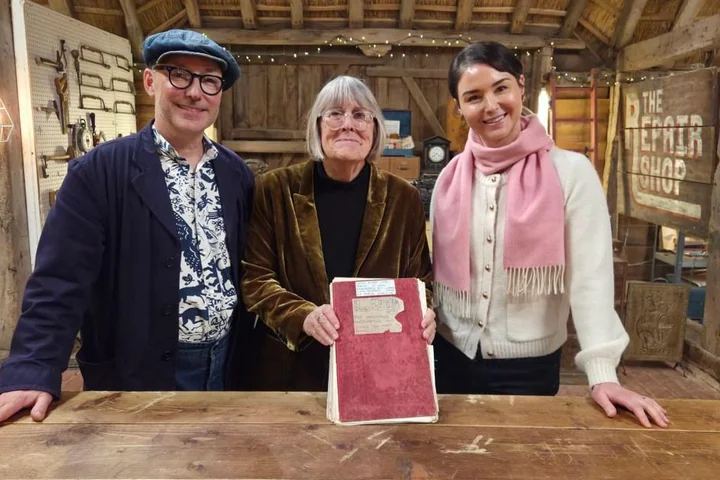
There are few episodes of The Repair Shop that could be more important than the one airing tonight.
Lisa Power is a prominent LGBTQ+ activist who, through volunteering at the first LGBTQ+ helpline, Gay Switchboard, has been at the centre of the most significant moments in queer history of the last 50 years.
Founded in 1974, Switchboard became an essential lifeline for LGBTQ+ people.
It was created when there were no legal protections for gay people and the world was actively fighting against them – they needed someone on the end of the line to tell them they are loved, they are wonderful, and, most importantly, they are not alone.
There is next to no documentation of the queer experience before the 80s, when the gay community was being obliterated by Aids and demonised by politicians and the media.
Letters, books and documents were usually burned for discretion, making Switchboard’s early logbooks one of the only points of reference to provide an authentic understanding of what was really happening on the ground to LGBTQ+ people in the 70s and beyond.
The books have become an essential part of modern queer culture.
They were essential research materials for Russell T Davies when he created the blistering Channel 4 drama It’s A Sin, and have been used for several queer television shows and movies too.
Power brought the very first book to restorers Chris Shaw and Donna Nooranvary to salvage what is one of the most important artefacts of modern British history, which has been neglected for decades.
‘It was in a terrible state,’ Lisa tells Metro.
‘It wasn’t even a book at all – it became a collection of papers with a couple of pieces of hey cardboard bracketing it.’
This is the first time the books have been given some TLC since they were discovered gathering dust in an attic, when one of Lisa’s colleagues found them and realised their importance.
‘The first one, this one, was in an appalling state, and of course it’s the one everyone eats to read.
Until now, they’d been preserved in plastic, but it had become so delicate it couldn’t easily be handled anymore
‘The Repair Shop was a godsend.’
Watching Chris work his magic on the book is remarkable – the pages, alive with the stories of volunteers, the beginnings of ideas that became reality, sewn back together and then attached with a new spine.
‘Working on the Switchboard logbook was an amazing thing to be a part of.
I grew up in the 1970s, so for me it was a real social comment and an insight into what was really happening at the time.
It was fascinating that they had discovered them, and the comments that were in them were enlightening to the situation at the time,’ he told Metro.
‘It was also fascinating to see whose hands had touched them and amazing to be a part of restoring social history at such a crucial time.
To highlight an artefact that shows real people’s lives at such an important point in history.’
‘I was gobsmacked,’ Lisa says, recalling the moment she saw the boy restored in all its glory for the first time.
‘I can’t believe what Chris has managed to do with it, it was so different – it’s a brand new book.
‘We overuse the word iconic, but this book is iconic.
It’s in Bishopsgate archives now, so people can take a look at it.
I’m also a trustee of Queer Britain museum, and I very much hope that at some point it will go on display there, but that’s up to Switchboard and Queer Britain.’
After all these years, Switchboard LGBT is still such an integral part of keeping the LGBTQ+ community safe and heard.
In 2024, it answered more than 14,000 calls from people who needed its vital help – from people living in the closet to those discreetly getting sexual health advice they’re too scared to seek elsewhere.
It’s not lost on Lisa quite how special a moment it is that they’ll now be displayed in front of millions on The Repair Shop tonight, because so rarely does LGBTQ+ history get such a significant spotlight.
‘We are starting to see a lot of people being emboldened to be unpleasant, particularly to trans people, but on a sliding scale to the rest of our community too,’ she says.
‘For us to keep having those really clear positive images of respect for our past and our current existence is really important.
‘I used to be the press officer for Switchboard, and we understood incredibly strongly that one mention on a soap opera or a family program on TV was worth any amount of demonstrations or documentaries to show us as just part of everyday life with the same rights to exist and to celebrate as everybody else is.
It’s as important now as it was then.
‘I’m just very grateful to The Repair Shop for celebrating our history, our existence and giving us back something that will be of immense use to researchers, but also just as an iconic object.
‘I’ve stood next to Oscar Wilde’s prison door and almost burst into tears, and this carries as much symbolic weight.
‘All of these items show that we exist, that we’ve been around and that we can fight for our rights and to be alongside everybody else.’
The Repair Shop airs tonight at 8pm on BBC One.
Got a story?
If you’ve got a celebrity story, video or pictures get in touch with the Metro.co.uk entertainment team by emailing us celebtips@metro.co.uk, calling 020 3615 2145 or by visiting our Submit Stuff page – we’d love to hear from you.
Related Stories



Source: This article was originally published by Metro UK
Read Full Original Article →
Comments (0)
No comments yet. Be the first to comment!
Leave a Comment