
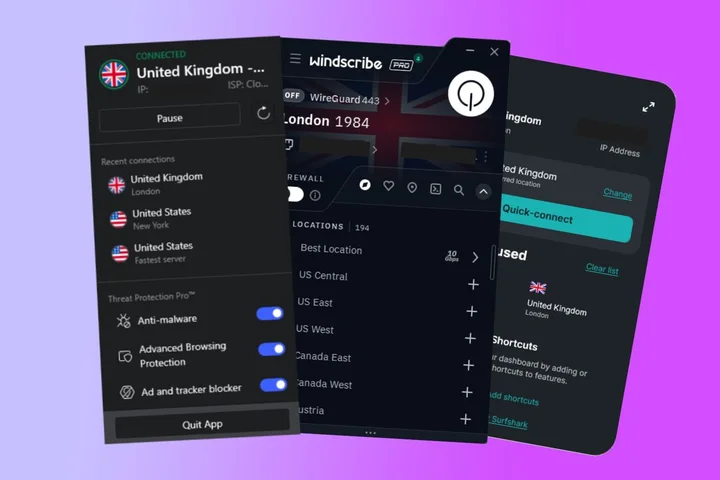
VPN gaming isn't the pointless endeavour I assumed it was.
I've always been an advocate of keeping your personal data as private as you can to stave off the creeping hand of digital tyranny, but for gaming?
Nah, no chance.
I'm a (wannabe) competitive gamer and I need my latency as low as possible, and VPNs are a no-go.
At least, that's what I thought until I actually tried a bunch of them out for an extended period.
During my testing of the best VPNs for gaming , I was surprised to find that—at least with some of them, in my location—it wasn't a case of making the best of a bad situation.
In fact, in some cases my ping actually dropped lower than without a VPN on.
This is good news not just because it means you don't have to keep toggling your VPN off and on, or keep adding an app to your 'split tunnel' in the VPN software each time you install a new game, but also because you get to keep all the benefits of a VPN while playing your games.
If you're cautious about sketchy enemies or teammates potentially trying to don their 1337 hacker gloves and doxx you, for instance, keeping your VPN on can give you some more peace of mind.
And if your ISP throttles gaming speeds, as some are known to do, a VPN should be able to hide what you're doing so speeds are kept high.
It might be counterintuitive at first, but the fact that a VPN might not actually cause much of a problem for your ping and even improve it, in some cases, makes sense when you consider that really all that's going on is your data is still just travelling to and from a given destination.
It can either travel along a route and to a server that your internet service provider (ISP) dictates, or that the VPN dictates (or, as actually happens, a mix of the two).
If a VPN server you're connecting to is closer to a game server than your ISP's server, or if the VPN route gets you there more directly, you might end up with better ping and lower latency.
For instance, as you can see in my benchmark results above, my ping actually dropped to 12.34 ms connected to Windscribe, my pick as the best VPN for low ping .
Sure, the difference isn't massive given my ping was already a relatively low 12.58 ms, but the fact it dropped at all over multiple benchmarks is impressive.
I will say that ExpressVPN was even lower, but all things considered I'm picking Windscribe over that one, personally, based on the companies and how much I'd trust my data in their hands.
Those results are averages across multiple runs in-game, and actually if I look at the raw data, one run for Windscribe gave me an average ping of 12.27 ms, and one with ExpressVPN gave 12.16 ms.
And even when pings were higher, they were usually only ever more slightly so.
NordVPN, for instance, would be my own personal VPN of choice because, while it might give me a slightly higher ping than my native connection, the difference really is very slight and there are other benefits to the VPN (overall compatibility, number of servers, other features like adblocks, etc.).
If you want your VPN to work across the board, compatibility will be an important factor.
With Windscribe and Surfshark, for instance, I couldn't get Valorant up and running at all.
I was either blocked from logging into the Riot app or from booting up the game, and I struggled to load Riot's website, too.
That being said, if you have a problem using a VPN with a particular app or website, you can permit the latter to not go through your VPN without disconnecting everything else from it.
This is called 'split tunnelling'.
In Windscribe, for instance, I can turn split tunnelling on and set it to 'exclusive', meaning everything goes through the VPN excluding the apps and sites I choose.
After doing this, I added the Riot app and the Valorant executable(s) to the list—including 'Valorant-Win64-Shipping' which I had to find by inspecting the process in Task Manager.
That's more of a workaround than actually getting an app or website working with the VPN, but it's an option.
Every VPN I tested allowed for split tunnelling, so if you don't mind having some things route outside your VPN then any should be fine.
But if you want everything on the VPN, that will eliminate some options which leaves NordVPN as the best overall.
The long and short of it, though, is that if you can manage to get everything on the VPN, it doesn't have to be as much of a death sentence for your online gaming connection as I thought—far from it.
If your ISP throttles gaming speeds, as some have been known to do, then it can help with that, but even if you have a pretty great connection for online gaming to begin with, I've found it can still help or at the very least not hinder anything.
2.
Best VPN for low ping: Windscribe
4.
Best VPN for privacy: Mullvad
5.
Best all-in-one VPN package: Proton
👉 Check out our full VPN for gaming guide 👈
Keep up to date with the most important stories and the best deals, as picked by the PC Gamer team.
Jacob got his hands on a gaming PC for the first time when he was about 12 years old.
He swiftly realised the local PC repair store had ripped him off with his build and vowed never to let another soul build his rig again.
With this vow, Jacob the hardware junkie was born.
Since then, Jacob's led a double-life as part-hardware geek, part-philosophy nerd, first working as a Hardware Writer for PCGamesN in 2020, then working towards a PhD in Philosophy for a few years while freelancing on the side for sites such as TechRadar, Pocket-lint, and yours truly, PC Gamer.
Eventually, he gave up the ruthless mercenary life to join the world's #1 PC Gaming site full-time.
It's definitely not an ego thing, he assures us.
You must confirm your public display name before commenting
Please logout and then login again, you will then be prompted to enter your display name.
Related Stories



Source: This article was originally published by PC Gamer
Read Full Original Article →
Comments (0)
No comments yet. Be the first to comment!
Leave a Comment