
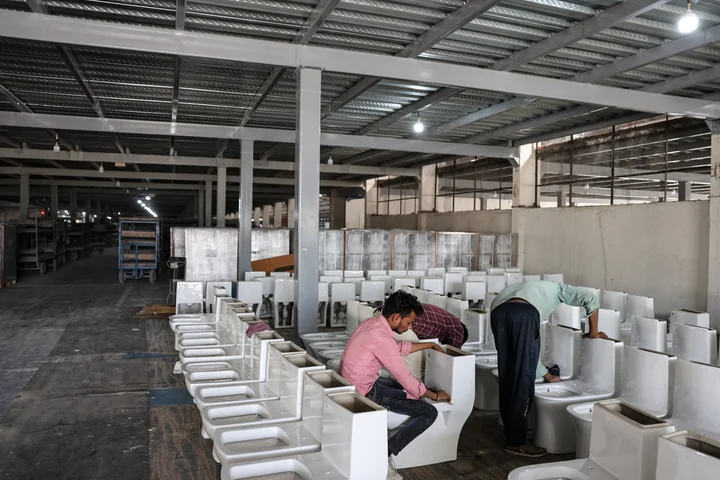
The ceramics industry in Gujarat’s Morbi has been badly hit by the fuel crisis, with most units closed and workers laid off.
Morbi, India – For seven years, Pradeep Kumar would walk into the ceramics factory in western India at 9am, load raw materials – clay, quartz and sand – into the kiln, and spend the day around the heat and dust of the furnaces.
He handled the clay at different stages, sometimes feeding it into machines, sometimes moving semi-processed pieces towards firing.
The work was repetitive and demanding, with no protective gear, such as gloves and masks, against the high temperatures.
“It would be very challenging in the summers since the heat would be at its peak,” he told Al Jazeera.
But on March 15, he lost his job – not because of anything he or the company behind his factory had done, but because the United States and Israel attacked Iran, triggering another war in the Middle East and a global fuel crisis.
Barely two weeks after the war began, the ceramics company where he worked shut down due to a shortage of propane and natural gas.
The company, in Morbi in Gujarat state – like all of its peers in the ceramics industry – depends on these critical ingredients.
Morbi is the centre of India’s ceramics industry that employs more than 400,000 people.
More than half of these workers, like Kumar, are migrants from poorer Indian states like Uttar Pradesh and Bihar.
About 450 of 600 companies shut
With more than 600 companies, Morbi produces about 80 percent of India’s ceramics in the form of tiles, toilets, bathtubs and wash basins.
But at least 450 of those companies have been forced to shut down as a standoff on the Strait of Hormuz, a lifeline for India’s gas imports, continues.
Meanwhile, the war continues, with the US on Sunday capturing an Iranian cargo vessel, even as Washington says it is willing to hold another round of talks with Tehran in Pakistan to reach a deal.
Tehran has refused to commit to peace talks after its ship was seized.
The developments came as a fragile ceasefire agreed by Iran and the US after a month of fighting expires on Wednesday.
But a re-escalation in hostilities has seen Iran shutting down Hormuz for traffic, disrupting global fuel supplies and raising oil prices.
“All manufacturing units in Morbi rely on propane and natural gas to fire kilns at high temperatures.
While propane is supplied by private companies, natural gas is provided by the state to those with connections.
Around 60 percent of manufacturers use propane because it is comparatively cheaper,” Siddharth Bopaliya, a 27-year-old third-generation manufacturer and trader in Morbi, told Al Jazeera.
Manoj Arvadiya, president of the Morbi Ceramic Manufacturers Association, said they had shut down the units till April 15, hoping that the Middle East crisis would be resolved by then.
“But even today, only around 100 units have opened, and most have still not begun the manufacturing process.
For at least another 15 days, it is likely to remain the same,” he told Al Jazeera.
India’s ceramic industry is valued at $6bn.
“About 25 percent of Morbi’s ceramics are exported to countries in the Middle East, Africa and Europe, with a net worth of $1.5bn.
But exports are now delayed and, in some cases, completely halted, especially to Middle Eastern countries, due to the production slowdown over the past month,” Arvadiya told Al Jazeera.
Factories that rely on propane remain shut in Morbi.
Though natural gas is mostly available, many units have not made the switch yet, as new connections are being priced at 93 rupees a kilo, while existing users receive it at about 70 rupees.
Khushiram Sapariya, a manufacturer of washbasins who relies on propane, said he will wait this month before deciding on reopening his factory.
Among the workers who left Morbi last month is 27-year-old Ankur Singh.
Silicosis is an incurable lung disease caused by inhalation of silica dust found in rock, sand, quartz and other building materials.
One of the oldest occupational diseases in the world, it kills thousands of people every year.
Gujarat-based labour rights activist Chirag Chavda says the disease is “widespread in Morbi because workers are routinely exposed to fine silica dust generated during ceramic production”.
“Even those not directly involved in moulding or kiln work often inhale the particles due to poor ventilation and prolonged exposure across factory spaces,” he told Al Jazeera.
Chavda said most ceramic companies do not follow the government regulations regarding the safety of workers.
Harish Zala, 40, had worked in different ceramic companies in Morbi for two decades before he got silicosis two years ago.
He said he received no help from his employer, who allegedly abused and threatened his father when he visited the company after the diagnosis.
“Every year, at least one labourer dies of silicosis in each company, while several get detected for silicosis,” Zala told Al Jazeera.
“Some like me get lucky and survive, but have no choice but to quit the job immediately.”
Zala said many companies do not provide the workers with written proof of employment, such as appointment letters, salary slips, or identity cards.
“This is done so that if a worker later demands labour rights or legal entitlements, they have no concrete evidence to prove that they were employed by the company.”
Chirag added that such workers are also denied social security under various Indian laws regarding salaries or pension funds, since doing so would establish proof of employment.
“As a result, even after working for years, workers are deprived of their labour rights due to a lack of evidence.
This leaves employers with little to no legal accountability,” he said.
“I am here with a few more people because we did not want to spend money on travelling.
Here, at least our ration is sorted,” she said as she walked with a bundle of dry twigs, wood and discarded plywood for the cooking.
“We step out to collect these every day to be able to cook our two-time meal,” said Devi.
“I hope the kilns and manufacturing resume soon, but I also hope they don’t stop giving us rice and potatoes even if the kilns don’t start running anytime soon.”
Devi’s husband, Debendar, and their son Ankit live in a one-room set given to them by their company.
The family has access to a common toilet for 10 families on one floor.
Kumar, meanwhile, is running out of his meagre savings and fears he could fall into a debt trap, as he looks for work in Hardoi as a daily wage labour.
Related Stories



Source: This article was originally published by Al Jazeera English
Read Full Original Article →
Comments (0)
No comments yet. Be the first to comment!
Leave a Comment