
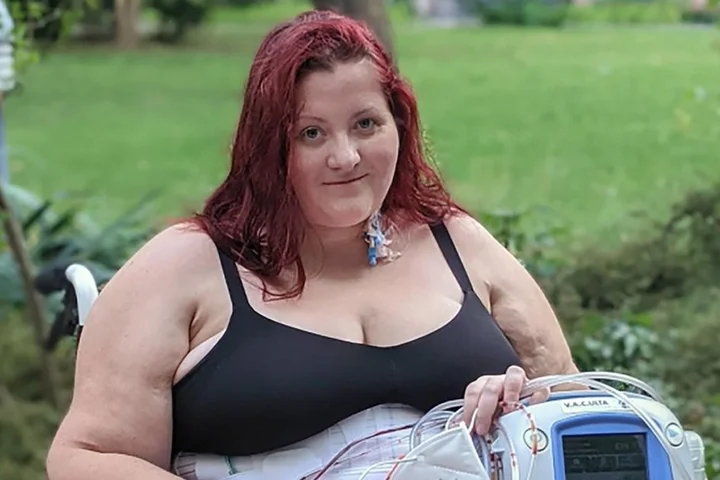
At 35 years old, Amy Bamford lives with an ‘unfixable’ hernia in her abdomen.
Since August 2022, it’s been slowly developing, pushing out of a 25 centimetre gap in her belly following emergency surgery.
Amy, from Chesterfield, had had five surgeries for lipoedema, an abnormal build-up of fat in your legs and sometimes arms, which can be really painful.
But after her fifth surgery, she became septic.
‘Things started to go wrong,’ she explains.
‘I got sepsis in my abdomen.
I had to have eight surgeries in a month to clear septic tissue and they had to remove 80cm of my small intestines.
‘Being cut from the top of my abdomen to the bottom, this trauma weakens the abdominal muscle.
And, once you have the damage to your abdominal wall it’s difficult to go back.’
It was this weakened abdominal muscle that herniated, and she now has a ‘giant’ incisional hernia, which surgeons and doctors have now told her shouldn’t be operated on.
‘I was in hospital and at my GP a lot [in the years after surgery], sometimes for the growth of my abdomen and pain, and other medical issues,’ Amy explains.
‘It’s common in appointments to explain your medical history, so I was constantly telling different medical professionals about my abdominal surgeries, the concern about my growing stomach.
‘No-one saw it as a concern.
It wasn’t serious enough for my referral to be rushed and not one person told me there was a point where it couldn’t be fixed.’
She’s had three NHS consultations and private consultations, but doctors agree her hernia is now too large to repair, leaving Amy to live with a large bulge in her stomach.
‘[Fixing it] would be major surgery, a lot can go wrong, but I have to add on my complex medical history, I’ve had a stroke, there’s a lot of damage in my abdomen, so I’m at a higher risk of complications,’ she explains.
What is a hernia?
A hernia occurs when an internal part of the body pushes through a weakness in the muscle or surrounding tissue wall.
It usually develops between your chest and hips, and in many cases, it causes no or very few symptoms, although you may notice a swelling or lump in your tummy (abdomen) or groin.
The lump can often be pushed back in or disappears when you lie down.
Coughing or straining may make the lump appear.
If you believe you might have one, visit your GP.
If you’re aware of your hernia and develop severe pain, vomiting, difficulty pooing or farting, or if your hernia becomes firm and can’t be pushed back in, you must go to A&E.
These symptoms could mean:
- the blood supply to a section of organ or tissue trapped in the hernia has become cut off (strangulation)
- a piece of bowel has entered the hernia and become blocked (obstruction)
A strangulated hernia and obstructed bowel are medical emergencies and need to be treated as soon as possible.
Source: NHS
‘My hernia is large and uncomfortable but it’s stable and not at risk of strangulating.
It’s not the right decision for me to try and repair it.
It’s scary.’
Amy says this has been ‘disappointing’ news but that she understands doctors reasonings.
‘Not only is it very large, even if there was a fix it might not be a permanent fix, and there are also safety issues to consider,’ she says.
‘I feel frustrated but also understanding.’
But despite opting not to go ahead with surgery, Amy has still found it difficult to come to terms with her new normal.
‘It comes with a lot of emotional and physical damage,’ she explains.
‘I flit between hating my body and being grateful for what my body has been through and recovered.
‘I hate how complicated my relationship is with my body but working every day to make it a little less complex.’
When it comes to her relationship with her husband, she feels her hernia journey has actually brought them ‘closer together’.
‘My husband has been very good and understanding,’ Amy explains.
‘He’s been with me through it all.’
She now runs an Instagram account (@hernia_troll_uk) where she raises awareness about her experience, although she gets a lot of hate comments.
‘I used to be bothered by the online hate and since then I’ve done a lot of work on myself,’ she says.
‘I don’t need to be validated by random people online.
‘I’ve blocked a few words, mostly to protect my community from seeing those words.
Sometimes I laugh at it, sometimes I answer back, sometimes I’ll ignore it.
‘It just doesn’t bother me at all anymore.’
Get in touch by emailing MetroLifestyleTeam@Metro.co.uk.
Related Stories



Source: This article was originally published by Metro UK
Read Full Original Article →
Comments (0)
No comments yet. Be the first to comment!
Leave a Comment