
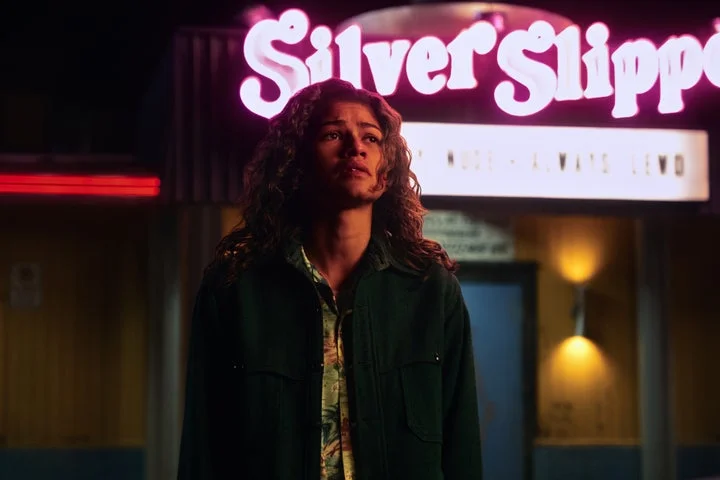
As Sam Levinson’s controversial HBO Max drama sparks outrage for a particularly brutal scene in its latest episode, Olivia Petter argues why onscreen sexual assault must be handled with care and not just used as a shallow dramatic vessel
A pretty woman is applying lip gloss.
Staring at her reflection, carefully dabbing her perfectly puckered mouth, she is focused.
She is fixated.
She is fine.
Never mind the fact that her eyes are red and watery.
So long as she keeps applying her lip gloss, everything will be OK.
And yet, watching this moment in the latest episode of Euphoria , I found myself wanting to weep for this woman, a new character who has just started working in the strip club that Rue (Zendaya) is helping to manage.
Her name is Kitty.
And she has just been raped .
Perhaps this was to be expected.
It may only be four episodes in, but Euphoria ’s third season has set a strong precedent for misogyny and a general disregard for its female characters from the very start.
Any agency the women have is granted exclusively through the male gaze: Cassie (played by Sydney Sweeney) is a vapid housewife trying to become an OnlyFans star to escape her abusive, financially destitute husband, Nate (Jacob Elordi).
Jules (Hunter Schafer) has dropped out of art school to become a full-time sugarbaby, which, from what we can see, mostly involves smiling politely while a perverted married man wraps her near-naked body in cling film, almost suffocating her in the process.
And then there’s Rue, who goes from drug mule to strip club mule, profiting off of an environment that relies on the sordid degradation of women and is run by an arms dealer who’d rather watch his female employees get shot than hand over the keys to his safe.
Among this manosphere-filtered muck, it makes sense that Euphoria ’s writer and creator, Sam Levinson, would throw in a rape scene.
It all unfolds in the club: new recruit from Kansas, Kitty, is taken into one of the private rooms with a group of men.
“What would you like?” she asks, smiling blankly.
The next time we see Kitty, she is bent over, her face writhing in pain as the men take turns having sex with her.
Some viewers have expressed doubt over whether this scene constitutes assault.
Perhaps they missed the fact that Kitty is on drugs and, therefore, unable to consent.
They might have also missed the look on her face while the brutal attack is happening; one of sheer terror and paralysis that will be familiar to anyone who has ever been raped.
But surely they could not have missed the standout detail that makes this scene so deeply disturbing: one of the men takes a swig from a champagne bottle before pushing the bottle inside Kitty – a clear shot on the CCTV Rue is watching shows him repeatedly forcing it inside her.
The next time we see Kitty, she’s in the women’s bathroom, rinsing her mouth and asking Rue for ketamine.
When Rue asks if the men hurt her, Kitty shakes her head robotically before continuing to apply her lip gloss, adding, “I like to dance.”
Some viewers have speculated that all this is building up to a trafficking subplot: is Alamo’s club really just a human trafficking ring?
Will Rue be the one to expose that?
But does any of this really justify an explicit gang rape scene with a champagne bottle?
Putting sexual assault on screen is not a decision to be taken lightly.
Particularly not in a world where one in four women has been raped or sexually assaulted as an adult.
I’m one of them, as is almost every female friend of mine, who each have experiences of being assaulted, violated, or harassed at the hands of male perpetrators in varying degrees.
Seeing this portrayed on TV and film can, in some ways, be helpful, validating even.
Take Michaela Coel ’s I May Destroy You , which educated the nation about the myriad contexts within which sexual violence can manifest, and the nuances of sexual trauma and how it affects survivors, psychologically and physiologically.
I’d argue ‘Euphoria’ falls far short.
In Levinson’s hands, sexual assault seems to serve as narrative fodder above all else
But, a lot of the time, the issue isn’t handled quite so delicately.
Coel herself is a survivor (and an exceptional writer), which explains why her depiction was so powerful.
Euphoria falls far short of the precedent she set.
In Levinson’s hands, sexual assault seems to serve as narrative fodder above all else.
It’s the thing that helps push the story forward, giving Rue leverage to use against her evil boss, while adding to the perverse debauchery of her working environment.
It’s treated casually and without much thought.
Kitty simply returns straight to work, while her rapists walk away, presumably unscathed.
A burglary scene is given far more attention, with lasting implications.
In Euphoria , assault doesn’t really warrant deeper examination, nor does it elicit any interesting questions, or raise awareness for under-discussed issues.
It’s a dramatic vessel, one that is as hollow as the look on Kitty’s face while she dances.
It’s as if the only response we’re supposed to have to this scene is, Wow!
Look how gross this place is!
Rue has to expose them!
It suggests something has gone horribly wrong in the way pop culture examines the experiences of sexual assault survivors and the respect, or lack thereof, that it shows them.
Watching that scene was upsetting.
I cried after seeing it, and after rewatching it to write this piece.
I noticed my hands shaking, and I would even deign to use the word “triggering” – a phrase that has sadly become hackneyed and maligned.
Seeing Kitty’s face, I also saw my own.
And I’m sure many other sexual assault survivors did, too.
If Levinson is going to impose those kinds of feelings onto us, he’d better have a good reason.
Rape shouldn’t be treated as a plot device.
It’s not just something that happens to women in depraved environments.
It’s the most violating crime on the mind and body that exists, one that can – and probably will – result in life-changing (and tragically sometimes life-ending) consequences for its victims.
I can only hope that Euphoria will, in its remaining four episodes, attempt to illustrate that through the character of Kitty.
Or at least provide some sort of deeper meaning to her storyline.
Although judging by how the season has panned out so far, I’m not going to hold my breath.
Rape Crisis offers support for those affected by rape and sexual abuse.
You can call them on 0808 500 2222 in England and Wales, 0808 801 0302 in Scotland, and 0800 0246 991 in Northern Ireland, or visit their website at www.rapecrisis.org.uk .
If you are in the US, you can call Rainn on 800-656-HOPE (4673)
Related Stories


Source: This article was originally published by The Independent
Read Full Original Article →
Comments (0)
No comments yet. Be the first to comment!
Leave a Comment