
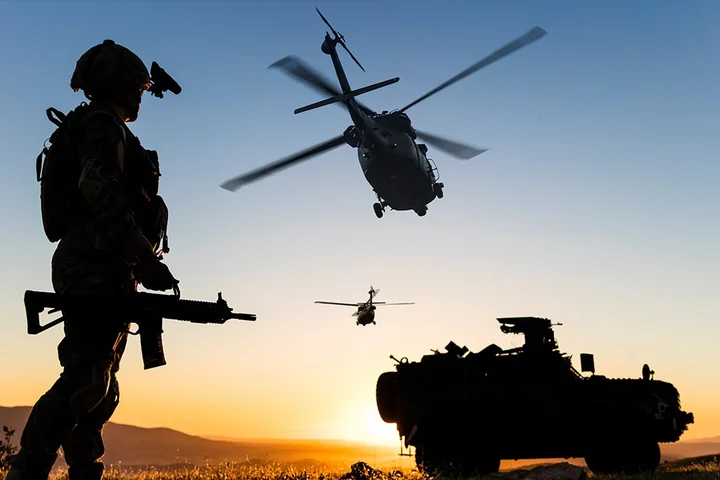
Forty-six years ago this month, America learned a brutal lesson in the Iranian desert.
In April 1980, Operation Eagle Claw, a Delta Force mission to rescue American hostages in Tehran, ended in disaster.
Mechanical failures, a sandstorm, and a catastrophic collision killed eight U.S.
service members.
The mission failed.
The world watched.
Our enemies took note.
But what they failed to understand then, and what they are being reminded of now, is this:
America learns.
America adapts.
And America returns more lethal.
TRUMP TO HONOR SPECIAL FORCES BEHIND MADURO CAPTURE AT FORT BRAGG AS GLOBAL TENSIONS ESCALATE
Failure Forged the Force the World Fears Today
Operation Eagle Claw exposed glaring weaknesses: fractured command, poor inter-service coordination, and no unified special operations capability.
America did not retreat.
America rebuilt.
This latest mission did not begin when the aircraft went down.
It began long before, through contingency plans, rehearsals, and layered decision-making built for speed.
When the call came, execution was not improvised.
It was immediate.
Decision cycles were not measured in hours.
They were measured in minutes.
MORNING GLORY: PRESIDENT TRUMP’S BIG SPEECH ON IRAN — WHAT WILL IT DO?
"No One Left Behind" Is Not a Slogan.
It Is a Covenant.
Every service member downrange understands one thing: if you go down, America is coming.
No matter the cost.
Whatever it takes.
That belief is not motivational language.
It is operational truth.
It drives risk tolerance.
It compresses timelines.
And it reinforces trust across the force in ways civilians rarely see or fully understand.
In this case, one airman landed roughly 40 miles from the crash site and survived over 36 hours evading capture, injured, alone, and moving.
He did not "get lucky." His training took over.
That is Survival, Evasion, Resistance, and Escape (SEREE) training in action: controlling movement, minimizing signature, mastering fear, and maintaining discipline until recovery forces arrive.
Meanwhile, a massive recovery package surged into motion: more than 150 aircraft, including bombers, fighters, refueling tankers, and rescue platforms.
This is what global reach looks like.
This is what capability looks like.
This is what commitment looks like.
RESCUE EXPERT SAYS MOST DANGEROUS MOMENT COMES AFTER ‘JACKPOT’ CALL IN RECOVERY BEHIND ENEMY LINES
The Brotherhood Civilians Will Never Fully Understand
There is something in these missions that is difficult to explain outside the community.
A switch flips.
I have had the luxury of a front seat to some of our most elite warriors.
The tales of teammates throwing themselves on top of hostages in the middle of a firefight, willing to absorb bullets and shrapnel meant for someone else.
That is not normal human behavior.
That is the product of training, trust, and an unbreakable brotherhood forged over years.
These are "no-fail" missions.
Not because failure is impossible, but because it is intolerable.
We Do Not Leave Our People.
And We Do Not Forget Our Fallen.
There is another legacy of Operation Eagle Claw that matters just as much.
From that tragedy came the Special Operations Warrior Foundation, whose mission is simple and sacred: ensure the children of fallen special operations personnel receive a full education.
That is part of America’s battlefield promise.
That promise is not a bumper sticker.
It is not a talking point.
It is a covenant, paid for in blood and honored in action.
A BRAVE MARINE COLONEL TOOK ON THE PENTAGON — AND PAID THE PRICE FOR IT
From 1980 to Today: Vindication in the Same Region
There is profound historical symmetry in what just happened.
Forty-six years ago, in that same region, we fell short.
Now, we executed with precision, recovering our people, striking enemy targets, and demonstrating a level of coordination and lethality our adversaries cannot match.
This is not just success.
This is vindication.
It sends a clear message to Iran, China, Russia, and every adversary watching: distance is not protection.
Terrain is not protection.
Time is not protection.
If you harm Americans, we can find you.
And we will act.
American Exceptionalism, Proven, Not Claimed
In a world that often questions American strength, this mission answered it.
Not with rhetoric, but with results.
What you saw in this rescue was not luck.
It was not improvisation.
It was the culmination of decades of hard lessons from both triumph and tragedy, relentless training, and an unshakable commitment to one principle: leave no man behind.
That principle was tested in 1980, and it failed.
But from that failure, we built something extraordinary, a force worthy of those still serving, those we have lost, and the warriors who built this legacy.
And now, the world has seen exactly what that looks like.
Kirk Offel is a Navy nuclear attack submarine veteran and the CEO of Overwatch Mission Critical, a Texas-based Service-Disabled Veteran Owned data center company that trains and hires future leaders for high-skill jobs in the data center industry.
He is a Top 10 ranked global voice on data centers.
Related Stories


Source: This article was originally published by Fox News
Read Full Original Article →
Comments (0)
No comments yet. Be the first to comment!
Leave a Comment